
Key Points
Bullet point summary by AI
- MLB and the MLBPA are preparing for upcoming CBA negotiations that could shape the league's financial landscape.
- Player representatives emphasize the need for solutions that promote competitive balance without restricting player earnings.
- Key topics include revenue sharing structures, minimum salary increases, and refining service-time reward systems to maintain momentum.
For as exciting as the 2026 season has been so far, there remains an elephant in the room lurking just a few months away. Once the World Series concludes, Major League Baseball and the MLB Players Association will get together to try and hash out a new collective bargaining agreement — and given the hard line some owners are drawing about a salary cap, a lockout feels like a very real possibility.
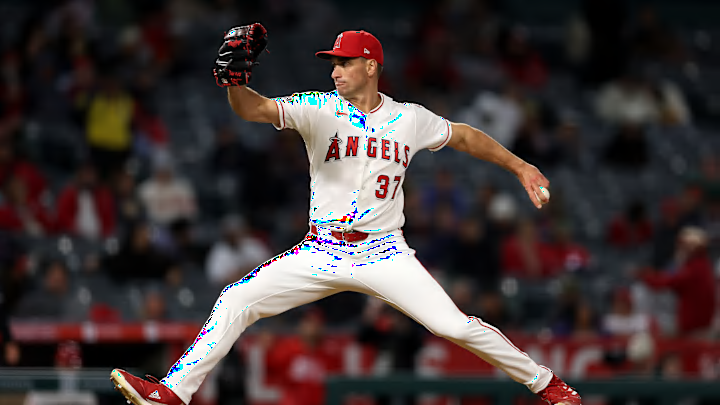
The MLBPA has 30 team reps and an eight player executive subcommittee, a group that consists of the Orioles’ Chris Bassitt, the Padres’ Jake Cronenworth, the Marlins’ Pete Fairbanks, the Rays’ Cedric Mullins, the Mets’ Marcus Semien, the Pirates’ Paul Skenes, the Tigers’ Tarik Skubal and the Angels’ Brent Suter.
With talks between MLB and the MLBPA scheduled to start at some point next week, FanSided spoke to Suter about the state of the union post-Tony Clark, his thoughts on a salary cap, other ways to encourage parity in baseball and much more.
What’s the state of the MLBPA after Tony Clark resigned as executive director?

Everyone has done a great job filling the gaps. Tony was obviously a huge presence, very respected, very relatable as a former player. He’s an easy guy to talk to. He cared about the union. It was unfortunate, but we had to make a move there for the betterment of the union. [Interim executive director] Bruce [Meyer], [interim deputy executive director] Matt [Nussbaum] and the other guys have stepped up big time and done a really good job. It’s as strong as ever. We have the right player leadership in place as well to have weathered that storm and guide the ship through the next storm in the CBA. We had a deep bench so we have the right people in place to get this thing done.
Have there been any talks between players and ownership as yet?
No. We’ve just been scheduling stuff. We’ll start stuff in the next week and we’ll hopefully get some good stuff rolling. I can speak for all the players in that we want to get a deal done that’s a good deal ideally without lockout time, ideally no missing games. We realize there’s a stance here and a lockout that happened the time before just four and a half years ago. I was through that one as the Brewers player rep and saw that one first hand. Definitely hoping for the best and preparing for the worst kind of thing.
Greg Johnson of the Giants recently said that he’s encouraged both sides to talk sooner. Why do you think discussions haven’t started yet?

This seems about the time that we started stuff the last time, maybe a week or two later. I remember it was later April, so it’s around the same time we started the meetings four and a half years ago. I don’t know when they started the time before that when there wasn’t a lockout because I had just broken into the big leagues. I hear where he’s coming from and the more we’re talking, the better. If we’re talking, there is at least stuff going on. Ideally, there’s ideas being exchanged and ideally from that there would be productivity. But you never know.
Salary cap. We’re going to hear it often.
It’s a tough sell. We’ve seen, in particular, the NHL, and you hear the horror stories from it. My view is that: A) It wouldn’t help parity; I think there would be a lot more things that would be more productive and better for both sides that would help get parity. And then b) it would be really bad for players; even if the first deal was nice and colored roses, after that you keep chipping away at revenue percentages, chipping away at the cap. It’s one of those things that once you give it, the spidey senses go up because of what the next rounds of bargaining would mean. I want to leave this game and union in a better spot than I found it and that wouldn’t be a good way to do it. It’s a tough sell. I’ll just put it that way.
You mentioned there are better ways to have parity in baseball. What are some?

After all the revenue sharing is happening, right now from what I gather there seems to be a pretty big delta between what the landing revenue of, say, the Dodgers and big-time markets are compared to the Marlins. Shrinking that delta would have everyone be more in the same playing field from a money-able-to-be-spent concept.
There’s a lot going on with the local TV deals getting cut and baseball is looking to nationalize the product, which I think can be a really good thing. Have that get into a way to be more of a national deal to have more parity and a more even playing field along the way. I don’t know how that would look, but that would be a really good landing spot. A win-win.
I’m throwing out some ideas of where we can get to and where everyone can start getting on some more even footing from a revenue perspective. And personally, as a middle reliever, a salary floor. It would be amazing to get everyone competing; we want teams that want to win and want to spend and put their best foot forward every year and for a healthy free agent market. That would be a great one for me. It would be hard to sell the owners without a cap, but a salary floor would be amazing.
Owners will say that a salary cap will improve competitive balance. What do you say about that?
We look at the other leagues with salary caps and the variety of teams in the playoffs and winning championships and it’s not as good as our system now in baseball. With the salary cap, the big, attractive markets are going to sign the good players and they’ll take less money. There’s still a draw to be playing in primetime and to stay loyal to your franchise. We want to encourage building teams that have good camaraderie and where fans can identify with a group of players who come up together and do well together. What would happen is those guys would take lesser deals. The thing that I hate about the cap, too, is it’s one less dollar that your buddy is making. Literally. Now, there’s a little flexibility and you can push it over the budget. But with a cap, literally, whatever I’m making is less money for everyone else to be making and I just hate that dynamic as a teammate. That’s another problem I have with it.
You look at the other leagues and the variety of teams making runs and all that … a salary cap doesn’t quite seem to do the job.
Getting players paid sooner has been a priority for the union. How do you think you can accomplish that?

We definitely love the pre-arbitration bonus pool and [want to] have that continue to grow. We want to see minimums continue to grow. The other bonus awards are great. Players who are in arbitration that are pushing the number are good. No one is obsessed with arbitration; it’s better than anything else we’ve come up with. There’s a point where you can fight for your salary and we like that. There’s an incentive to make deals that are beneficial for both sides during the process. But the pre-arb bonus pool has been great and the minimums raised has been great. That last deal really introduced some good new things for compensating the players and we want to build on that.
Players who have signed early extensions are still part of the pre-arb bonus pool. Why is that?
MLB didn’t want to discourage guys from signing extension deals and felt if they weren’t part of the arb bonus pool after signing those, that it would be a deterrent to signing an extension. Some of the player group was saying that if you signed an extension, you’re already getting compensated early because of the guarantee. But for MLB it was pretty much a non-starter to take that out. I remember them being very insistent on that.
Is there a fix for service-time manipulation?

It’s been better. The rewards, it’s almost like a carrot and a stick. The carrot is that if you have a guy up all year and he wins Rookie of the Year, you get draft-pick compensation. That’s been working better. The service-time manipulation has not been as egregious as it was previously. Is it still going on? Sure. But it’s been better for the high-profile guys who make a lot of the headlines. The compensation for calling a guy up and winning Rookie of the Year or being top-three or top-five in voting has been a really good carrot for clubs.
Is there a way to limit it even more?
Yes. We believe so. I can’t get into that though.
Revenue is up. In 2024, it was $12 billion. Last year it should have been higher. Attendance is up. Young stars have emerged. Yet it seems like all we hear about is a lockout coming. Why?

It happened four and a half years ago and there’s a lot of harsh rhetoric. We are in a system that isn’t perfect. No system is. But we’re in a system that isn’t perfect. There’s always going to be conflict when it comes to collective bargaining. The ABS has been amazing. Baseball is in a really good spot. It’s been really good from that end, a lot of young, great players and superstars [who] are just great dudes. It’s a really good spot for the league to be in and all the more reason to get this going and keep the momentum going.
There’s been talk of getting rid of the qualifying offer in years past. Is that still a priority?
I can’t quite comment on the exact nature of it. But qualifying offers, we’ve fought to get that less stringent on the penalties. It’s still something that hurts free-agent markets, and it’s not something we love.
 Add us as a preferred source on Google