
The NL East is extraordinarily rich in star power, with free agents like Kyle Tucker, Bo Bichette and Framber Valdez threatening to add more in the coming days or weeks. But even the best teams need a strong internal pipeline. And so often, a contender’s season is made — or broken — by their prospect development.
Case and point: Does Toronto even get to the World Series without the Herculean efforts of 21-year-old Trey Yesavage. That is an outlier, of course, but for fans of every NL East team, here is one prospect worthy of your attention and anticipation in 2026:
Washington Nationals: C Harry Ford

The Washington Nationals struck gold early in the offseason, flipping reliever Jose A. Ferrer to the Seattle Mariners in exchange for 22-year-old catcher Harry Ford. It felt like a steep price in the moment. Ferrer is a very talented reliever with a few years of control left, but Ford addresses a specific area of need for Washington and exhibits genuine All-Star potential.
The dearth of dependable offensive catchers in MLB makes those who can hit at an above-average level all the more valuable. Ford didn’t do much with his brief big league cameo for the Mariners last season — he went 1-for-6 with an RBI and three strikeouts — but the Minor League production was highly positive. Ford posted an .868 OPS with 16 home runs and 74 RBI in just 97 Triple-A games.
Ford is a unique catching prospect in that speed and athleticism are genuine weapons. He can steal a few bases. Seattle even experimented with Ford in the outfield at lower levels, giving the Nats a pathway to positional flexibility if Ford can’t stick at catcher for one reason or another, or if Keibert Ruiz takes a leap.
Odds are, we don’t see much of the Nats in the national spotlight next season. This is very much a rebuilding team. That said, there’s plenty of talent on the roster between James Wood, Daylen Lile, MacKenzie Gore and DC’s other former top prospects. Ford could join the fray as soon as Opening Day as a savvy hitter and proficient game manager with plus, plus tools.
Atlanta Braves: RHP J.R. Ritchie

The Atlanta Braves’ rotation has been a sore spot in recent years. The hope is that the injury bug finally subsides and Atlanta can put together a relatively healthy campaign on the mound. Spencer Strider is due for a bounce back. Chris Sale is still an ace, even as he pushes into his late 30s. Spencer Schwellenbach and Hurston Waldrep look the part of long-term staples. The pieces are there, but consistency — and availability — have proven elusive.
Atlanta has been connected to trade candidates like Freddy Peralta, but there’s a good chance president Alex Anthopoulos opts to lean on internal development instead. JR Ritchie, the 22-year-old righty, made huge strides across various Minor League levels in 2025. After spending much of the last year recovering from elbow surgery, Ritchie posted a 2.64 ERA across 26 starts. He made 11 starts for Triple-A Gwinnett, with a solid 3.02 ERA and 1.09 WHIP, suggesting a readiness for the next step.
Ritchie has a solid 6-foot-2 frame on the mound and a dependable three-pitch arsenal that he commands with aplomb. His fastball and slider tend to do the heavy-lifting, but he can sprinkle in a deceptive changeup. He keeps it in the strike zone with a healthy swing-and-miss rate (140 strikeouts in 140.0 innings last season).
If the Braves find themselves in need of an extra rotation body, Ritchie is probably the next in line. It remains to be seen if he can replicate the remarkable early success of Schwellenbach and Waldrep, but the Braves’ rotation has a chance to meaningfully improve without much outside help.
Miami Marlins: LHP Thomas White

After dominating High-A and Double-A competition in 2025, Thomas White — the Miami Marlins’ No. 1 prospect, per MLB Pipeline — made a late leap to Triple-A. He looked solid, and his MLB moment could be right around the corner as a result. The Marlins don’t typically spend much in free agency. This is an organization rooted in internal development. White’s ceiling stretches incredibly high, and he could pay dividends for the Fins as soon as early summer.
A 6-foot-5, 240-pound lefty with great extension, White is an imposing figure on the mound. His fastball sits in the mid-90s but it jumps through the zone and misses plenty of bats. His slider, a recent upgrade to his arsenal, has the makings of a genuine 1A, put-away pitch. His changeup, while not as devastating as his other offerings, does its job and puts hitters in an unbalanced state.
The Marlins just traded Edward Cabrera to the Cubs and Ryan Weathers to the Yankees, opening a door to White with spring training on the horizon. Miami may prefer a more patient approach with the 21-year-old, who can still struggle with command issues on occasion. But after narrowly missing the postseason in 2025, Miami will be looking for ways to level up without a ton of external upgrades.
Slot White behind Eury Pérez and Sandy Alcántara in the rotation, and the Marlins might start cooking with gas. This team needs to find offensive help, and outfielder Owen Caissie — the centerpiece of Miami’s return package in the Cabrera trade — is another obvious candidate here. But don’t sleep on White, because his stuff is nasty. Nothing raises a team’s floor like quality starting pitching.
New York Mets: OF Carson Benge

The New York Mets have a trio of young pitchers in Nolan McLean, Jonah Tong and Brandon Sproat who could all make an impact next season, with McLean in particular looking like a future Cy Young candidate. That’s too obvious. Another name to watch, however, is 22-year-old outfielder Carson Benge, who could earn a spot in the Mets’ Opening Day lineup, depending on how the rest of the offseason plays out.
Kyle Tucker, Cody Bellinger and other high-profile outfield bats remain connected to Queens in the rumor mill, but as things currently sit, the Mets are looking at Tyrone Tracy in center field and Benge in left field, unless there’s an unexpected push from Jared Young or Luisangel Acuña. Benge has all the tools for immediate success.
Benge will need to boost his power metrics in the years ahead, but he generates plenty of strong contact from the left side and he’s beyond his years when it comes to swing IQ. Benge sees the zone well and is capable of hitting to all areas of the field.
That baseline consistency, paired with speed on the bases and plenty of defensive range, should help Benge stick at the next level. The Mets are undergoing seismic changes, with Brandon Nimmo, Jeff McNeil and Pete Alonso all sent packing — and the potential for more movement on the horizon. If Tucker or Bellinger sign, Benge probably starts ends up in center. If not, left field is Benge’s to lose.
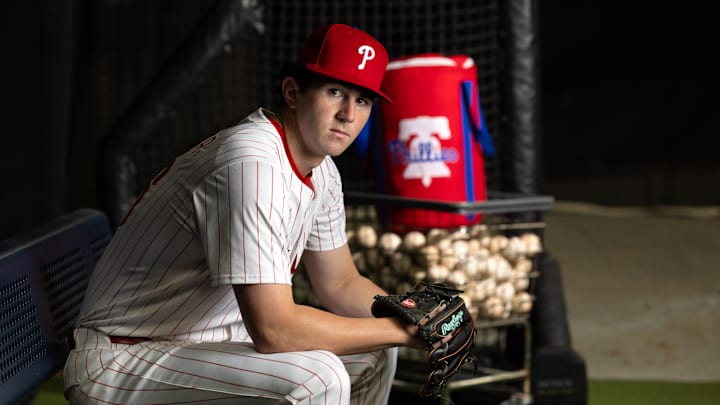
Philadelphia Phillies: RHP Andrew Painter

Ranger Suárez is officially a member of the Boston Red Sox, which leaves the Philadelphia Phillies with a sizable gap in the rotation. Cristopher Sánchez and Jesús Luzardo are two of the most dominant arms in the NL, but Zack Wheeler will begin next season on the IL as he recovers from Tommy John surgery. Meanwhile, Aaron Nola experienced a sharp downturn in 2025 and Taijuan Walker, despite a remarkable turnaround, still does not profile as a weekly starter on a competitive team.
Odds are Philadelphia will add another arm for depth, either via trade or free agency, but the time is rapidly approaching for Andrew Painter’s MLB debut. The Phils’ No. 1 prospect struggled last season upon his return from TJ — 5.40 ERA in 22 Triple-A starts. But he’s another year removed from the injury now and the stuff remains electric.
Painter’s fastball can touch 100 and it rips through the zone with incredible bite. He has three plus pitches he can sprinkle in alongside it: a changeup, slider, and a nifty low-80s curve. Command was an issue for Painter as he worked his way back into a weekly routine, but those issues should not persist long. He still profiles as one of the best pitching prospects in MLB and should crack the Phillies’ rotation within months.
Philadelphia is historically very patient with its prospects and will probably begin the season with Painter in the Minors — unless he shoves in spring training. The Phils will lean on the vets to keep their rotation afloat, but if Painter is throwing high-leverage pitches in October, do not be surprised. It’s a matter of when he gets that phone call, not if.
 Add us as a preferred source on Google