
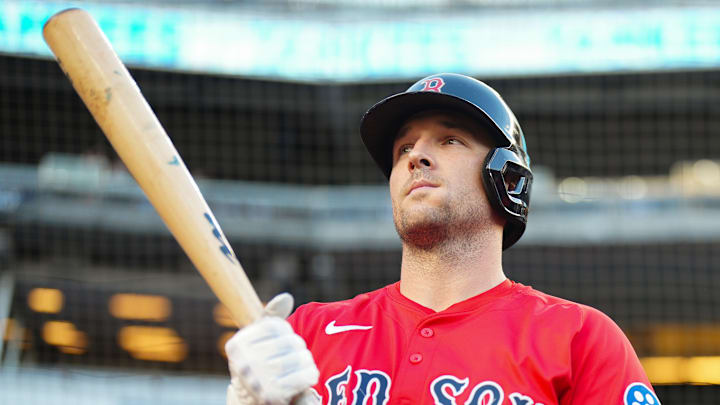
As the MLB free agent market explodes, the Boston Red Sox run the risk of losing All-Star third baseman Alex Bregman. The two-time champ made a strong impression on Red Sox fans with his leadership qualities and five-tool contributions last season, but the Red Sox need to be wary of paying him too much.
ESPN currently projects Bregman's next contract at five years, $170 million — a $34 million AAV through his age-37 season. That's just hard to stomach, especially given the volume of infield talent in Boston's pipeline. Here are a few worthwhile alternatives to consider, Red Sox fans.
Eugenio Suárez

The book on Eugenio Suárez is pretty simple. Last season he recorded 49 home runs, 118 RBI, 196 strikeouts and -6 Outs Above Average. He's a bad defender and a volatile hitter, but he's also incredibly explosive. Last season, Suárez put the good and the bad on full display: His numbers pre-deadline in Arizona (.897 OPS, 142 OPS+) stood in stark contrast to his post-deadline numbers in Seattle (.682 OPS, 94 OPS+).
Suárez is a one-note contributor, but he plays his note quite effectively. The Red Sox whiffed on the offseason's premier power bats, Kyle Schwarber and Pete Alonso. Suárez might be the next best thing. He can crank 40-plus homers and drive into 100-plus runs in the heart of Boston's lineup. His career OPS of 1.277 in Fenway Park is a plus.
Is that sustainable for an entire season? Of course not. But last season, before falling into bad habits in Seattle, Suárez appeared to make genuine strides with his plate approach. He was a genuine All-Star. And hey, Suárez struggling in Seattle and thriving elsewhere has oddly become a career-long theme.
He's not going to defend or add value as a base-runner. Yes, he's going to strike out a ton. But he can also mash, and Boston can probably get him on a relatively cheap, short-term contract. That is as appealing as anything else given the wealth of young infield talent in Boston's pipeline.
Munetaka Murakami

Munetaka Murakami shares a lot of similarities to Suárez — light-tower power, lots of Ks, questionable defense — but he's 25 years old, almost a decade younger. That ought to appeal to Boston as the Red Sox attempt to build around Roman Anthony, Marcelo Mayer and this young core. There's a case to be made that Murakami is the ideal outcome at third base. I'm not going to make it, but the argument does exist.
Murakami finished last season with a 1.051 OPS and 24 home runs in 69 games with NPB's Yakult Swallows. Back in 2022, he cranked 56 home runs and drove in 134 runs over a full season. The discourse around Murakami has been confusing and, at times, outright misleading. He does not struggle inordinately against high velocities, but he does struggle — in general — with strikeouts. He finished last season with 71 Ks in 220 at-bats, compared to only 38 walks.
The case here is simple. Murakami is young, and thus provides a long-term upside that few other free agents can match. He's still growing, and could benefit immensely from MLB coaching. The numbers won't translate one-for-one from NPB to MLB, but Murakami has 30-home run potential for the next decade. He can replace Bregman at the hot corner in Boston, but he also has experience at first base — versatility that would be especially valuable for this Red Sox team.
Kazuma Okamoto

If the Red Sox prefer a slightly different flavor of third-base production, Kazuma Okamoto is considered the "better" — or at least the more reliable — of the Japanese corner infielders making their way Stateside this winter. Okamoto finished last season with a .992 OPS and 15 home runs in 77 games for NPB's Yomiuri Giants, hitting .322 and recording only 36 strikeouts (compared to 34 walks) in 270 at-bats.
Okamoto is four years older than Murakami and he doesn't achieve the same torque and power with his swing, but there's still 25-plus home run potential (especially in Fenway) with a much higher production floor. Okamoto is a smart hitter with gap-to-gap, line-drive ability and a knack for working deep into counts. He's not so boom-or-bust in nature.
Like Murakami, Okamoto figures to spend time at both third and first base. He's probably a better defender than Murakami in the short term, but as he ages into his 30s, he could become a permanent first baseman before long. Even so, the offensive profile is tantalizing and he should come at a reasonably affordable price tag, hopefully without too long a commitment.
Bo Bichette

If the Toronto Blue Jays land the plane on Kyle Tucker, that could set up Bo Bichette to join a division rival. Boston would be wise to inquire; you could argue he's a better option than Bregman outright. He won't come for much of a discount, if any, relative to Bregman's projected payday, but Bichette's age (27) and profile could mean the Red Sox are more comfortable paying him.
Bichette bounced back from an abysmal 2024 campaign last season, hitting .311 with an .840 OPS and 129 OPS+. He piled on 18 home runs and 94 RBI, but we've seen Bichette approach 30 home runs in the past and his style of hitting — smoking rockets into the outfield gaps and stacking doubles — should play quite well in Fenway. There are scant Rafael Devers parallels, if you want to stretch a bit.
Bichette is not a third baseman by trade, but there's significant chatter around the idea of moving him off of shortstop. He projects better at second base, but the Red Sox can just as easily slide Marcelo Mayer to the hot corner, so Bichette's positional fit is no issue. He could even take on some DH reps. Bichette is one of the most efficient offensive weapons in MLB. Taking him from a division rival would be the cherry on top.
Ketel Marte

Straight up, the Red Sox should prefer this outcome. Ketel Marte is roughly the same age as Bregman, but he's dramatically more productive. With all due respect to Bregman, whose postseason experience and leadership qualities are invaluable, Marte generates more production and he's on a better contract — due just $16 million this upcoming season. That number scales up to $22 million by 2030, but that's so much better than paying Bregman $34 million through his age-37 season.
Marte finished last season with 28 home runs and an .893 OPS across 480 at-bats. He stacks extra-base hits, provides reliable defense at second base and can reach MVP-level heights when healthy. The locker-room dynamic is important to consider — there's a reason Arizona is even considering trading Marte on such a favorable deal — but if Boston is confident in Marte's willingness to show up and compete, he's the dream infield upgrade this winter.
Mayer slides over to third, Marte takes root at second, Trevor Story remains elite at shortstop and Boston can figure out its first base solution, whether that's Triston Casas, Kristian Campbell or another free agent. It doesn't matter. I wouldn't put it past Boston to add two of these players in lieu of Bregman, especially if a Marte trade goes through. The Red Sox probably won't pay a premium on Bichette and make a Marte deal, but acquiring the latter and signing Murakami or Okamoto? That's extremely feasible, and moves the needle meaningfully in the right direction.
 Add us as a preferred source on Google