
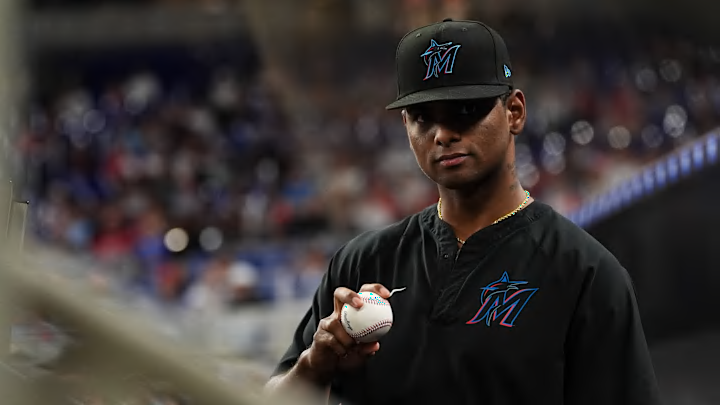
The Chicago Cubs finally made a big move earlier this week, acquiring right-handed pitcher Edward Cabrera from the Miami Marlins in exchange for No. 1 prospect Owen Caissie and other young talent. It’s a bold but overdue swing for the Cubs, who add a controllable rotation arm with postseason equity. Cabrera is still under club control for three more years and he ought to solidify the Cubs’ suddenly deep pitching staff, especially once Justin Steele returns.
This applies pressure on the rest of the NL Central. Pittsburgh has done its damnedest to improve its lineup and take the leap toward contention, but Milwaukee and Cincinnati have remained stagnant, while St. Louis is … well, Chaim Bloom is doing his thing. It will take some time.
All that is to say, Chicago made serious progress with the Cabrera trade. Here’s how their division foes can keep up.
St. Louis Cardinals: Trade for SS CJ Abrams

The St. Louis Cardinals are in the middle of a deliberate teardown, with Bloom turning burdensome veteran contracts into young pitching and other valuable prospect capital. There is no pressure to win in St. Louis next season — at least not internally — and it feels like Bloom will probably avoid shelling out major assets in a trade.
That said, there’s no reason the Cards can’t at least consider someone like CJ Abrams, the 25-year-old lefty with three years of cheap club control remaining. The Washington Nationals are similarly undergoing an intense and all-encompassing rebuild. Abrams is, on paper, young enough to be part of that rebuild, but the clock is ticking.
Abrams has his shortcomings, especially as a defender. The Cards have Masyn Winn and needn’t even consider Abrams as a shortstop. He’d either move to second base or try his hand at center field, perhaps with some DH reps sprinkled in. Abrams can, for the most part, negate those defensive concerns with his performance at the plate. He finished last season with a .748 OPS and 111 OPS+, rocking 19 home runs and stealing 31 bases, all while sporting a hearty 3.1 fWAR.
Abrams is an incredible athlete with the potential to acclimate well to a new position — especially center field, if St. Louis is so bold, following in the footsteps of fellow uber-athletic NL Central shortstop Oneil Cruz. Last season was not the most prolific performance offensively, but Abrams is an annual 20-30 threat, still on the upswing of his career. The Cards received quite the haul for both Sonny Gray and Willson Contreras, rapidly building out the farm system. Washington could use one of St. Louis’ many pitchers, or one of their many catchers. Chaim Bloom is right to prioritize the long view, but he can do so without avoiding the buying market altogether. Sometimes the right upside swing can take a rebuild to the next level.
Pittsburgh Pirates: Sign 3B Eugenio Suárez

All your Eugenio Suárez concerns are well-founded. He’s 34 years old, with a sky-high strikeout rate and persistent bouts of inconsistency. But he also hit 49 home runs last season, and maybe hits a good handful more if not for his midseason trade to the Seattle Mariners. That was not Suárez’s first stint with Seattle, and he had struggled in the PNW before. In 106 games with Arizona prior to the trade deadline, Suárez belted 36 of his dingers with 87 RBI and an .897 OPS.
There’s no telling if Suárez falls closer to his pre-deadline production or his post-deadline production (.682 OPS), but the Pittsburgh Pirates are a softish landing spot. There are more expectations than usual around this Buccos squad after a productive offseason; Suárez would be joining Brandon Lowe, Jake Mangum and Ryan O’Hearn in a revamped Pittsburgh lineup. But still, the Pirates are not viewed as immediate World Series contenders, at least not in the same way Seattle was a few months ago.
Pittsburgh can probably land the plane with Suárez on an affordable two- or three-year contract. How it ages will be a concern, no doubt, but look: 49 home runs are 49 home runs, and this Pirates offense needs to add as much pop as possible to support Paul Skenes and that feisty young rotation. Suárez and Lowe can split time at DH, limiting their combined defensive shortcomings in the infield. Meanwhile, the Pirates’ three main offensive additions would have combined for 97 home runs in 2025. Not bad.
There’s still a world in which Pittsburgh aims higher, but with Bo Bichette, Alex Bregman and the premium free agents holding out for substantial long-term money, it would take a serious miracle for the Pirates to purchase from the top shelf of free agency. Suárez fits squarely in their budget and could deliver results far exceeding his payment, if the first half of last season was any indicator.
Cincinnati Reds: Trade for 2B Jazz Chisholm Jr.

The Cincinnati Reds were willing to pay Kyle Schwarber in an effort to sell tickets. I wonder if the front office (and ownership) could be persuaded to make a similar exception for Jazz Chisholm Jr., who’d provide max entertainment value in the middle infield opposite Elly De La Cruz. There is some obvious risk to this trade, with Chisholm more likely than not a one-year rental. But it’s risk worth taking for a Reds team on the precipice of contention.
Cincy snuck into the final NL Wild Card spot last season. Hunter Greene anchors a talented rotation, but Terry Francona could use a bit more firepower offensively. Chisholm is one of the absolute best second basemen in MLB, coming off a 31-home run, 31-stolen base campaign in New York. He finished with an .813 OPS and 125 OPS+.
Chisholm defends his position well, he’s a menace on the bases, he's a singular power source at second base and, most importantly, he’s so damn easy to root for. Truly, the list of players who have more fun on a baseball diamond can be counted on one hand. That bothers some folks with archaic views on the sanctity of the sport, but if the goal is to sell more tickets, Chisholm is the kind of player who puts butts in seats.
If this trade does not work out, odds are Cincinnati can flip Chisholm for assets at the deadline, recouping a nice chunk of what they gave up. If he leaves in free agency after a spectacular season, the Reds will have gotten plenty from their one season of All-Star production — with top prospects Sal Stewart and Edwin Arroyo coming up behind him as potential replacements. The Reds do not seem like the team to take on a high-profile rental like this, but De La Cruz and Chisholm is too fun not to fantasize about.
Milwaukee Brewers: Trade for RP Mason Miller

If the San Diego Padres are willing to trade Mason Miller — a profoundly depressing twist of the knife after AJ Preller’s haphazard trade deadline splurge in 2025 — the Milwaukee Brewers are among the teams best positioned to make a run at him.
Milwaukee has an excellent farm system and one of the deepest, most well-rounded MLB rosters. There aren’t a ton of holes to poke. What the Brewers maybe lack in outright star power, they tend to make up for with sheer competence across the board. That said, said depth does give them the ammo to go out and a swing a blockbuster trade. The Brewers will almost always operate under strict financial restraint, but Miller is a reliever being paid at cheap arbitration rates through 2029.
This trade gives Milwaukee at least four full seasons of MLB’s most dominant closer — or three seasons before he is flipped for more assets, which is the standard Brewers operating procedure. Miller’s performance in San Diego after the deadline last season was mesmerizing: He pitched 23.1 innings with a 0.77 ERA and 0.73 WHIP while striking out 45, an objectively hilarious set of numbers. When he’s in a zone, there isn’t a reliever who comes close to dominating lineups the way Miller does. His triple-digit fastball, combined with a wideout slider in the high 80s, is really all Miller needs to put great hitters in The Bad Place.
Why would San Diego trade him? Especially after giving up one of the best prospects in all of baseball in Leo De Vries? God only knows, but Preller clearly feels the pressure to build out the farm system again and establish more depth after his failed all-in push at the 2025 deadline. The Brewers won’t get Miller for cheap, and there’s a line Milwaukee shouldn’t cross prospect-wise (Jesús Made is borderline untouchable). But if Miller is truly available, he’d make an already-dominant bullpen even better. The Brewers don’t have a ton of weaknesses to address, but a bullpen headlined by Miller, Abner Uribe, Trevor Megill and Jared Koenig — with that rotation, and that lineup — positions Milwaukee for another run at the No. 1 seed.
 Add us as a preferred source on Google