
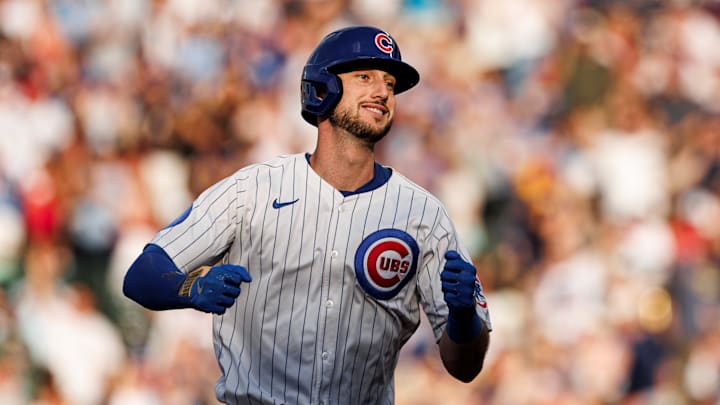
Kyle Tucker is the MLB offseason’s great white whale — and yet he remains unsigned through the first week and change of January, with little tangible momentum toward a new contract. It feels like departing the Chicago Cubs is a foregone conclusion, but where Tucker lands remains a mystery, as does the framework of his new deal.
According to ESPN’s Jesse Rogers, Tucker “has both short- and long-term options” available to him. When the 28-year-old, a four-time All-Star and two-time Silver Slugger, began the offseason, most projections put him at north of 10 years and $400 million. That could well still be in the cards, but if Tucker does not receive the contract he desires up front, reports indicate he could attempt to game the system and try the whole free agency thing again next winter.
Why would Kyle Tucker accept a short-term contract?

Let’s say teams are unwilling (or “unable”) to exceed the $400 million-plus threshold Tucker is presumably aiming for. Rather than settling on a long-term agreement he believes falls short of his actual value, Tucker can opt to take the route popularized by Scott Boras clients in recent years: the short-term, high-AAV contract with opt-outs.
The idea is simple: Instead of locking yourself into a yearly salary you think is beneath your production, take substantially fewer years in exchange for an AAV at or above your asking price. You get paid what you think your worth in the immediate term, more teams are in on the bidding and you give yourself the chance to hit the market again after another big year while still in your prime.
For examples, you needn’t look further than Pete Alonso, who inked such a deal with the Mets last winter after his market stagnated. The result? Five years and $150 million from the O’s this winter. Back in 2022, Carlos Correa inked a three-year, $105 million contract with Minnesota including opt-outs after years one and two. An offseason later, he landed a six-year, $200 million contract, essentially doubling the length and guaranteed money. Alex Bregman took the same route in Boston last winter and appears primed to sign a hearty six- or seven-year deal in the coming weeks.
This is a proven method. Not necessarily a risk-free method, but for a player of Tucker’s caliber, it’s an understandable bet on himself. Maybe even a smart one. This will ultimately come down to how many teams are willing to bid on long-term deals versus short-term deals. If the Toronto Blue Jays are bidding against themselves in the long-term market, as it has often felt, then Tucker can expand his options by exploring the short-term market — and wind up making even more money over the long haul, if he plays it right.
What does a short-term Kyle Tucker contract look like?

The standard procedure here is essentially two or three years at an exorbitant annual rate ($40 million per year for Bregman, $35 million per year for Correa, $27 million per year for Alonso, etc.). Tucker is better than all of that trio, and he’s still in the prime of his career at 28 years old. So he can expect something in the ballpark of three years, $150 million — with successive opt-outs, of course, giving him maximum flexibility and leverage.
Any number of teams should be willing to spend that money for a star of Tucker’s magnitude. There will, of course, be an absence of serious bidders outside the elite coastal markets, but still: Tucker can expect a lot more competition with three-year offers than he can expect on 10-year offers; the calculus changes significantly when you're only locked into three prime years rather than his age-35, -36 and -37 seasons. Juan Soto at least had a few teams seriously in the mix. Same for Shohei Ohtani the year prior. It’s unclear if any team besides Toronto would actual stretch to 10-plus years for Tucker right now.
That said, here’s where Tucker could realistically end up if he takes the three-year, $150 million (give or take) route.
Potential landing spots for Kyle Tucker on short-term deal
Toronto Blue Jays

Toronto doled out $500 million to extend Vladimir Guerrero Jr. and could lock up Tucker for a similar timeframe. This still feels like the most believable outcome. That said, if Tucker decides to maintain his optionality, the Blue Jays by no means exit the conversation. Toronto would just as happily give him $50 million next season and try again in 2027, perhaps after Tucker has proven himself over an All-Star campaign for the AL frontrunners. The Blue Jays might actually prefer a trial run, which could be the impetus for even having this conversation.
New York Yankees
The Yankees almost certainly prefer Cody Bellinger at a more affordable rate, but if Tucker starts seriously taking calls on short-term deals, it would be borderline malpractice for Brian Cashman to not pick up the phone. We’re talking about the Yankees, for crying out loud. They have the money, and Tucker is the closest thing to a Juan Soto replacement New York could hope for after last winter’s disappointment. This feels improbable, but never say never with a team like the Yankees.
Philadelphia Phillies

The Phillies are probably set in the outfield after signing Adolis García (sigh), but there’s an outside chance Tucker enters the fray if JT Realmuto walks and Bo Bichette signs elsewhere. Dave Dombrowski has been hesitant to run up the tab in recent years, but Tucker is a worthy exception. He’d address the Phillies’ ongoing corner outfield problem — and he’d position them, almost unequivocally, as the Dodgers’ foremost challenger in the National League. Opening games with Trea Turner, Kyle Tucker, Kyle Schwarber and Bryce Harper? That’s a winning recipe.
Pittsburgh Pirates
This is almost certainly not the outcome, but Pittsburgh offered four years and $120 million to Schwarber in the early stages of free agency. The Pirates are desperate to start winning, and if Tucker is signing three-year deals, he’d be well worth the inflated single-season salary, even if he’s only in Pittsburgh for a year. The Pirates want to show Paul Skenes they are serious about winning. Landing Tucker, even if it requires going above and beyond ($60 million AAV?), proves that point in emphatic terms. This is not happening, though, to be honest.
Los Angeles Dodgers

If Tucker settles for a short-term deal, I’d strongly encourage folks to mentally prepare for this outcome. It might be the most likely landing spot if Toronto can’t lock up Tucker for the next decade. Los Angeles has a documented need in the outfield and a longstanding disregard for the competitive balance tax. If Tucker has any respect for the santicty of competition in MLB, he’d pick a different spot. I am only half kidding. In reality, though, the Dodgers give Tucker an excellent chance to win his second World Series title while competing alongside the best players in the world — in a gorgeous coastal city, no less. What’s not to love?
New York Mets
The Mets appear hesitant to line up multiple decade-long contracts after the Soto deal, but if Tucker comes with fewer strings attached, that is Steve Cohen’s music. He’s still the richest owner in baseball and the Mets need significant upgrades to their lineup after the departures of Pete Alonso, Brandon Nimmo and Jeff McNeil. Outfield in particular is a sore spot on the depth chart right now. Tucker immediately alleviates the problem and gives New York the best three-man hitting gauntlet in the National League alongside Soto and Francisco Lindor.
Chicago Cubs

Look, we’re in pipe-dream territory again, but if the Cubs were ever going to re-sign Tucker, this is how. Jed Hoyer is not shelling out $400 million in guaranteed money over the next decade, no matter how much Tucker is willing to defer. Chicago is a risk-averse organization, still reeling from recent free agency missteps like Dansby Swanson. If Tucker is willing to take the short-term, flexible contract instead, however, we can’t entirely rule out a Cubs reunion. By all accounts, he enjoyed his time on the North Side, and this would be a huge boost for Hoyer’s reputation as an executive.
San Francisco Giants
The Giants are disappointingly quiet in the rumor mill these days, but Buster Posey swung the Rafael Devers trade. He also made a semi-serious run at both Shohei Ohtani and Juan Soto, even if neither effort advanced past the 50-yard line metaphorically. So yes, if Tucker decides to shorten the window of obligation a bit, the Giants could register interest. San Francisco has a spot waiting in the outfield and Tucker would finally position the Giants as a real threat in the NL West.
 Add us as a preferred source on Google