
Key Points
Bullet point summary by AI
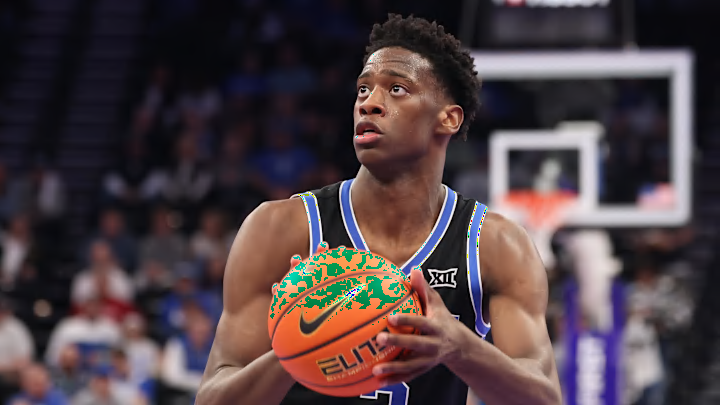
- AJ Dybantsa is one of the headliners in the 2026 NBA Draft class, expected to go No. 1 overall.
- Dybantsa has the playmaking ability that could be compared to Kevin Durant as a prospect.
- The Dallas Mavericks are just one team that would be perfect for Dybantsa as a landing spot.
The 2026 NBA Draft class features the strongest projected top-3 in over a decade. Cameron Boozer won the Wooden Award at 18 years old. Darryn Peterson was the top recruit out of high school and put together an incredible shot-making season despite chronic cramping. And despite all of that, the current odds-on favorite to land No. 1 in June is BYU forward AJ Dybantsa.
There is still time for Dybantsa's stock to slip, but most tanking GMs would probably tell you off-record that they spent the last few months tanking for Dybantsa first and foremost. With less than a month until the lottery on May 10, let's dive into what makes Dybantsa special — and which potential landing spots feel the most synergistic.
Why AJ Dybantsa is a special prospect

Dybantsa put together one of the most dominant freshman scoring seasons in recent memory, up there in the history books with Kevin Durant and Trae Young. He notched 25.5 points per game on .510/.331/.774 splits. A dominant slasher, Dybantsa finished 72.3 percent of his rim attempts (only 20.3 percent assisted) and was a steady presence at the free throw line (49.0 FTR).
A high school mixtape legend, Dybantsa's athleticism clearly played at the college level. He was simply much too tall, explosive and shifty for the average college defender to have much of a chance at stopping him. Dybantsa can explode in a straight line to the rim and finish vertically, but what's really special are his side-to-side movement skills. The 19-year-old does such a wonderful job of mixing speeds, stacking dribble moves and carving out angles he can attack with force or finesse.
Dybantsa needs to prove his 3-point shooting on higher volume, but he displays soft touch in the mid-range, where he's liable to take and make difficult shots (46.3 percent on non-rim 2s, only 11.9 percent assisted). It's damn near impossible to keep a 6-foot-9 wing with Dybantsa's handles, athleticism and high release point away from a shot he's comfortable taking.
The playmaking vision is better than he gets credit for, too. Dybantsa needs to speed up his decision-making at times, but he's capable of roping skip passes to a corner shooter on the move or threading the needle to a cutter. He's a high-usage star by default and will suck up serious oxygen for his next team, but Dybantsa has 30-point-per-game potential with NBA spacing.
5. Dallas Mavericks

So much of modern NBA team-building success is locating the ideal intersection of size and skill. Dallas already has one big wing creator with generational upside in Cooper Flagg. Add Dybantsa to the mix, with Kyrie Irving due back next season, and the Dallas offense will be able to create constant advantages all over the place.
Dybantsa will demand his share of touches, but part of what makes Flagg so special is his ability to scale back and operate as a spot-up shooter and a connector. Dallas fed him a lot of on-ball responsibilities as a rookie, but Flagg can set screens, attack off the catch and find ways to contribute as a secondary weapon when asked to. Irving, meanwhile, is one of the best off-ball scoring guards in the NBA. Dybantsa will need to take a back seat every now and then, but Dallas has the infrastructure and complementary star-power to let Dybantsa eat and win a lot of games sooner than later.
The primary concerns with Dybantsa are his limited engagement on defense. Dallas has Dereck Lively and Daniel Gafford to hold down the paint, with a future All-Defense candidate helping from the weak side in Flagg. So Dybantsa can be hidden if it comes to that (although with his physical tools, he could decide to flip the switch and guard).
4. Chicago Bulls
![Josh Giddey - Chicago Bulls ]](https://images2.minutemediacdn.com/image/upload/c_crop,x_0,y_0,w_4666,h_3110/c_fill,w_16,ar_16:9,f_auto,q_auto,g_auto/images/ImagnImages/mmsport/229/01kphpedpc395h6e16pp.jpg "Josh Giddey - Chicago Bulls ]")
This is in part assuming that Billy Donovan sticks around, which seems like priority No. 1 for Bulls ownership. Chicago loves to push the tempo and Dybantsa is an absolute tank in transition. Once he's sprinting out in space, good luck to the opposing defense. Get him receiving outlet passes from Josh Giddey, with Matas Buzelis flanking him on the break, and the Bulls will be showtime. It's been a while since the Bulls were showtime.
Chicago can also really benefit from Dybantsa's help in the halfcourt. Giddey has never possessed a ton of self-creation juice; he applies limited rim pressure and isn't the most potent pull-up threat. With Chicago's revolving backcourt expected to experience a mass exodus in the offseason, the Bulls need somebody to create advantages and set the offense in motion. To stir the drink, so the speak. Dybantsa can oblige.
The Bulls typically defend above their means, too. If the Bulls can add a proper rim protector with the 15th pick, they will have addressed their two most glaring needs ahead of what promises to be a transformative offseason under new management. Dybantsa would look great in Chicago — and the Bulls really need this sort of lucky break.
3. Memphis Grizzlies

Memphis is another team that likes to run and gun, with AJ Dybantsa as a potential bridge to the post-Ja Morant future. He's not a point guard obviously, but there are a lot of similarities. Both apply constant pressure on the rim and blitz opponents in transition. If Dybantsa can become Memphis' 6-foot-9 Morant analog, why yes, that'll play.
The Grizzlies have quietly built a really solid foundation, despite all the losing of this past season. The JJJ-Morant era is kaput. But the Grizzlies have a bunch of interesting two-way wings, a phenomenal post anchor in Zach Edey and a potential burgeoning star at point guard in Ty Jerome. Dybantsa fits in beautifully on paper. The first Dybantsa and Edey pick-and-roll might break physics. How exactly teams line up their defense to cover such an action, only God knows.
Edey and Dybantsa are both walking mismatches in their own special ways. Meanwhile, Cedric Coward is another big wing with dribble-pass-shoot utility; Jerome's elite shooting and connective traits should play beautifully next to Dybantsa, who will become Memphis' primary on-ball weapon.
2. Brooklyn Nets

The Nets took five first-round picks last summer and virtually none of them really lived up to the hype, but there's enough long-term promise sprinkled between Nolan Traoré, Egor Dëmin and Drake Powell to not be a total downer. What that haul showed was Brooklyn's obsession with the aforementioned intersection of size and skill. Every NBA front office wants positional size and rapid-fire processing. Dybantsa could be the spark that ignites the rest of Brooklyn's developmental plans.
Dëmin is a tremendous shooter and passer, but he struggles to apply pressure on the rim. Traoré is a phenomenal athlete, a total blur in transition, but the Nets don't really have the personnel to run and gun effectively alongside him. Dybantsa is a prime solution. He's a great receiver for outlet passes from Traoré or Dëmin. In the half court, he's the rim pressure engine and broken-play iso scorer the Nets currently lack.
Brooklyn does not own its first-round pick outright in 2027, so their tank efforts will be on hold — potentially abandoned entirely. Dybantsa would join another big, shot-making wing in Michael Porter Jr., on a team with solid playmaking infrastructure and a lot of cap space. Things could get very exciting, very fast for the Nets.
1. Indiana Pacers

Just about every top prospect should, on some level, want to join the Indiana Pacers. That is the clearest path to playing meaningful basketball early in one's career. The Pacers were in the NBA Finals — in Game 7 against the OKC buzzsaw, no less — a year ago. Tyrese Haliburton needs to get back up to speed, but he's basically the closest to Nikola Jokić a point guard can get. He is a tide raising all boats, and the sort of instictive, hair-trigger passer that should form an immediate bond with a freakish scorer and finisher like Dybantsa.
Already great in transition, Dybantsa takes the Pacers to a whole new level. Meanwhile, Dybantsa's slashing and advantage creation in something Indiana's halfcourt offense has lacked in the past. Between Dybantsa and Pascal Siakam on the wing, opponents will have trouble mustering the size and athleticism to keep Indy away from the rim. Ivica Zubac is a monster screen-setter. Haliburton, Ryan Nembhard and Aaron Nesmith can all stretch the floor, bomb spot-up 3s or attack a tilted defense off the catch. All the pieces fit together.
Indiana rarely leans on isolation scoring, which is an undeniably huge part of Dybantsa's game. So there could be some moderate growing pains — especially since the Pacers are an established contender without Dybantsa. How quickly the veterans cede ground to Dybantsa, or how willing Dybantsa is to take the backseat on occasion, would be fascinating. Once it clicks, however, Dybantsa might be co-leading Indy back to the Finals.
More NBA Draft news and analysis:
 Add us as a preferred source on Google