
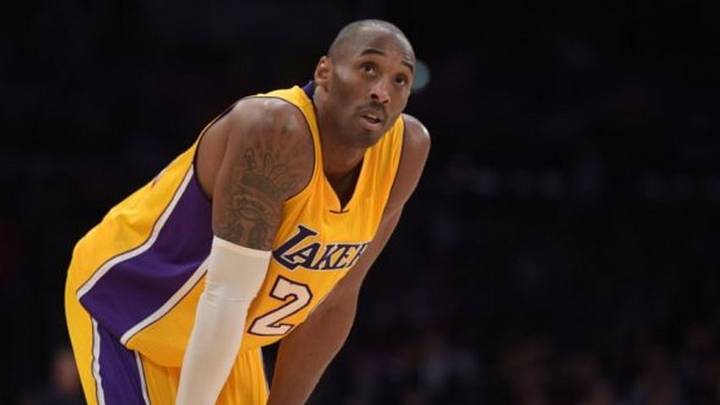
Kobe Bryant is second among Western Conference guards in the latest NBA All-Star balloting returns, but does he deserve to be there?
Throughout the history of world, one thing remains undefeated and untied: Time. Although time grants athletes the ability to mature physically and mentally, it will eventually render their bodies unable to compete at the professional level. Los Angeles Lakers guard Kobe Bryant is beginning to come to grips with this reality.
It began two seasons ago when Bryant ruptured his Achilles tendon on April 12, 2013, in the Lakers’ 80th game of the season. At that point of his career, Bryant had already logged 45,390 minutes regular season minutes and 8,641 playoff minutes. Bryant vowed to return stronger than ever.
More from Los Angeles Lakers
- Predicting NBA’s Christmas Day Schedule: Lakers, Warriors highlight slate of postseason rematches
- Bronny James collapses at practice, taken to ICU with cardiac arrest
- NBA Rumors: Lakers nearing another savvy minimum signing
- Lakers projected lineup and rotations heading into 2023-24 season
- NBA Rumors: Warriors, Lakers among contenders for key free agent
After showing his legendary work ethic in physical therapy, Bryant returned nine months later on December 8, 2013. Six games later, Bryant fractured the lateral tibial plateau in his left knee against the Memphis Grizzlies that was supposed to keep him out six weeks. The injury ended up keeping him off the court for the remainder of season.
Though Bryant’s health became a concern, one thing that no one ever thought would happen was Bryant’s skills diminishing when he returned to the court for the 2014-15 season. The prevailing thought was that he would adjust to his newfound mortality and pick his spots to take over on the floor to maximize his production while cutting down the wear and tear that his body would sustain. Many believed he was too intelligent of a player to continue playing at the pace he accustomed to in the past. Or at least that is what Lakers fans hoped.
Although he is projected to be an All-Star starting guard, Kobe Bryant is in the midst of one of his worst seasons ever as an NBA player. He is fourth in the league in scoring at 24.1 points per game, but he is doing so shooting 37.5 percent from the field and a horrific 28.6 percent from beyond the three-point arc. He also leads the league in missed field goals at 391; a full 67 missed shots ahead of James Harden who ranks second in the category.

Time has even robbed Bryant of his late game heroics where he has built a majority of his reputation. With his body getting older and his repaired legs carrying 18 seasons worth of games, Bryant has been unable to sustain enough energy to close out games. In games where the Lakers are either up by five or down by five in the fourth quarter and overtime, Bryant ranks 92nd in the league in effective field goal percentage among players who have taken at least 25 field goal attempts within those parameters, shooting an anemic 34.3 percent.
Bryant’s anti-All-Star résumé also includes a -0.2 offensive win shares, meaning that his contributions on offense have actually taken away wins from the Lakers this year. Also, he currently has an offensive rating of 97 estimated points scored per 100 possessions which ranks 87th among guards who are qualified for the points per game leaderboard. The numbers do not get any better for Kobe Bryant when looking at the Lakers’ performances with him off the court.
With Bryant off the court, the Lakers score an estimated 4.4 more points per 100 possessions and shoot 4 percent better in effective field goal percentage. Defensively, when Bryant is not playing, they give up an estimated 11.5 points less per 100 possessions. It is hard to make an argument for Bryant to be an NBA All-Star when his team performs better with him off the court.
Additionally, relative to the other guards of the Western Conference, Kobe Bryant’s drop in efficient production should make him a spectator this year for the All-Star Game. At this point in the season, Bryant’s 17.7 Player Efficiency Rating currently ranks 14th among guards in the Western Conference who qualify for the points per game leaderboard.
Bryant also ranks 15th among Western Conference shooting guards in the more telling Value Over Replacement Player stat, where Bryant only contributes one point more than a replacement-level player on an average team. Bryant finds himself behind star Western Conference players such as J.J. Reddick, Anthony Morrow, and Andrew Roberson in that category. Oh, how the mighty have fallen.
If nothing else, there is something rather impressive about Bryant’s staying power with NBA fans. Even though his numbers have been down, fans still come out in droves to vote him into the All-Star Game solely on name recognition and reputation. That is a testament to Bryant, his otherworldly work ethic, and psychotic competitiveness that has stuck in the minds of fans across the world.
However, time has robbed him of ability to physically perform the signature Kobe Bryant moves that made him so successful before. Because of this, it is time for Kobe to pass his perennial All-Star spot to a new generation of guards that grew up idolizing him as much as he grew up idolizing Michael Jordan.
All this is not meant to be a slight towards Kobe Bryant or his career. He will still go down as one of the greatest players to ever grace the NBA hardwood. Nevertheless, like so many players before him, time has finally caught up. This year, time took away Bryant’s numbers. This year, time should also take away his All-Star spot.
Next: Kobe Bryant feels 2015-16 NBA season will be his last
 Add us as a preferred source on Google