
At the core of a well-functioning offense is structure. That comes in different forms for different teams — Houston’s methodical generation of mismatches represents a markedly different framework than the Warriors’ ballet of passes and cuts or Utah’s slow cycle of pick-and-rolls.
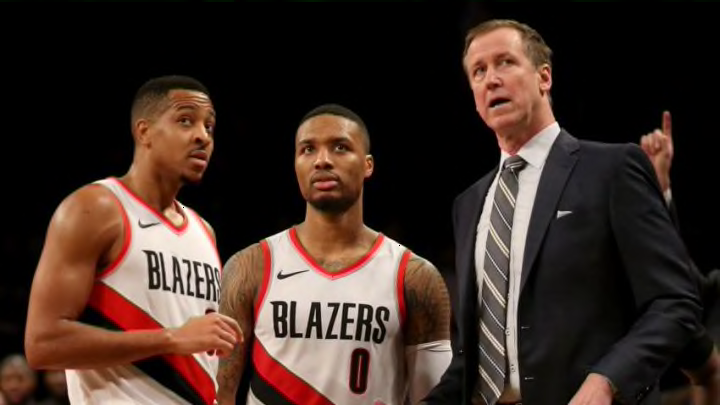
Every scheme depends on the talent, of course, but all need tactical support to remain viable. Damian Lillard and CJ McCollum would likely fare well in any offense, but it’s Terry Stotts’ well-crafted system that adds layers of texture to their games and unlocks them to the extent that they have been in Portland.
Stotts has a knack for finding creative ways to spring his stars open or use them as decoys for the benefit of a teammate. More importantly, he knows when to call certain plays and how to mix them up enough to keep the defense in a constant state of uncertainty. Even the plays Portland runs most often still catch opponents off guard due to the threats Lillard and McCollum pose and the myriad of ways in which they’re deployed. In recent years, this gem has become a staple of Portland’s offense:
It’s a simple play with very little trickery or flash involved, and requires little movement from four of the five offensive players on the court; it could easily be run to perfection in a 3-on-3 pickup game. But time and again, it allows McCollum to torch defenses with mid-range jumpers. Portland runs this play for him a handful of times each game — not so much as to become predictable, but enough to poach a handful of easy points — and executes with such swiftness and precision that defenses have little time to react before the shot goes up.
It begins with a down screen for McCollum in the corner, an action typically designed to create an immediate shot off the catch. But McCollum flips that expectation by immediately tossing the ball back to Lillard. He uses the brief moment of hesitation from the defense to gain a head start as he continues his path to the other side of the floor, where a flare screen awaits. McCollum simply curls along the outside of Jusuf Nurkić or Al-Farouq Aminu as Lillard floats a pass over the defense. (If Nurkić can get away with a little shuffling on his pick, it’s all the more to the Blazers’ benefit.)
Like individual moves, no play can be maximized without effective counters. On occasion, the Blazers station McCollum at the top of the key while another wing zooms around screens:
Portland can tweak the action in more strategic ways as well. Rather than waiting for McCollum to loop around the second pick, Lillard can instead initiate a pick-and-roll with the first screener, an action almost guaranteed to produce some advantage for the Blazers:
Other alterations are based on reads of the defense’s positioning or anticipation of what’s coming. Shade too far over that flare screen, and McCollum simply reroutes his course in the other direction:
On the rare instance a defense successfully denies McCollum his initial look, Portland will seamlessly flow into secondary actions designed to weaponize its stars from other spots on the floor:
McCollum scores on that play, but notice Nurkić hammering Shane Larkin with another flare screen to make space for Lillard on the weak side. The mere threat of McCollum curling around another set of picks diverts the defense’s attention enough to momentarily free Portland’s other dynamic guard. Therein lies the lies the beauty and potency of Stotts’ offense; Lillard and McCollum work off of one another so well that the Blazers are able to deploy both at near-maximum capacity, without muting any of the skills that make each so dangerous. To deny one his preferred shots and spots on the floor is to afford the other enough room to operate.
The efficiency of Portland’s offense dipped to the league average last season as McCollum’s shooting tailed off ever so slightly and no other reliable creator emerged. Both components could be due for a correction this year, and the Blazers desperately need it. The offense cratered without Lillard on the floor last year, and they’ll need McCollum to take up a larger share of the playmaking duties in light of Evan Turner’s volatility and Shabazz Napier signing in Brooklyn. So brutal is the Western Conference that Portland can ill afford any regression, even after a 49-win season. Well-coached veteran teams, however, tend to take care of the details that add up over the course of a season, and the Blazers have the luxury of leaning upon built-in advantages.
 Add us as a preferred source on Google