
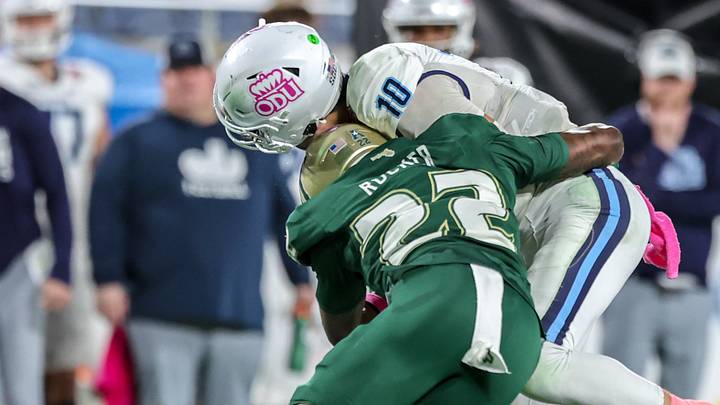
Whether fans love or hate it, the targeting penalty in college football is undeniably here to stay. The heart of the rule is protecting the players and prioritizing safety. Even with all of the changes that have come to the sport, they aren't going to go away from that. However, it's also something most agree on that changes needed to come for the targeting rule in many facets. And some of those changes are now instituted for the 2026 college football season.
In terms of the rule itself, we aren't going to see all that much different on the field. However, the changes that the NCAA and college football have made to the targeting penalty will be seen much more so in the consequences that result from being called for targeting.
Changes to college football targeting for the 2026 season

Starting as an experimental rule for the 2026 season, targeting will not result in an immediate suspension for the following game anymore. Instead, a player's first targeting penalty will still result in an ejection, but he will be able to play the following game. That, however, escalates if players are called for targeting more than once.
If a player is called for targeting for a second time in the same season, that player will be suspended for the first half of the following game, as well as the rest of the game in which the penalty is called. And if a player is confirmed to have committed targeting for the third time in a season, he will be suspended for the full following game.
There is also an option afforded to players and conferences in the rules to initiate an appeals process after a player's second targeting penalty. The appeal would be sent to the NCAA for video review and could result in the suspension for the first half of the next game being overturned. It remains to be seen how leagues are set to handle that, though I'm sure we'll get word on that sooner than later.
Perhaps the most important thing to note in all of this, though, is that more changes could be coming to college football's targeting rules. They are calling this a trial and an experiment with these new suspension rules, which leaves the door open for the rules to be further tweaked and changed in the coming years.
What is targeting by the rulebook in college football?

As it feels like we all do every fall, it feels like a good time to refresh on what targeting in college football is actually defined as. Per the NCAA rulebook, targeting is any hit or play that "goes beyond making a legal tackle or a legal block or playing the ball".
That, of course, is a tad ambiguous in how it could be interpreted. However, targeting is further defined as forcible contact to an opponent. Forcible contact can include but is not limited to:
- Forcible contact to the head or neck area of a defenseless player
- Leading with the crown of the helmet for forcible contact
- Launching
- Crouching and driving upward
When the officials or the upstairs officials flag a potential targeting penalty, there is a review of the play to determine if targeting did, in fact, occur. If it is determined that it did, then a 15-yard penalty is assessed and the player is ejected. As mentioned, the new rule changes will affect the ensuing games, which was previously that the player was suspended for the following half of football, meaning it'd be the first half of the following game if the foul occurred in the second half.
 Add us as a preferred source on Google