
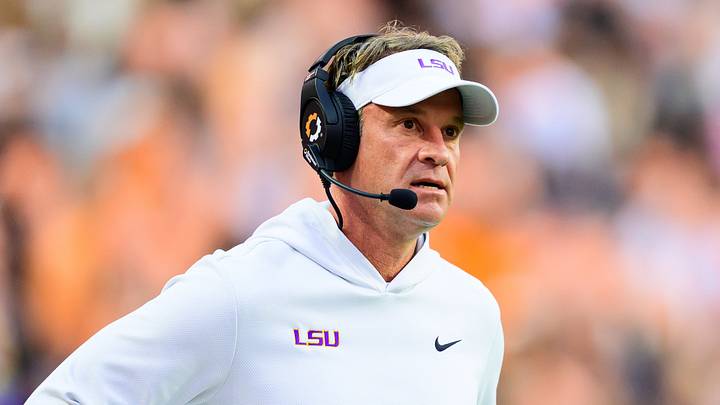
The SEC's threat to hold a vote on whether to kick LSU out of the conference is very real and also very stupid. On Dec. 3, the league's chancellors and presidents will meet to "deliberate" whether the Tigers will be cut loose for attempting to circumvent SEC rules barring professional players from participating in its sanctioned sports.
Most notably, LSU football coach Lane Kiffin attempted to roster two players that were cut from NFL training camps and sued for a fifth year of eligibility. The conference sued the school in a preemptive legal strike to ensure it could punish its members for violating bylaws. LSU additionally rostered former St. John's basketball standout RJ Luis Jr. after he played NBA preseason games with the Boston Celtics but was ultimately waived. Luis played in one game, a victory over Louisiana-Monroe before university President Wade Rousse said he told coach Will Wade to stop playing him. Luis has announced plans to sue the conference over his eligibility status.
Should the SEC decide to use the nuclear option on one of its founding members, it could send shockwaves throughout the college football world and trigger unintended consequences. Here are just a few of the biggest impacts such drastic move could have.
Schedule strength value shifts dramatically
Forcing LSU into independent status means the Tigers won't have the benefit of an SEC schedule to boost their AP ranking and College Football Playoff chances. However, that means LSU can enter into individual scheduling agreements that otherwise would've been limited with SEC membership. The first school it should call is Notre Dame. Setting up a multi-year series would automatically give both schools a perennial validating opponent.
While the Irish have a relationship with the ACC — among its already established rivals — to fill out its schedule, LSU could look to do the same, considering the SEC will probably deem it persona non grata. The ACC needs more strong nonconference ties, and other conferences like the Big Ten and Big 12 should view it as a similar opportunity. Freeing up LSU to schedule anyone it wants (within reason) may only strengthen its hand.
Lane Kiffin becomes completely unaccountable

If the SEC thinks it's punishing LSU's football program — and by extension Lane Kiffin — for allegedly breaking conference rules and enabling unprofessional antics, it's vastly mistaken. Kicking LSU out of the league would only take the shackles off Kiffin and leave only the already toothless NCAA to govern him. That's only going to give him the opportunity to mutate into an even bigger monster.



Kiffin's bad-boy-of-college-football persona has already given him an edge in recruiting. If he has no league to tie strings to his tactics, Kiffin could rise to the level of Notre Dame's Marcus Freeman in sniping top prospects away from programs vulnerable to conference constrictions. Legally, Kiffin would be free to test the waters of rostering the gray-area athletes who sue for eligiblity and win it in a federal courtroom. The NCAA, who would hold jurisdiction over LSU as an independent, is the party losing in those cases. There would be nothing holding Kiffin back from stacking his rosters with questionable yet effective names.
LSU's media rights revenue is thrown in jeopardy
Outside of the benefits of independence, LSU would also suffer some pretty serious financial consequences. It would no longer get a slice of the multi-billion dollar media rights agreement the SEC has with partner ESPN to carry its games on television and streaming services.
One key unresolved question revolves around which group would control the school's media rights — the SEC or LSU? — in case of an expulsion. It is a near certainty that an attempt by the SEC to kick LSU out while keeping its media rights would result in a significant lawsuit.
But let's assume the Tigers are permitted to sign their own deal. Multiple suitors would find that worth negotiating due to the vast reach of the LSU brand. Could the school be limited to who it could approach? What if the SEC adds a condition to an expulsion barring LSU from signing a deal with ESPN, and the network may have to blackball the school, lest it risk the profits it pockets from carrying the SEC? More questions that certainly would have to be answered by a judge.
Other networks like NBC, CBS, Turner and Fox already have agreements with Notre Dame, the Big Ten and Big 12 that could leave little room to squeeze LSU in. If there are limits to LSU's opponents being able to appear on other networks, especially if the Tigers manage to schedule former SEC neighbors, the Tigers could be in the same boat the Pac-12 was in and stuck courting streaming platforms instead. That could really hit the school in its bottom line.
LSU may be entitled to a guaranteed College Football Playoff berth

When the CFP expanded to 12 teams, one of the first controversies that emerged was how to address the exclusion of a good independent program based on a lack of conference championships. That was aimed at Notre Dame for having a CFP-worthy record but being kept on the outside of the bracket when a conference runner-up "earned" a berth over them. The solution was a negotiated concession that the Fighting Irish get a guaranteed bid if they finish among the Top 12 ranked teams.
Would LSU be in a similar situation? There is an argument to be made that the Tigers deserve the same guarantee if they indeed finish among the best 12 teams in the sport. With the expansion of the playoff to 24, conference championship games are being eliminated altogether and perhaps conferences will become obselete as well. The SEC could be doing LSU a favor by setting it up to perennially compete for a national title without fear of schedule antics and conference bias factoring into the equation.
 Add us as a preferred source on Google