
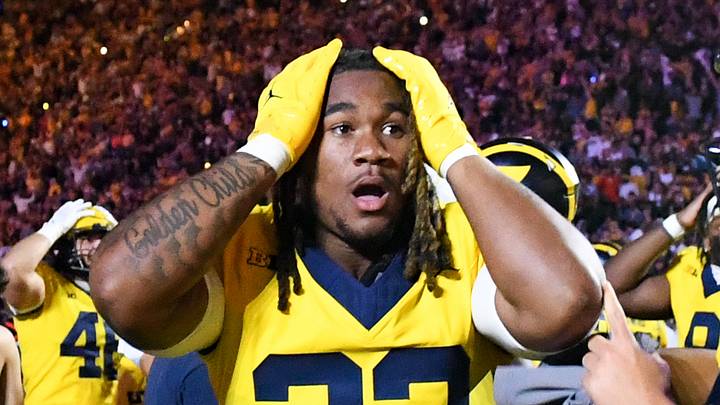
The biggest controversy of the young 2026 college football season isn't going away just yet. Michigan's disputed victory over Western Michigan on Saturday night is now under threat from the MAC, who is officially disputing the result to the NCAA Oversight Committee.
In case you (somehow) missed it: Michigan attempted a last-second Hail Mary while trailing Western Michigan, a 27.5-point underdog. That attempt fell incomplete and the Broncos celebrated, thinking they'd pulled off an epic upset. However, the replay review booth determined there was one second left on the clock when a WMU defender touched the ball from an out of bounds position. The broadcast's replay of the sequence showed no time remaining. Regardless, a second was put back on the clock and this time JJ Buchanan hauled in Bryce Underwood's Hail Mary pass to give Michigan the win. Controversy exploded throughout college football.
The conference had initially accepted the Big Ten's explanation of how refs came to the decision to give Michigan one more play at the end of their 13-12 win. However, they changed their tune by Tuesday. The MAC claims "it is now evident that replay protocol was not properly followed."
MAC claims replay protocol was not followed properly in Michigan vs. WMU
Wow, MAC reverses course and is now fighting the ending of WMU-Michigan game. pic.twitter.com/Wh8dKExfmy
— Bryan Fischer (@BryanDFischer) September 8, 2026
Here is what the MAC's says the protocol is for resetting the game clock at the end of a half:
- The Communicator should immediately alert the Replay Official when the in-stadium game clock has expired.
- The on-field crew is then alerted through O20 to hold both teams and confirm that the game is not over.
- The Communicator contacts the television truck and requests that the in-stadium game clock insert (embedded clock) be shown on the program feed.
- The Replay Official/Replay Center Official then determines whether time should be restored to the game clock based solely upon the game clock insert on the program feed.
TL;DR The MAC claims the replay center is supposed to use the television truck's feed. Instead, they used the replay center's feed. Thus, time was put back on the clock.
The Big Ten's initial statement on the situation suggested that the call was correct because the replay center's clock showed time remaining. On Sunday, WMU president Russ Kavalhuna said Big Ten commissioner Tony Petitti told him there's a "known discrepancy" between the two clocks, per Chris Vannini of The Athletic.
However, the MAC is changing the framing of the whole controversy. It doesn't matter that there was a discrepancy. The issue is that if there was a discrepancy, the replay center is supposed to default to the broadcast's sync.
"This is not simply a disagreement over the proper amount of time to place on the clock, nor is it a judgment concerning an officiating call. It is a failure to follow an established and specific replay protocol designed expressly to govern end-of-half timing situations," the MAC wrote in the appeal.
MAC is seeking WMU to be named the winner over Michigan
The MAC is calling for the oversight committee to make an unprecedented call: Overturn the result of the game and award Western Michigan with the win, 12-7.
Overturning a result isn't just uncommon in NCAA history. It's literally never happened. Conferences and referees have acknowledged significant errors at the end of games in the past, but those results have never been changed.
I wish I could say this appeal is different, but the MAC itself was involved in an extremely similar situation in 2016.
Central Michigan's upset of Oklahoma State wasn't overturned in 2016
Central Michigan upset Oklahoma State on a last-second lateral play that was incorrectly awarded. In that case, Cowboys quarterback Mason Rudolph was intending to finish running out the clock by throwing the ball out of bounds with his team up by three. However, because none of his receivers ran routes, he was flagged for intentional grounding. Since it was fourth down, the play resulted in a turnover on downs.
The refs gave CMU the ball with one second on the clock. After all, a game can't end on a penalty, right? No, not right. There's an exception stating "the period is not extended if the foul is by the team in possession and the statement of the penalty includes loss of down."
The MAC officials admitted they got it wrong. The Big 12 replay booth also got it wrong by not reviewing the play. Everyone acknowledged it was a mistake and Oklahoma State should have won the game.
Of course, the NCAA did not overturn the result. It stood because NCAA rules state that a game is over when the refs say it is over and that decision is final.
Could the NCAA change the precedent to make WMU-Michigan right?
Sure, anything is possible, I suppose. The NCAA has had to change their thinking on a lot of things that were once set in stone recently.
However, I would not bet on this outcome being changed. WMU could be 100 percent right in its argument, everyone could acknowledge that, and the result could still go unchanged, as it did in the CMU example.
There is one significant difference that could give WMU (and a whole lot of neutrals) hope:
Neither Oklahoma State nor the Big 12 appealed the ruling in the 2016 debacle. They accepted that there was nothing they could do. Perhaps the MAC's willingness to take this to the oversight committee will result in a different outcome.
To believe that's possible, you'd have to believe that the MAC can take on the Big Ten and win. We almost saw it happen on Saturday, but it's much easier to pull off an upset on the football field than behind the scenes where power and influence creates an even more uneven playing field.
Even so, there are some who already aren't acknowledging the official outcome. Jeff Sagarin lists WMU as 1-0 and Michigan as 0-1 in his ratings.
Jeff Sagarin, an official NCAA-recognized National Championship selector, chooses to recognize Western Michigan’s 12-7 win over Michigan in his ratings this season. pic.twitter.com/ldes5lAKiB
— RedditCFB (@RedditCFB) September 8, 2026
All it would take is the NCAA showing some backbone to make this happen in the official records as well.
 Add us as a preferred source on Google