
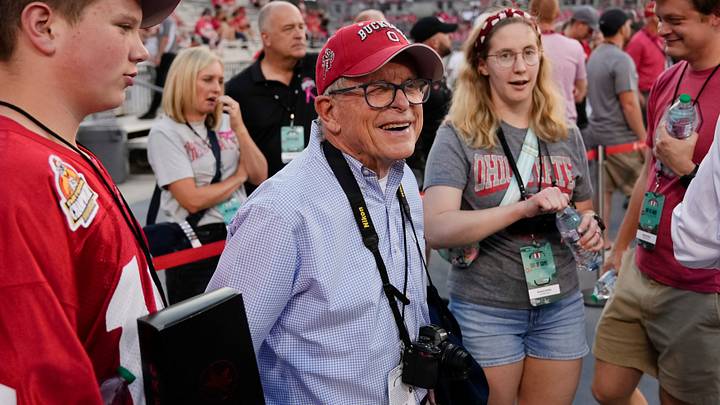
Just when it appeared the eligibility chaos for college athletes was finally settling down, the pot has been stirred again. On Tuesday, Ohio Governor Mike DeWine signed an executive order intended to grant members of the Class of 2022 a fifth year of eligibility in his state if those athletes haven't played professionally.
An executive order from Ohio governor Mike DeWine, which appears to impact every Class of 2022 athlete at a college in Ohio who is seeking a fifth year. (And hasn't played professionally.) Essentially, he's saying NCAA rules can't trump the rules of the state of Ohio. pic.twitter.com/bIxTsqwXoP
— Pete Thamel (@PeteThamel) October 13, 2026
The move throws a wrench in many lawsuits already filed or under active consideration nationwide seeking injunctions against the NCAA's stance that the Class of 2022 is not covered under the new so-called "five-for-five" rule, granting five years of eligibilty from the time an athlete enrolls at a university. DeWine, it seems, is trying to establish some sort of legal precedent that state laws override NCAA policy.
Blowback was rather immediate with external state officials weighing in. Oklahoma Attorney General Mike Hilgers called DeWine's order "unprecedented" and adding he "can't imagine such an order being enforceable" in his state or any other that hosts members of the Big Ten Conference.
NCAA President Charlie Baker released his own statement that fired back "the Governor of Ohio cannot legislate NCAA eligibility rules." He's right too, and things are only going to get more complicated over the next few months.
Ohio governor further muddies NCAA eligibility waters with confusing order

Let's establish a few civic definitions here. An executive order, particularly one issued by a state's governor, is a directive to state agencies and their policies. It is not law and it is not binding by law enforcement most times. In fact, DeWine's order supposedly directed all Ohio colleges and universities to grant eligibility, but private universities are not bound by executive orders and even entities that receive state funding like public universities — Ohio State included — aren't always compelled to act accordingly.
So the first consequence of DeWine's order will not be compliance but rather confusion over what the order was actually intended to do. It would come in contradiction with federal legislation -- the U.S. Senate-passed Protect College Sports Act -- that was written to address this very issue. In fact, DeWine's order would be trumped by that bill should it pass the U.S. House of Representatives and be signed into law by President Donald Trump after the November midterm elections.
There are bound to be legal challenges to the order incoming. DeWine directed schools to grant eligibility for the 2026-27 school year for those Class of 2022 athletes, but many athletic seasons are already underway and rosters locked. Whenever those cases pertaining to the order are cleared up, it'll be far too late for those players affected to participate even if they won eligibility ultimately.
DeWine's order is more performative than anything and it comes at a rather inconvenient time, not only for the NCAA and politicians but also for the schools and athletes at the center of it all. The governor muddied the waters further on an issue that was only just starting to get cleared up and created a nuisance rather than a solution to the problem.
It's unclear if any schools will immediately comply with DeWine's order. His state hosts several FBS programs, most notably the Big Ten's Ohio State, the Big 12's Cincinnati and six Mid-American Conference teams. Football rosters, however, have been locked for weeks and any newly granted eligibility would essentially be for nought.
 Add us as a preferred source on Google