
Every program in the country is vying for one of the 12 seats at the College Football Playoff table, and each week, Table for 12 will break down the 12 most important things that happened in the season-long game of musical chairs.
Week 5 lacked the marquee matchups that college football had blessed us with so far this season — and that are coming next week, with Georgia taking a trip to Tuscaloosa. But for what it lacked in ranked-on-ranked showdowns, it made up for it in de facto College Football Playoff elimination games.
This week we’re making four contenders pay their check and leave the CFP dinner party, including James Franklin and his former team, both of which lost in one of the more entertaining Friday night slates we’ve had in a while.
It may have been the apple-picking weekend for some, but Week 5 still helped shape the CFP picture. And if you decided not to spend Saturday glued to the couch, I’ve got you covered.
1. Florida’s offense isn’t solved, but Missouri finally tested it

- First course: Eli Drinkwitz’s first statement win in the SEC
- Tasting note: A letdown spot mixed with the first real adversity for Buster Faulkner’s offense was trouble for Florida
- The takeaway: Nobody had dared Aaron Philo to beat them yet. Missouri loaded up to stop the run and held the highest-scoring offense in college football to one offensive touchdown before garbage time in a 45-17 blowout win.
The Florida offense came into Week 5 averaging 54 points a game, and Jon Sumrall’s Gators shot up to No. 8 in the country after knocking off Ole Miss in the Swamp last week. But the Gators had trailed for just 4:03, the amount of time it took to answer a Campbell first-drive field goal with a touchdown in Week 2, all season. That meant Aaron Philo had attempted five total passes when trailing this year, and all were against FCS competition in the first quarter.
It’s difficult to make a Buster Faulkner offense one-dimensional. The entire ethos of his system is that he keeps you off-balance by threatening the run and pass at all times and dressing them both up with plenty of eye-candy. But Missouri did it — not just by taking the lead and scoring on eight of its first 10 possessions, but by loading the box to stop the run.
For the season, Florida had a 63.5 percent run rate and a 70.5 percent run rate on first down, No. 11 in the country. With that, the Gators ranked No. 4 in EPA/rush of 0.29. Against Missouri, Florida averaged -0.41 EPA/rush, a third-percentile outcome, holding Jadan Baugh to 13 yards on 12 carries and forcing Florida into a 60 percent early down pass rate and an average third-down distance of 10 yards.
The plan wasn’t just to make Florida one-dimensional in terms of run/pass splits; it was to make their run game one-dimensional. Missouri did that with a lot of five-down fronts, which neutralized the gap-scheme runs Florida had dominated with much of the season. That allowed Missouri’s penetrating defensive line to shoot gaps against zone runs and its fast linebackers to flow with Baugh and Duke Clark.
This isn’t necessarily a blueprint, but I’d expect a lot of defenses to steal pieces of this game plan from Missouri defensive coordinator Corey Batoon. But it may not work quite as well once wide receiver Vernell Brown III, who missed the game with an injury, is back to help provide more of a vertical element.
It’s not all about Florida, however. With the defense flying around, Robert Woodyard Jr. and Nicholas Rodriguez making plays at the second level, 6-foot-6, 250-pound sophomore Daedin Hopkins continuing to emerge as one of the best edge rushers in the SEC and Austin Simmons threatening every inch of the field with an electric arm, Missouri is a real player in the SEC’s upper-middle class.
Texas, Georgia and Alabama appear to be in a tier of their own. After this win, it’s hard not to place Missouri alongside Ole Miss, Florida, LSU, Tennessee and Mississippi State, which just beat the Tigers last week.
Being considered a real contender is unfamiliar territory for Missouri under Eli Drinkwitz, who, since arriving in 2020, has yet to win a conference game over a team that finished above .500 in SEC play (0-16). I have a good feeling this will be his first.
2. It’s wasn’t just Keelon Russell vs. Kamario Taylor in Starkville

- Second course: Alabama’s well-balanced offensive attack
- Tasting note: Some early vindication for Kalen DeBoer and Ryan Grubb’s offense
- The takeaway: Alabama had its worst rushing attack since World War II last season. This year, the Tide are running it as well as they’re throwing it and with Keelon Russell living up to expectations, that equals the best offense in college football.
Keelon Russell was better than Kamario Taylor in the marquee QB showdown of the week. Russell probably is better than Taylor, who struggled early with two ugly turnovers that allowed Alabama to build an early lead. But the reason the Tide ran away from Mississippi State in its 56-23 win in Starkville is all the pieces around its star QB.
Alabama’s run game ranked No. 120 in the FBS in success rate last season. This year, it’s one of the most efficient in the country. Russell’s legs have helped unlock things, but so have underrated offensive line transfer portal additions and two freshman running backs: Trae’shawn Brown, who was the bell cow in front of the cowbells on Saturday, and EJ Crowell, who has been dynamic at other times this season.
Alabama | 2025 | 2026 |
|---|---|---|
Run rate | 40.0% | 51.5% |
Rushing success rate | 42.5% | 54.8% |
EPA/rush | -0.04 | 0.16 |
Play-action YPA | 8.9 | 10.5 |
Play-action rate | 29.0% | 42.9% |
So, as Alabama ran for 203 yards with a 61 percent success rate, Mississippi State finished with 59 yards on the ground (removing sacks) and a 28 percent success rate. Even Taylor can’t do it all himself, at least not against a team like the Tide.
The biggest change in Bama's run game has been the involvement of the tight ends, a position group Alabama just didn’t have enough depth at early in DeBoer’s tenure. Now, with Kaleb Edwards, Josh Ford, Marshall Pritchett and Jay Lindsey making up a well-rounded TE room, Alabama can force defenses into conflict with its heavy personnel groupings.
If you put big bodies on the field, Russell will burn you through the air; if you don’t Brown, Daniel Hill or Crowell will bury you on the ground.
3. Ohio State still has another gear, and his name is Jeremiah Smith

- Third course: A record-breaking day for college football’s best player
- Tasting note: Big piece of humble pie for Iowa after last week’s upset win
- The takeaway: It’s too early to officially declare Iowa eliminated from the Playoff with just one loss, but it's games like this that show the levels of college football. The Hawkeyes are a good team, probably somewhere between 20-35. Ohio State is a top-five team and, even for its flaws, always has a trump card it can play.
Ohio State offensive coordinator Arthur Smith heard someone say to build the whole plane out of Jeremiah Smith, and he took it seriously. Julian Sayin attempted 27 passes on Saturday; 15 of them went to the best player in college football. Smith hauled in 11 for 206 yards and two touchdowns, breaking the Ohio State records for career receptions (206) and receiving touchdowns (36) in the process.
Smith has been targeted 62 times this season, a 39.7 percent target share, by far the largest of his career and just clear of Rutgers’ KJ Duff for the highest in the country. Maybe unsurprisingly, it’s leading to more efficiency for everyone. The 2026 numbers may come down as Ohio State gets deeper into Big Ten play, but with Iowa and Texas already on the schedule, it’s probably a fairly accurate representation of the distribution.
Ohio State | Jeremiah Smith target share | Jeremiah Smith yards/target | Everyone else yards/target |
|---|---|---|---|
2026 | 39.7% | 13.3 | 10.2 |
2025 | 27.3% | 11.7 | 8.9 |
2024 | 24.2% | 12.5 | 8.8 |
4. Penn State doesn’t have the talent and it may not have the toughness

- Check, please: When it’s clear there won’t be a seat for you at the CFP table, it’s time to pay your check and leave
- The cost: The softest schedule the Big Ten could possibly offer up looks a lot tougher if you’re not good enough to beat Wisconsin and Northwestern.
Last week, it was the Penn State offense that was a complete disaster, and while it didn’t get any better on that side of the ball in Week 5, the defense took center stage on Friday night, allowing 500 yards — 413 on the ground — and a 61 percent rushing success rate. Chip Kelly has been in his bag with Northwestern, breaking out triple-option runs off jet motion and getting as weird as he has in years. But this win wasn’t about eye candy; this was about physicality.
There was always a very real possibility that Penn State had a talent deficiency relative to the rest of the Big Ten in year one under Matt Campbell. It was hard to imagine this team having its toughness and physicality questioned, but here we are.
Penn State overhauled its DL group with supersized DTs to stop the run with light boxes. Then Northwestern pushed them around for 400 yards on the ground and a 61% rushing success rate. It was as bad as it sounds. pic.twitter.com/pfnF5APyVk
— Josh Yourish (@JYourish3) October 3, 2026
5. Virginia Tech lost James Franklin’s first big game

- Check, please: When it’s clear there won’t be a seat for you at the CFP table, it’s time to pay your check and leave
- The cost: It’ll take time for James Franklin to build up the Virginia Tech program, but in year one, he has an NFL quarterback and one of the best tight ends in the country — if not the best. Ethan Grunkemeyer will likely be back, but you never want to waste a year with a QB like that.
It may look different than hosting Oregon for the White Out, playing Notre Dame in the Orange Bowl in a CFP semifinal or any of his matchups with Ohio State, but this was James Franklin’s first big game at Virginia Tech — and he found a way to lose it. I, for one, never would’ve seen that coming.
Not only did he lose on a controversial missed field goal after refusing to center the ball for his kicker, but he lost to a Pitt team that lost its star quarterback, Mason Heintschel, to a torn ACL in the third quarter and an offense that managed a 31 percent success rate and 4.8 yards per play for the game. With Heintschel healthy, these two teams are fairly evenly matched, but without him, this is a brutal loss powered by four turnovers and -16 points of turnover luck, according to Gameonpaper.
Grunkemeyer averaged 10.1 yards per dropback, and though he had two interceptions, one of which should not have been ruled a pick in the first place, he was excellent. He’s a quick decision-maker with high-level pocket awareness, a quick release and enough arm strength to push the ball downfield out of structure. He’s an NFL quarterback and may even force his way into a first-round conversation eventually.
Ethan Grunkemeyer pressured vs. Pitt:
— Josh Yourish (@JYourish3) October 3, 2026
10/13, 182 yards (14.0 ypa) 83.3% adjusted completion
Throws over 20 yards downfield:
5/10 for 164 yards, 2 TD/1 INT (started 5/6)
Rough loss for VT, but James Franklin brought an NFL QB to Blacksburg. Hopefully he gets 2 years of him.
This game was essentially a CFP eliminator. With Miami still on the schedule, this loss effectively knocks Virginia Tech out of the race, because no two-loss ACC team will make the field. But with Heintschel’s injury, it spoiled both teams' chances. Pitt backup Holden Geriner was fine in relief, but this team was built almost entirely around Heintschel; without him, there isn’t enough talent.
6. Kyle Whittingham can’t figure out Michigan, so how could anyone else?

- Check, please: When it’s clear there won’t be a seat for you at the CFP table, it’s time to pay your check and leave
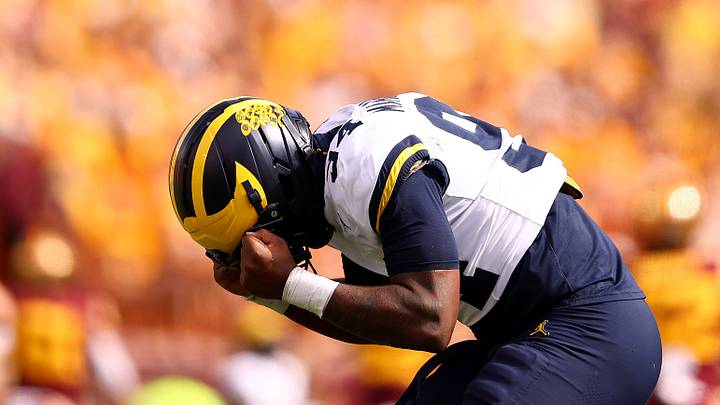
- The cost: A 20-14 loss to Minnesota spoiled any chance to salvage a shaky start to the season, and Michigan is staring down 0-2 on CFP appearances in the Bryce Underwood era — which may not see a year three.
Last week, Michigan gained 429 yards and had a positive net success rate of +12 percent against Iowa, only to come away empty-handed from two red zone trips and leave the door open for an all-time Hawkeyes comeback. Despite the loss, it was Bryce Underwood’s best game of his career, generating 0.46 EPA and 9.52 yards per dropback. It seemed that OC Jason Beck found something by moving Underwood outside the pocket to throw on the run. Apparently he didn’t.
This week, Michigan improved its red zone success rate from 27 percent to 67 percent, but its overall success rate fell from 46 percent to 35 percent. Underwood’s EPA/dropback fell to -0.53, and his yards/dropback dipped to 4.21. The Wolverines scored just one offensive touchdown as Minnesota’s massive, pocket-pushing defensive line collapsed things around Underwood and limited his escape routes.
6-foot-6, 280-pound edge Anthony Smith had two pressures and a half-sack, and his counterpart, 6-foot-3, 265-pound TJ Bush Jr., had four pressures and three sacks. It was a great defensive game plan from PJ Fleck’s staff to claim the Little Brown Jug on their home field for the first time since 1977, and it left Whittingham dumbfounded.
Kyle Whittingham opens up about the challenge of figuring out this Michigan team. pic.twitter.com/1YHEVULHHk
— FOX College Football (@CFBONFOX) October 3, 2026
7. Jedd Fisch threw the kitchen sink and it still wasn’t enough

- Check, please: When it’s clear there won’t be a seat for you at the CFP table, it’s time to pay your check and leave
- The cost: A shot at being the dark-horse Big Ten contender for the College Football Playoff with a dynamic QB like Demond Williams officially went by the wayside with a 25-21 loss to USC on Saturday night.
Jedd Fisch’s roster has a lot of problems this year, most of them on the offensive side of the ball. The Huskies ranked outside of the top 100 in rushing success rate and allowed the fifth-highest pressure rate on Demond Williams among qualified Power 4 QBs.
But Williams is still good enough to keep Washington is some of its games, especially when Jedd Fisch is pulling out the trick plays in his bag as he did on Saturday night in L.A. Washington scored three touchdowns in the game. The third was a 42-yard catch-and-run from tight end Decker DeGraaf with a terrible display of tackling by USC. The first two, however, were significantly aided by trick plays: first a touchdown throw from wide receiver Dezmen Roebuck, then a flea-flicker for a 17-yard gain the set up the Huskies in Trojans territory.
Fisch is as good as anyone at manufacturing explosives, and Williams best plays are as good as anyone. But down-to-down, this team isn’t very good, and this effort against a gettable USC team felt like a last gasp.
8. Jamal Roberts gives Missouri the balance it was missing

- Head of the table: The best individual performance of the week earns a seat at the head of the table
- The resume: 24 carries, 211 yards, 3 TDs (149 yards after contact, 6 missed tackles forced
- The takeaway: Austin Simmons is the best player on Missouri’s offense, but Jamal Roberts is plenty good enough to take advantage of the respect defenses play to Simmons’ arm, and that gives Missouri’s offense the balance that eluded Eli Drinkwitz last year.
Missouri’s ground game was supposed to run through Ahmad Hardy, who was shot this offseason and has yet to return to the field. Jamal Roberts, though, has filled Hardy’s massive shoes quite well — well enough to get a split-screen graphic with Derrick Henry, which is always a good thing for a running back.
In Week 5, Roberts became the first SEC running back since Henry to run for 200+ yards and three or more touchdowns against a top-10 opponent. Austin Simmons was throwing darts all day, but Roberts put the game away with his explosive runs.
OFF TO THE RACES!@0fficialmal20 pic.twitter.com/Wokitq6Xcl
— Mizzou Football (@MizzouFootball) October 3, 2026
Last year, Hardy was running into a lot of loaded boxes once SEC defenses realized Beau Pribula couldn’t burn them over the top. Simmons, however, can make every single throw, and that makes the run game that much tougher to stop.
9. Bear Bachmeier is still playing like a QB wearing No. 47

- Send it back: Sometimes when a meal just isn’t right, you’ve got to send it back, and in this category, these head coaches feel that way about their team’s performances
- The problem: The improvement of BYU’s dropback passing game may have been greatly exaggerated.
BYU nearly made the CFP last season without a particularly functional dropback passing game. As a true freshman, Bear Bachmeier was hyper-efficient when playing with a lead in advantageous situations, averaging 9.8 yards per attempt off play-action with 10 touchdowns to one interception. On straight dropbacks, he averaged 6.6 yards per attempt with five touchdowns to six picks.
To be a real threat — not just to make the CFP what looks to be a lackluster Big 12 race, but to have a shot at winning a game in it or knocking off Notre Dame in a few weeks — Bachmeier needs to give BYU something in obvious passing situations. This year, however, his play-action splits are even more drastic, and facing a stout TCU run defense largely without star running back LJ Martin, who left the game in the first half with an injury, Bachmeier went 11-24 for 62 yards and was 0-3 on throws over 15 yards downfield.
Bear Bachmeier | 2025 w/ PA | 2025 w/o PA | 2026 w/ PA | 2026 w/o PA |
|---|---|---|---|---|
DB% | 36.4% | 63.6% | 36.8% | 63.2% |
Yards | 1,375 | 1,647 | 392 | 312 |
Comp% | 62.9% | 65.5% | 68.8% | 61.1% |
YPA | 9.8 | 6.6 | 12.3 | 5.8 |
TD/INT | 10/1 | 5/6 | 5/0 | 1/1 |
There was rain in Fort Worth, and Bachmeier did what he does best, rushing for 66 yards and two touchdowns on 15 carries. That can carry the Cougars through most of their schedule, but you can’t be a “top-10 team,” as BYU technically is, and be this one-dimensional.
10. Josh Heupel has Tennessee ready for life with a QB controversy

- Hors d’oeuvres: A little something to chew on from the week that was in college football
- Nutrition facts:
- 5-star true freshman Faizon Brandon was benched in the 1st half for redshirt freshman George McIntyre
- Brandon started 3-8 for 0 yards with 1 INT, 2 sacks and a 12.5 rating
- Brandon went 0-2 with an interception on passes over 10 yards downfield
- Brandon is 1-8 on passes over 10 yards downfield in SEC play
When you think of Josh Heupel, who is the current patron saint of the veer-and-shoot offense in college football, you probably think of an aggressive downfield attack and a team that wants to win games 42-40. But not this Tennessee team.
Heupel has made a concerted effort to alter that identity, and this team might do it. Brandon, not the offensive line, was the biggest reason Texas finished with 10 sacks last week, and he looked in over his head against Auburn’s defense as well. So, Heupel pulled him for redshirt freshman George MacIntyre, who didn’t do much, attempting just two passes over 10 yards downfield. But he went 1-2 for 44 yards on those attempts, finished 8-10 for 86 yards overall, took just one sack, didn’t turn the ball over and got it out in 2.65 seconds after Brandon posted a 3.79-second average time to throw in Week 4 and a 3.35-second time to throw in Week 5.
Even without much of a passing game, Tennessee imposed its will. DeSean Bishop went for 220 yards and three touchdowns on 34 carries. On the other side, Jim Knowles stifled Auburn’s offense (though with Byrum Brown at quarterback, that’s not particularly hard) and Tennessee looks good enough to tread water without a difference-maker at QB.
11. Will Stein rolled the dice and kept Kentucky’s slim CFP hopes alive

- Dessert: Whether it’s a rich play design or a decadent athletic display, here’s a sweet football treat
- Tasting note: A sharp, up-and-coming head coach putting a fork in the messy Shane Beamer era at South Carolina.
If you get the ball second in college football overtime and match your opponent’s touchdown, you should almost always go for two. In the second overtime, you’re going to need to use your best two-point play anyway, so you might as well break it out when the other side doesn’t have a chance to respond. It’s a risk, but it’s worth it. Will Stein knew that, and with a nice design on the goal line, he escaped Columbia with a 35-34 win over the Gamecocks after trailing 17-0 in the second quarter.
KENTUCKY GOES FOR 2 IN OVERTIME TO STUN SOUTH CAROLINA 😤 pic.twitter.com/EKj2lq0CEP
— SEC Network (@SECNetwork) October 4, 2026
The play that preceded it was even prettier, a TE leak for a wide-open touchdown. Watch the inside tight end next to the right tackle just work his way across the line of scrimmage before catching the touchdown.
Spider Pass + TE Leak
— Coach Dan Casey (@CoachDanCasey) October 4, 2026
Kentucky wins it on the 2pt Play! pic.twitter.com/kLDK1SBoA0
Stein is sharp — not just as a play-designer, but as a game manager. This isn’t Indiana 2.0, but I’d be surprised if Stein doesn’t return Kentucky to the heights it reached under Mark Stoops before it fell apart, and maybe even climb a bit higher.
12. Oregon State has it rolling with Braden Atkinson and Jesse Legree

- Kid’s menu: The CFP saves one spot at the big kids’ table for the Group of Six
- The takeaway: Oregon State’s high-powered passing attack is positioning the Beavers as the biggest threat to Boise State in the Pac-12.
Oregon State is just 3-2 because it began the year with close losses to Houston and Texas Tech. Since then, JaMarcus Sheppard’s team has won three straight, hanging 52 on Montana, 33 on UTEP and 56 on Colorado State on Saturday.
On Saturday, Atkinson, a Mercer transfer who is looking like the find of the portal, went 30-34 for 413 yards and five touchdowns. More touchdowns than incompletions at that volume is incredibly difficult to do, and one of the reasons Atkinson can do it is Jesse Legree, a 5-foot-10, 172-pound three-star true freshman from Baltimore who has over 100 yards in all five games and continued that streak this weekend with five receptions for 156 yards and three touchdowns.
If those numbers don’t tell you how good this passing game is, this might: Jim Mora Jr. fired his defensive coordinator midway through the game.
Source: Tyson Summers has been dismissed as the defensive coordinator at Colorado State. He was replaced as play caller during CSU’s loss to Oregon State today. pic.twitter.com/yiwzFDJ50i
— Pete Thamel (@PeteThamel) October 4, 2026
 Add us as a preferred source on Google