
You would think that a Halloween Saturday would’ve brought the upsets and chaos we’ve been seeing all year in college football, but there wasn’t much spooky about Week 9. Sure, No. 2 Ohio State went down in L.A., but it was without its starting quarterback, so it’s scary times in Columbus no matter the time of year.
No, Week 9 was straightforward — a solid college football Saturday that stood out as uniquely dull against the backdrop of the historic season we’ve had so far, but in some ways the perfect precursor to a Week 10 slate that’s bringing us The Holy War, Texas at Missouri, Alabama at LSU, Kentucky at Tennessee, Georgia at Ole Miss and Miami at Notre Dame. A slate that has the makings of an unforgettable day of football.
Before we get there, though, we have Week 9 to sort out and the first College Football Playoff rankings of the year to get to on Tuesday.
1. Tommy Castellanos brings Texas Tech more boom and less bust

- First course: A bounce-back win for the Red Raiders in Lubbock
- Tasting note: Who knew Tommy Castellanos would ever be a nice piece of ginger to calm the stomach?
- The takeaway: Not a true Playoff eliminator, but likely a knockout blow to Arizona behind Texas Tech’s dominance in the trenches on both sides of the ball. The Red Raiders ran for 328 yards and held Arizona to just 12 on the ground.
As a play-caller, Texas Tech offensive coordinator Mack Leftwich hunts explosives. He loves to take shots down the field with a veer-and-shoot-inspired passing game that features wide splits, stacked alignments and vertical option routes. And even with Will Hammond at QB, he was finding a decent number of them.
However, in Week 9, he made the switch to Tommy Castellanos, who recently had his eligibility reapproved, as the Michael Scott snip, snap, snip, snap rulings continue. And, against an Arizona defense that came in ranked No. 11 in points per drive, he led the Red Raiders to 34 points — and, notably, an 11 percent explosive play rate.
It’s not just how many big plays Texas Tech created on the ground; it’s also how big those plays were, with 164 of the team’s 329 rushing yards coming on the five carries of 15+ yards (49.8 percent of the team's total rushing yards). That’s up from 46 percent for the season.
Texas Tech O (season) | Arizona D (season) | TTU vs. AZ | |
|---|---|---|---|
Rush SR | 46% | 42% | 47% |
Explosive rush % | 8% | 8% | 11% |
Explosive play % | 7.5% | 9.6% | 11% |
Havoc % | 19.6% | 13.7% | 15% |
Arizona didn’t necessarily rank highly as a defense in terms of havoc rate, and allowed more explosives than you’d expect. So, the question going forward for the Red Raiders: How much of the offensive boost came courtesy of Castellanos, and how much came courtesy of an Arizona defense that maybe hadn’t been allowing the number of points the underlying numbers would indicate?
Castellanos carried it 18 times for 124 yards and a score, and while the 47 percent rushing success rate is right in line with Texas Tech’s 46 percent season average, it’s obvious how he stresses defenses in a way that Hammond couldn’t — and how he allows Leftwich to call an even more diverse run game.
RAIDER TERRITORY
— Big 12 Conference (@Big12Conference) October 31, 2026
Thomas Castellanos run for an 8-yd TD
📺 ESPN pic.twitter.com/adfiSQtZ0P
Hopefully, that can help an offense that ranks No. 119 in the country with a 51.7 percent red zone touchdown rate turn more trips inside the 20 into touchdowns when it doesn’t hit the explosives. You’d expect the QB run game to improve down-to-down efficiency, but if that’s not going to happen, at least it seems he can unlock more explosives and avoid more negatives than Hammond.
2. Georgia’s defense is good enough to survive Mike Bobo
- Second course: The World’s Largest *Indoor Cocktail Party
- Tasting note: A satisfying Georgia beatdown in Atlanta that comes with a few unwanted questions.
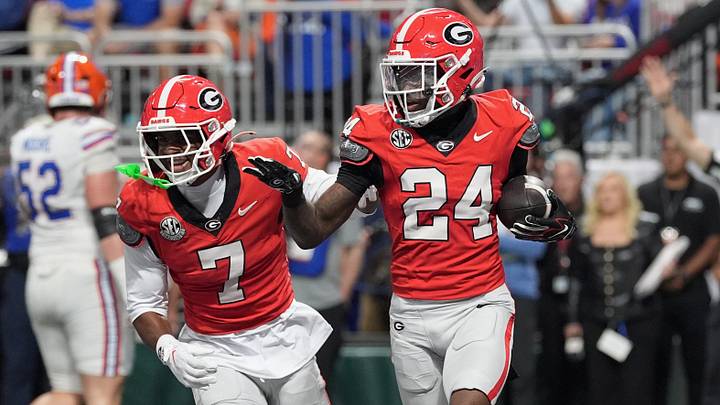
- The takeaway: Georgia’s offensive numbers were wretched against Florida in Week 9, but it didn’t matter because the Gators never had a chance with a four-turnover day in a 27-8 loss at Mercedes-Benz Stadium.
For the second time this year, Gunner Stockton and the Georgia passing game had a truly terrible performance in a game that the Dawgs never had to sweat. Starting with Aaron Philo’s mind-numbingly bad interception in the first quarter, Kirby Smart and Glenn Schumann’s defense had the Gators in a vice grip, finishing the game with a 38 percent stuff rate and a 25 percent havoc rate — both 95th-percentile or better outputs — and scoring its first 10 points directly off Florida Philo picks.
The Georgia defense managed 11 tackles for loss and four sacks, accounting for -57 yards, and with KJ Bolden back at safety, they hardly had to worry about getting beat over the top. The Dawgs sat in a two-high shell all day and wrecked shop against a Florida offense that didn’t have a whiff of a vertical element without Vernell Brown III, attempting two passes over 20 yards on the day and completing one for 23 yards. Both of those throws came from backup Trammel Jones, who replaced Philo after his second INT.
However, the Dawgs never truly put this one out of reach because Stockton went 13-for-23 for 101 yards, averaging 4.0 yards and -0.66 EPA per dropback with just 38 total air yards. Stockton’s average depth of target was 5.3 yards, and he went 7-for-9 on screens for 13 yards (1.4 ypa). That -0.66 EPA/dropback is the worst of Stockton’s career as a starter. His previous worst was -0.31 against Georgia Tech in 2025, and his previous worst without a turnover was -0.20 in the 2025 Sugar Bowl loss to Notre Dame after Carson Beck was injured in the SEC Championship Game.
The other rough Stockton performance in a win came against Oklahoma, when John Mateer yakety saxed his way to a blowout loss. Now there are a few questions: Did Bobo call the game that way because Kirby trusts the defense that much? Did he call it that way because he doesn’t trust Stockton after the turnovers against Auburn? Or did he call it that way because he’s Mike Bobo?
I lean toward the third option, because we’ve seen Bobo do this for a while. But I’d have a hard time trusting Stockton right now if I were him, and if I were me, which I am, I’d have a hard time trusting Georgia to reach its championship ceiling with Stockton and Bobo — however you choose to assign the blame.
3. Ohio State isn’t good enough to keep rolling without Julian Sayin

- Third course: An ugly 30-18 loss in freshman Luke Fahey’s debut.
- Tasting note: A tainted first top-five win for Lincoln Riley at USC
- The takeaway: Even as a Heisman finalist last year, Julian Sayin has largely been regarded as a beneficiary of Jeremiah Smith’s greatness. But no matter how fast the race car is, you still need someone who knows how to drive it.
Julian Sayin is far from my favorite quarterback in college football. He actually navigated pressure and created out of structure quite well this season before his injury, which were my primary criticisms of him in 2025, but he still doesn’t quite have the frame or the arm to be considered a quality NFL prospect (however much that matters to Ohio State’s offensive ceiling).
Sure, he got handed the keys to a Ferrari last season; most of the time, he didn’t crash it. Now, it’s a lot to ask true freshman three-star Luke Fahey to get behind the wheel halfway through his first season in Columbus, but as he missed open receivers, drifted in the pocket and got skittish under pressure, it became clear that as fancy as this car is, it’s not self-driving.
It also doesn’t help that Ryan Day continues to manage the game in such a conservative way. Coming into this game, even with a loss on the resume, Ohio State had trailed for just 23 plays all year, so the Buckeyes, understandably, had about a 45 percent pass rate on early downs and a 42.3 percent pass rate on first down. If you adjust for situation, the Buckeyes are actually at a +3.6 percent pass rate over expected.
However, despite trailing wire-to-wire against USC, Day’s early down pass rate was just 47 percent. On those early-down throws, often with the benefit of play-action and a more favorable look in a less obvious passing situation, Fahey produced a 50 percent success rate. On late downs, with a 59 percent pass rate, Fahey managed a 30 percent success rate, going 3-for-9 for 44 yards.
Then, on Ohio State’s penultimate drive, trailing by 15, Ohio State took well over five minutes off the clock and operated with almost no urgency. It’s a continuation of Day’s conservative approach, which in 2024 served him well as his loaded roster had far less wear-and-tear by the time it reached the playoffs. His pace isn’t so glacial this year, but his conservative approach remains.
Fahey wasn’t terrible, and Day and Smith schemed up some really good stuff for him. But he wasn’t Sayin, and Ohio State clearly isn’t good enough on either side of the ball to hold serve without its QB. Oregon, Northwestern, Nebraska and Michigan are left. If Sayin is out, the Buckeyes could lose every one of those games.
4. SMU got Steve Angeli’d
- Check, please: When it’s clear there won’t be a seat for you at the CFP table, it’s time to pay your check and leave
- The cost: With two ACC losses, falling to Louisville earlier in the year and to Syracuse 30-27 in Week 9, SMU’s path to the ACC Championship Game is suddenly very murky — and any chance of an at-large bid has sailed. Much like their loss to Cal last year, Rhett Lashlee’s team found a way to waste a favorable schedule in the ACC.
Syracuse went on three touchdown drives against SMU. All three were aided by fourth-down conversions; the second of the three was helped by two fourth-down conversions, including a one-yard touchdown run on fourth-and-goal. By going 4-for-4 on fourth down while SMU didn’t attempt a single fourth down, Syracuse added 20 percent win probability, and two fumble recoveries, including on the final play of the game, added 25.2 percent win probability as well.
It’s hard to imagine SMU losing a game in which Kevin Jennings throws for 351 yards, averages 7.29 yards per dropback, is sacked just once and doesn’t turn the ball over. That’s everything you want from a quarterback who has been quite volatile throughout his career. But it’s what happens when the margins are as slim as they are in college football now.
5. Wisconsin had the latest letdown

- Check, please: When it’s clear there won’t be a seat for you at the CFP table, it’s time to pay your check and leave
- The cost: After pulling upset of USC last week, Wisconsin had a clear path to 10-2 and potentially the Big Ten title game. At that point, even without many marquee wins, it may have been tough to keep the Badgers out of the CFP. Instead, after falling to Iowa 30-0 in Iowa City, Wisconsin will fall out of the top 25 of Tuesday’s release and out of the Playoff race entirely.
Offensively, Wisconsin’s performances in its 24-7 Week 8 win over USC and 30-0 Week 9 loss to Iowa weren’t terribly dissimilar. Quarterback Colton Joseph didn’t do much in the passing game, and the unit averaged fewer than 4.0 yards per play. Defensively, though, it was hardly the same team.
Wisconsin’s dominant front seven has continued to control the ground game, but after keeping a Jayden Maiava-Lincoln Riley passing attack in check, the Hank Brown-Tim Lester passing attack went wild.
vs. Wisconsin | USC Week 8 | Iowa Week 9 |
|---|---|---|
Points | 7 | 30 |
yards/dropback | 4.00 | 8.69 |
EPA/dropback | -0.07 | 0.57 |
EPA/rush | -0.18 | -0.22 |
1st down + touchdown rate | 32% | 46% |
Brown completed 15 of his first 16 throws for 196 yards and two touchdowns. Iowa’s tight end duo of DJ Vonnahme and Reece Vander Zee were dominant, and Brown was at his best. And with a quarterback who hasn’t thrown for 100 yards since Week 5, Wisconsin was uniquely susceptible to a defensive letdown.
6. If you have Charlie Becker, you have a chance
- Head of the table: The best individual performance of the week earns a seat at the head of the table
- The resume: 8 catches, 149 yards, 1 TD (OT game-winner)
- The takeaway: Charlie Becker has made a whole host of consequential catches throughout his Indiana career, but it’s hard to imagine two bigger than his 33-yard reception to set up the game-tying 60-yard field goal as time expired and his 25-yard touchdown grab in overtime to put Indiana in front for the first time since the first quarter.
Minnesota had Indiana on the ropes, so much so that Curt Cignetti benched a banged-up Josh Hoover for former Old Dominion quarterback Grant Wilson, who is in his second year with the program. Wilson was an immediate upgrade, finishing with an 89.3 QBR to Hoover’s 39.1. And most importantly, he understood that in the big moments, he should throw it to No. 80.
Aside from Hoover’s performance, it was a dreadfully bad special teams day from Indiana. Minnesota gained 12.52 expected points from special teams, helping to keep it in the game despite a 27 percent success rate.
Strangely, rather than being the team that is greater than the sum of its parts because it does everything so well on the margins, this year’s Indiana team, with performances like Becker’s and Tobi Osunsanmi’s — who finished with two tackles for loss, five QB pressures and the game-winning sack — is incredibly star-driven. Luckily, they’ve found and developed enough of them to make it work.
7. BYU got pushed around in Provo

- Heimlich Maneuver: Sometimes a CFP contender chokes on their food, but the best teams know the Heimlich
- The choking hazard: With a quarterback named Bear and a physical identity, there aren’t many teams that can push around BYU, but Arizona State did for most of the day in the Cougars' 27-20 Week 9 win.
BYU isn’t supposed to be the team winning with chunk plays, and in most cases it won’t be. But against Arizona State, the Cougars got pushed around in the trenches and leaned heavily on explosives. Not only did Arizona State finish with a 26 percent stuff rate, but BYU stuffed the Sun Devils on just one run. It was a significant discrepancy that continues a somewhat alarming trend of BYU being gettable on third-and-short.
Facing third-and-short in Week 9, BYU allowed four of eight conversions, plus 2-for-2 on fourth down. Facing third-and-short this season, BYU ranks No. 104 in the country in opponent EPA/play at 0.34 and No. 67 in the country with a 60.7 percent success rate allowed.
It’s simply a fly in the ointment for a really good team with a strong statistical resume, but once again, with thin margins, it could be costly. The good news is that despite facing such a high stuff rate in Week 9, BYU has just a 13 percent stuff rate for the season (No. 30 nationally) and is No. 5 in third-and-short success rate.
Arizona State took a lot of chances, slanting and twisting aggressively up front with a good number of run blitzes to play the feast-or-famine game as a run defense, and they hit at a pretty unsustainable rate. So, while it was a major determining factor in this game, it’s probably not a long-term concern for the Cougars.
8. You just can’t hold off the Miami Hurricanes’ storm surge
- Heimlich Maneuver: Sometimes a CFP contender chokes on their food, but the best teams know the Heimlich
- The choking hazard: Bill Belichick and Bobby Petrino built a masterful game plan to keep Malachi Toney quiet for most of the game and keep Miami’s defense off balance with a barrage of quick passes.
Malachi Toney had four catches for 27 yards and a touchdown on Miami’s first drive of the game, but his next catch didn’t come until 10:42 in the fourth quarter — when a UNC linebacker hit him hard at the top of the route and he didn’t break stride as the defender fell and left him wide open.
Belichick did everything to take him away, and yet, because he’s so talented and Miami has so many other options, Toney still went seven catches for 75 yards and two touchdowns, and the Miami offense finished with a 62 percent success rate.
The crazy thing is Petrino schemed up the UNC offense so well that the Tar Heels matched that 62 percent success rate. UNC QB Billy Edwards Jr. actually outdid Miami QB Darian Mensah by EPA/dropback at 0.68 to 0.52. The difference was that Edwards was sacked four times for 22 yards and made the game’s only turnover, a fourth-quarter fumble that led directly to Miami’s game-winning TD.
That’s the thing about this Miami team: There’s so much talent that you really don’t get to make mistakes. That’s why Petrino put such an emphasis on getting the ball out of Edwards’ hands.
Billy Edwards Jr. | Under 2.5 seconds | Over 2.5 seconds |
|---|---|---|
Dropbacks | 19 | 22 |
Comp/ATT | 16/18 | 12/16 |
Yards | 191 | 150 |
YPA | 10.6 | 9.4 |
TD/INT | 3/0 | 1/0 |
Sacks | 1 | 3 (1 fumble) |
9. CJ Carr keeps rounding out his arsenal

- Hors d’oeuvres: A little something to chew on from the week that was in college football
- Nutrition facts:
- Notre Dame has had five different pass-catchers lead the team in receiving yards this season. Jerome Bettis Jr. led with 78 yards and a touchdown on six catches vs. Navy.
- Notre Dame has had three different leading rushers this season.
- With six catches on six targets in Week 9, Bettis is averaging 5.67 yards per route run, which is No. 2 in the country behind Penn State’s Koby Howard among players with at least 10 targets.
Notre Dame didn’t get to its Week 10 matchup with Miami undefeated, but that only takes a bit of the shine off one of the games of the year. And while Miami is a team of overwhelming superstars, Notre Dame is all about the balance around QB C.J. Carr.
This week, it was Jerome Bettis Jr. emerging as the dominant pass catcher in a 35-13 win over Navy. Between Bettis, Jordan Faison, Jaden Greathouse and Micah Gilbert, the Irish have enough weaponry on the outside even without a true superstar. Bettis playing well is particularly impactful because of his size — which is not like his father’s, but at 6-foot-2 and 200-plus pounds, is still enough to be an imposing figure outside the numbers.
10. Wake Forest's passing game is absurdly efficient
- Hors d’oeuvres: A little something to chew on from the week that was in college football
- Nutrition facts:
- Wake Forest’s offense is No. 1 in the country by EPA/play.
- Over the last two games, Wake Forest has outscored its opponents (Cal and Virginia) 92-14.
- Gio Lopez’s lowest EPA/dropback of the season is 0.15; Miami’s Darian Mensah and North Texas’s Tayven Jackson are the only other QBs in the country without a single game below 0.10 EPA/dropback (46th percentile).
Here is Wake Forest’s drive chart against Virginia in Week 9:
- Touchdown
- Field goal
- Touchdown
- Field goal
- Field goal
- Touchdown
- Touchdown
- Touchdown
- Touchdown
- Punt
That’s two weeks after scoring touchdowns on six of its first eight drives against Cal. Between Gio Lopez and Carlos Hernandez, this passing game is the most efficient and explosive in the country, and with SMU going down in Week 9, the Demon Deacons are now the clear No. 2 in the ACC.

11. Even after a loss, it’s impossible to quit Chip Kelly and Northwestern

- Dessert: Whether it’s a rich play design or a decadent athletic display, here’s a sweet football treat
- Tasting note: A sweet homecoming turned sour for the game’s most creative play-caller.
Chip Kelly made another trip back to Eugene and went deep in his bag as Northwestern built a 20-6 first-half lead ... only to see it disappear because, for all his greatness as a play-caller, Oregon’s great talent was too much to keep up with. The Ducks managed an 18 percent explosive play rate based purely on an improvement to simple competence after firing OC Drew Mehringer this week.
Still, Kelly put on a show, breaking out another new formation and a route combination that was impossible for Oregon’s secondary to decipher.
64 YARDS FOR @NUFBFamily's GRIFFIN WILDE 💥
— Big Ten Network (@BigTenNetwork) October 31, 2026
Watch on Peacock pic.twitter.com/0nFLZQkDkf
With Chip calling the plays and Aidan Chiles playing as well as he is, Northwestern can win out — yes, including a game in Columbus.
12. The Pac-12 needs a Boise State bulldozer, not a collision course
- Kid’s menu: The CFP saves one spot at the big kids’ table for the Group of Six
- The takeaway: Boise State survived an upset scare from Texas State but lost QB Maddux Madsen in the process, while Fresno State finally shut down Oregon State’s high-powered offensive attack.
After Maddux Madsen went down in a wild fourth quarter that featured 38 total points, Max Cutforth stepped in to throw three touchdowns to keep Boise State unblemished in the Pac-12 and in pole position for the Group of Six spot in the CFP. However, if Madsen’s knee injury is serious, Boise State will be vulnerable right when the league suddenly needs it to be a class above everyone else.
For the first time this season, Jesse Legree was held under 100 yards as Fresno State cranked up the pressure on Braden Atkinson, sacking him five times and limiting him to just 5.53 yards per dropback. With Oregon State taking its first loss, the Pac-12 is in real danger of cannibalizing itself and opening the door for UTSA if the Roadrunners (meep, meep) can win the American.
 Add us as a preferred source on Google