
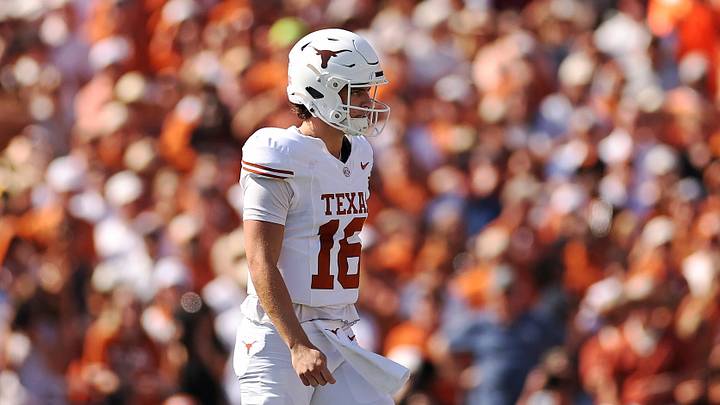
Even with just two ranked-on-ranked matchups in Week 6, we had six AP Top 25 teams go down on Saturday, including the No. 1 team in the land, the Texas Longhorns.
The two ranked matchups we did have couldn’t have played out more differently. Up in Eugene, Oregon, and UCLA both finished the game with their preseason QB3 in a matchup that had you wondering if either team is any good. Then, down in Tuscaloosa, Georgia and Alabama played another classic that had everyone dreaming of an SEC Championship Game rematch.
Is that just the difference between the SEC and the Big Ten right now? Maybe. We’re a long way from making our reservations at the Table for 12, but from the looks of it, the SEC is going to occupy nearly every open seat. That is, if the top contenders can ever reveal themselves.
1. Arch Manning had no business letting Texas lose Red River
- First course: The Longhorns’ major meltdown at the Texas State Fair
- Tasting note: A frustrating collapse from the soon-to-be-former No. 1 team still unable to reach its tantalizing potential
- The takeaway: Even with the offense sputtering, Texas had multiple chances to finish off Oklahoma, but Manning’s lack of growth and Steve Sarkisian’s undisciplined team let the Sooners hang around long enough for Brent Venables to steal one.
This isn’t a case where Texas thoroughly outplayed Oklahoma on a down-to-down basis. Oklahoma actually had a +8% net success rate edge over the Longhorns. However, if it weren’t for a blocked punt in the end zone that went for a Sooners touchdown and Arch Manning’s two ugly fourth-down quarterback interceptions, including his first-career pick-six, John Mateer and kicker Tate Sandell, who missed his third-straight field goal attempt earlier in the game, to complete their in-game redemption arc.
It’s not clear-cut to diagnose the cause of Texas’ relative offensive ineptitude for its wealth of talent, with an 18th percentile performance by success rate and 22nd percentile by EPA/play. In this game and for the season, with matchups against Ohio State, Tennessee, and now Brent Venables, the opponent has a lot to do with it. Still, without Manning’s mistakes, which led directly to Oklahoma’s last 10 points, the first of which came following a four-and-out, and three straight three-and-outs to start the second half, the Sooners don’t claw their way back into that game.
In a lot of ways, Manning has been his best when creating out of structure, but dropbacks over 2.5 seconds have also accounted for all five of his interceptions this season, including both on Saturday. His first was simply an inaccurate throw on the run. His second was a case of him either not realizing he was hot with Oklahoma sending an overload pressure to his right side, or just starting his progression on the wrong side and working back to the right too late. Either way, it’s a mistake he can’t be making at this point, and a symptom of his biggest issue: his eyes.
Arch is the best runner and rushing threat in the Manning family since Archie, which has its advantages. But it has also taught him to bring his eyes down to the rush far too early. With an elite receiving corps and a coach proven to be capable of scheming his receivers open, Manning has the second-highest clean-pocket scramble rate (11.3%), trailing only Boston College’s Mason McKenzie.
Not to over-index on the quarterback in a game Texas probably would have won if not for a roughing the passer on a double pass when Oklahoma was desperate for a spark, but his struggles are hard to ignore, and might be what holds the Longhorns back.
2. UCLA beat Oregon in all the ways it wasn’t supposed to

- Second course: Bob Chesney’s signature win
- Tasting note: An ugly rockfight of a football game with backup QBs galore won the old-fashioned way: in the trenches.
- The takeaway: There was always a path for UCLA to beat Oregon in Eugene, but that path was seemingly to win a shootout, not just behind a power run game, but with a few explosive plays from Nico Iamaelava to bail out an unproven defense. Instead, UCLA imposed its will on both sides of the ball as Dylan Raiola melted down and was benched in the Bruins 17-15 win.
While coaches like Matt Campbell, who took the job many expected Bob Chesney to wind up with in last year’s coaching carousel, still believe in multi-year rebuilds, Chesney flipped a roster that went 3-9 last year and has it looking like a legitimate College Football Playoff contender in Year 1. Maybe it’s more Curt Cignetti at Indiana in Year 1 than Curt Cignetti at Indiana in Year 2, but regardless, it’s impressive that we’re potentially seeing this kind of turnaround take place again.
But while UCLA already had its QB in place and Chesney imported plenty of talent from his CFP team at James Madison last year, including his star running back, Wayne Knight, who went for 103 yards and a touchdown on 22 carries, a team like UCLA in its first year is typically still overmatched in the trenches. Indiana was in 2024 the two times it played high-level competition.
Now, Oregon has proven itself to potentially not be high-level competition, especially not when Dylan Raiola, who was making his first start for the still-injured Dante Moore, proceeds to complete just six of his 19 attempts for 43 yards with two interceptions and a lost fumble before he was benched for Brock Thomas in the second half.
However, UCLA controlled the line of scrimmage in this game, managing just enough on the ground against Oregon’s vaunted defensive line for backup Ty Dieffenbach, who replaced the struggling and injured Iamaleava, to white-knuckle his way to the win and bottle up Oregon’s run game. A constant stream of stunts and twists allowed the Bruins to get after the quarterback, but a 27% run-stuff rate (89th-percentile) with seven tackles for loss isn’t something you can scheme your way to. Or at least it shouldn’t be against plenty of people’s preseason national championship pick.
It was ugly, but it was the win UCLA needed. Now, there’s a real chance that the Bruins will be favored in every game the rest of the way. Whether you believe in this team’s viability in the CFP or not, it is undeniably the Big Ten’s best chance of getting a third team into the field, which is far from a guarantee right now.
3. We need Round 2 of Kirby Smart’s chess match with Kalen DeBoer (and maybe Round 3)

- Third course: Georgia’s 1st win in Tuscaloosa since 2007
- Tasting note: A sweet schematic matchup between two of the best coaches and best teams in the country.
- The takeaway: After Georgia’s narrow 20-17 win over Alabama, and a horrible missed pass-interference call against KJ Bolden late, it’s hard not to feel like the Bulldogs and the Tide are the two best teams in the country, destined to meet again in the SEC Championship.
The SEC Championship Game last year notwithstanding, Kalen DeBoer seemingly always has a new offensive wrinkle to break out against Kirby Smart. Two years ago it was running Jalen Milroe from empty sets; last year it was Ty Simpson’s late-down answers for Georgia’s blitz packages. This time around, it was Alabama suddenly morphing into a spread offense after dominating with heavy 12-and-13-personnel usage for much of the year.
Spreading the field horizontally pre-snap forced Smart and Glenn Schumann to essentially declare their intentions. Are they loading the box to stop the run, or are they playing coverage? DeBoer and Grubb helped their 19-year-old phenom QB answer that question formationally. It also has the knock-on advantage of limiting Georgia’s ability to get after Russell.
The Bulldogs have a good defensive line, but the strength is on the interior with Elijah Griffin. They’ve yet to find an answer at edge, so off-ball linebackers Chris Cole and Raylen Wilson came in leading the team in pressures. Without tight ends tight to the formation or condensed wide receiver splits, it’s a lot harder to disguise where you’re blitzing from or to blitz from the secondary at all. It was a great move by DeBoer and a big reason Russell was only pressured 10 times, most of which were invited by him holding onto the ball.
Smart, of course, had a counterpunch, which is the reason Russell held onto the ball so much. With a talented and veteran-laden secondary, he and Schumann mixed coverages all night. They still blitzed at a high rate, which takes bodies out of coverage and simplified reads for Russell, who went 7-for-13 for 119 yards and a touchdown when Georgia brought five or more, but was also sacked three times. When he wasn’t blitzed, Russell went 9-for-18 for 66 yards and a sack.
Alabama can run the ball this year, so a rematch likely wouldn’t be as lopsided as last year’s was. Alabama also has Keelon Russell this year, who, despite Gunner Stockton’s impressive array of lasers he was firing all over the field on Saturday night, is the tough QB to prepare for and, as quickly as he’s learning, probably won’t get fooled twice.
4. Pitt spent big to keep Mason Heintschel, and without him, it has no answers

- Check, please: When it’s clear there won’t be a seat for you at the CFP table, it’s time to pay your check and leave
- The cost: By beating Virginia Tech last Friday, Pitt threw its hat into the ring as the potential second-best team in the ACC, but not without its starting QB
On the first drive of the game, Pitt, with backup QB Holden Geriner making his first career start, marched 75 yards down the field on a 12-play touchdown drive. And to Geriner’s credit, he marched Pitt into field goal range twice in the first half, but to start the second half, he went interception, interception, punt, as UNC took the lead, and Pitt’s offense averaged 4.35 yards per play.
Geriner is a fine backup, and Pitt is an upper-half ACC team, but it’s a team that reportedly spent $3 million to retain Mason Heintschel after his promising true freshman season. That’s not an obscene number, but it’s about a sixth of Pitt’s entire roster spend, estimated between $16-20 million.
Would Heintschel have lived up to that investment? It’s hard to say. Many of the mid-tier spending teams that paid up to keep their QBs, such as NC State with CJ Bailey and Maryland with Malik Washington, Washington with Demond Williams, or even South Carolina with LaNorris Sellers, have struggled, but Pitt was 5-0.
Was hard to imagine Pitt could keep its season afloat without Mason Heintschel.
— Josh Yourish (@JYourish3) October 10, 2026
Using On3's NIL valuations and The Athletic's roster spend estimates, he had one of the highest allocations of total resources in the country pic.twitter.com/R49pHOugCb
It certainly would have had a better chance of beating UNC, but after losing this game and looking this bad, any faint CFP hopes have been squashed.
5. Bear Bachmeier looks ready for Notre Dame

- Head of the table: The best individual performance of the week earns a seat at the head of the table
- The resume: 22/30, 329 yards, 2 TD - 9 carries, 109 yards
- The takeaway: With LJ Martin out, BYU needs Bear Bachmeier to carry its offense, and for most of his career, that’s meant his legs. But in Week 6, Bachmeier was excellent as a dropback passer, which is what he’ll need against Notre Dame.
BYU and Notre Dame both have two-game seasons. That includes their matchup next week in Provo, and after an ugly win over TCU in Week 5, Bear Bachmeier and the Cougars look ready to welcome the Fighting Irish to town. Now, Leonard Moore and that defense are a whole different animal than Iowa State, but Bachmeier may have had the best game of his career in the 24-10 Friday night win over the Cyclones, and without LJ Martin.
Bachmeier was still best with play-action, going 10 for 13 for 208 yards and a touchdown, but that doesn’t mean he was bad without it. He’s still a better runner than thrower, but with Legend Glasker’s ability to stretch the field, BYU’s offensive line, which allowed just two pressures, and Bachmeier’s newfound decisiveness, the passing game is coming along.
Bear Bachmeier Masterclass 🐻
— Big 12 Studios (@big12studios) October 10, 2026
22/30
329 PASS YDS
109 RUSH YDS
2 TD
Highlights vs. Iowa State 🎬@BYUfootball pic.twitter.com/M4AV4fKcML
You can’t beat Notre Dame as a one-dimensional team. BYU probably still is that, but leave room for teams and players to improve, and it seems as though BYU and Bachmeier are.
6. We may have to start taking Kentucky seriously at some point soon

- A seat at the bar: When all the tables are full, sometimes you can grab a seat at the bar, and maybe these emerging contenders will be seated soon
- The takeaway: After a second-straight SEC win on a two-point conversion in the first overtime, beating No. 10 LSU 35-34, Kentucky is 5-1 with three conference wins, and no Georgia or Texas left on the schedule.
Here’s the thing about Kentucky: Will Stein just is that dude. On top of converting a two-point conversion in the first OT — which is the correct decision to attempt, by the way — for the second straight week, he schemed his way to matching Lane Kiffin and LSU’s offensive production all game.
A +7 turnover margin on the season has undeniably helped Kentucky reach 5-1; even if LSU’s two turnovers led to zero Kentucky points, with a turnover on downs and a missed field goal following both. The underlying metrics, such as ranking outside the top 25 in net points per drive and net success rate, say this team is merely good and not a legit CFP threat.
Still, you can’t take this team lightly. The run game is elite, with over a 50% success rate on the year, and when CJ Baxter can deliver the explosiveness he did from Play 1 vs. LSU, the Wildcats will be tough for most SEC teams to beat.
Kentucky averaged 7.3 yards per carry on 1st down in this game and 0.21 early-down EPA/play. Kentucky is No. 2 in early-down EPA/rush to UCLA and No. 8 in early-down EPA/play. A lot of that is Stein, because last year, Oregon ranked No. 10 and No. 18 by those metrics.
7. Wake Forest is the ACC’s second-best team

- A seat at the bar: When all the tables are full, sometimes you can grab a seat at the bar, and maybe these emerging contenders will be seated soon
- The takeaway: Jake Dickert’s Demon Deacons improved to 5-1 with a 38-14 win over NC State in Week 6, and with Gio Lopez and Carlos Hernandez balling, Wake Forest, not SMU, is the ACC’s best shot at putting a second team in the CFP
Through Week 6, Gio Lopez is No. 4 in the country by EPA/dropback at 0.42. Keeping him company in the top five are Julian Sayin, Darian Mensah, Josh Hoover, Jayden Maiava, and CJ Carr. His No. 1 receiver, Carlos Hernandez, who hauled in 12 of Lopez’s 26 completions for 117 yards and a touchdown on Saturday, ranked No. 6 in the country by yards per route run behind Jeremiah Smith, Oregon State phenom Jesse Legree, Malachi Toney, Nick Marsh, and Cayden Lee. They are the only six receivers over 4.00 yards per route run.
Wake Forest is No. 16 by adjusted EPA/play with a 75th percentile explosive play-rate and a 94th percentile late-down success rate, a credit to Lopez’s resurgent season unshackled by Bill Belichick and Freddie Kitchens. Wake gave Miami the closest thing to a game it’s had all season, and might just be meeting the Hurricanes again in Charlotte.
8. Indiana DC Bryant Haines is still one of the best in the country

- Heimlich Maneuver: Sometimes a CFP contender chokes on their food, but the best teams know the Heimlich
- The choking hazard: Indiana couldn’t impose its will on Nebraska, and without a run game, the Cornhuskers mounted a valiant upset bid in a 20-17 Hoosiers win.
It’s hard to say if this game was Indiana struggling with an inferior opponent, Nebraska legitimately leveling up, or maybe even just two teams somewhere from 15th to 30th best in the country. Regardless, these two teams looked evenly matched on the field, but on the chalkboard, as is almost always the case, the Hoosiers had the edge.
Nebraska offensive coordinator Dana Holgersen was in his bag early, and QB Anthony Colandrea was seemingly confirming concerns that mobile QBs like Tayven Jackson and Aidan Chiles, who gave the Hoosiers problems this season, are IU’s kryptonite. Then, Indiana defensive coordinator Bryant Haines, the reining Broyles Award winner, found an answer:
Indiana may not be quite as good as it was last year, but it always has the coaching edge. DC Bryant Haines had an incredible plan for Anthony Colandrea's mobility in the 2nd half. pic.twitter.com/7OcsoQFrmW
— Josh Yourish (@JYourish3) October 10, 2026
9. Florida’s offense is broken, and it’s not entirely clear why
- Bad spill: It’s not a party until somebody spills, and these teams might need a change of clothes after their major mishaps
- The mess: Florida looked like a wagon through the first four weeks; now the wheels are completely off, with Texas and Georgia ready to deliver a CFP knockout blow the next two weeks
Florida’s defense is clearly a work in progress, but after the Gators took down Ole Miss in Week 4, it appeared that the offense was good enough to carry it to CFP contention. The defense is still the biggest problem. South Carolina went 10/16 on third down, including converting five of its seven attempts on third-and-nine or longer. That’s unacceptable, but the reason for concern is more on offense because that unit and its star running back have plummeted back to earth.
Jadan Baugh | 1st 4 games | Last 2 games |
|---|---|---|
YPG | 150 | 36 |
YPC | 7.2 | 2.7 |
TDs | 11 | 1 |
It’s not just the run game. Florida’s passing game hasn’t been nearly as effective either. The absence of Vernell Brown III may explain some of that, but when it’s not exactly clear what the issue is with a struggling offense, it’s usually the offensive line. In this case, I’d say that holds true.
Aaron Philo was only pressured on seven of his 34 dropbacks, but was sacked three times, averaged 3.8 yards per attempt, and threw an interception. Left tackle Bryce Lovett allowed three pressures, and right tackle Emeka Ugorji allowed four pressures and two sacks before he was replaced by Caden Jones. South Carolina star edge rusher Dylan Stewart accounted for two pressures and a sack and posted a 23.5% pass rush win rate.
Florida has shown too much good to write off completely, but with Texas and Georgia up next, it’s probably over for the Gators.
10. Iowa’s offensive explosion doesn’t erase its underlying issues

- Hors d’oeuvres: A little something to chew on from the week that was in college football
- Nutrition facts:
- Iowa came into Week 6 No. 120 in rushing success rate (36.1%) and No. 115 in explosive rush rate (4%)
- In Week 6, Iowa posted a 53% rushing success rate with 263 rushing yards, but just a 3% explosive rush rate
This is not the Iowa offense of 2023 that required former offensive coordinator Brian Ferentz to have a 25-point-per-game ultimatum in his contract. No, under Tim Lester, the Hawkeyes are respectable on that side of the ball and, at times, have even been good. But a 41-point outburst with quarterback Jeremy Hecklinski, who replaced the injured Hank Brown for a 41-24 Week 6 win, doesn’t mean this offense is great.
Hecklinski was hyper-efficient, doing most of his work off play-action in a favorable game script as the Hawkeyes built a 27-0 lead in the first half, going 11/12 on 12 dropbacks with play-action for 166 of his 202 passing yards and two of his three touchdowns. The dropback game is still far from elite, and while the Hawkeyes ran it well on a down-to-down basis against a Huskies defense that looked deflated after last week’s loss to USC, the explosiveness still isn’t there.
Iowa has not run it well down-to-down against bigger, physical Big Ten defenses (42% success rate vs. Ohio State and 23% rushing success rate vs. Michigan). So, you need to be explosive, and though Kamari Moulton put up big numbers and had a 56-yard touchdown run, there just isn’t enough juice in that backfield to change my opinion on Iowa. This offense is respectable, not quite good, so the defense needs to be elite, and it simply has not been.
11. Missouri’s run defense might be elite, but it needs another test

- Hors d’oeuvres: A little something to chew on from the week that was in college football
- Nutrition facts:
- Missouri has allowed 71 rushing yards over the last two weeks (Florida and Texas A&M)
- FLA and A&M managed 11 combined successful runs and a 28.6% rushing success rate
- Texas A&M finished with 55 sacks-adjusted rushing yards, averaging 2.75 yards with just 1 tackle for loss
Missouri lost most of its defensive line from last year, including its No. 1 edge rusher, Damon Wilson II, who transferred to Georgia. Still, Corey Batoon has this unit rolling. Daeden Hopkins has easily replaced Wilson, though he wasn’t the star in Missouri’s dominant 27-6 win over Texas A&M on Saturday.
Linebacker Nicholas Rodriguez, a homegrown junior, was all over the field with 13 tackles, 0.5 sack, and 1.5 tackles for loss. Last week, this run defense dominated Florida. That appeared to be a monumental task, but a week later, South Carolina stifled the Gators. This week, Missouri stonewalled Texas A&M, which ranked No. 9 in rushing success rate coming in. Still, it’s worth wondering if this run defense is merely great or if it's elite enough to carry the Tigers to the CFP. Facing Kewan Lacy and Ole Miss next week could provide an answer.
12. Boise State and Oregon State are on a collision course
- Kid’s menu: The CFP saves one spot at the big kids’ table for the Group of Six
- The takeaway: Boise State escaped Fresno with a 38-31 win, while Oregon State pounded San Diego State 66-14 as the Broncos and the Beavers separate themselves for the G6 bid.
UTSA beating USF positions the Roadrunners as the Americans' best chance of representing the Group of Six in the CFP this year, but in a week when James Madison finally had a scare, beating Georgia Southern 27-24 on the road, and North Dakota State took its first loss as an FBS team, falling to UNLV 13-7 in Sin City, the G6 bid looks more and more like it will be decided between Boise State and Oregon State, which play head-to-head on the Smurf Turf in Week 11.
 Add us as a preferred source on Google