
In my eyes, Week 7 of the 2026 college football season feels like a meaningful signpost in the history of the sport. It the week when the 24-team College Football Playoff became officially inevitable, and it delivered the exact type of results on the field that could justify that decision.
The sport is flattening at the top with NIL, revenue-sharing and the transfer portal; we’ve been saying that for a few years now. This is what it looks like: Half of the AP top-10 teams losing on a college football Saturday, including No. 1 and No. 2, two of them to unranked teams (and nearly a third; we saw that, Miami).
Two years ago, we were in awe of Ohio State’s “$20 million roster.” This year, there are 28 teams with a high-end estimate at or above $30 million. That includes Florida (which upset Texas in Austin), Auburn (which upset Georgia in Athens) and Florida State (which gave Miami a scare). The power has consolidated. So while it looks like we don’t have any great teams, we may have more good teams than ever — and we may need to recalibrate our expectations for the teams we regard as championship contenders.
I don’t like the 24-team Playoff, but it was created as an incentive for those mid-tier programs to keep spending like serious contenders, to have more Saturdays like this one. How good that is for the sport is unclear, but it feels like where we’re heading. Is the chaos only chaos because of the stakes?
1. Indiana and Ohio State both have problems; only one team has Jeremiah Smith
- First course: Ohio State’s costly revenge
- Tasting note: A classic game of chess-boxing between Ryan Day and Curt Cignetti with two quarterbacks who never quite settled in
- The takeaway: While they’re clearly the class of the Big Ten, Indiana and Ohio State both look meaningfully worse than last season, and with Julian Sayin out, the value of the best player in college football will truly be tested.
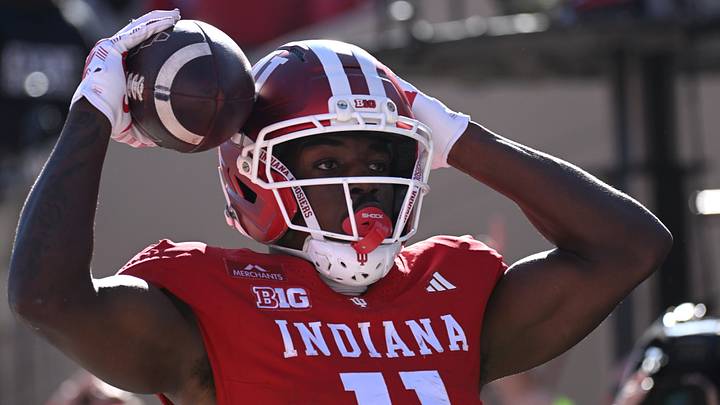
Chaos Saturday began in Bloomington with the biggest game in the history of Memorial Stadium, which ended with Indiana star wide receiver Nick Marsh failing to get his foot in bounds on what would have almost certainly been the game-winning touchdown for the Hoosiers. The rematch of last year’s Big Ten title game also saw Ohio State QB Julian Sayin go down with a right arm injury that will probably keep him “out for several weeks,” according to Ryan Day in his postgame presser.
That injury thrust 2026 three-star Luke Fahey into the game, not 2025 five-star Tavien St. Clair, and completely stalled out an Ohio State offense that scored its only second-half touchdown courtesy of a 38-yard prayer from Sayin to Smith just prior to his exit, the epitome of an “F it, 4 down there somewhere” play.
And regardless of who is playing quarterback for Ohio State, while it’s simultaneously true that Sayin has struggled his last four times against quality defenses and his loss has a massive impact on the Buckeyes’ potential range of outcomes this season, No. 4 is still going to be down there somewhere.
A season ago, Indiana defended Ohio State primarily how it defended everyone else, by playing base defense with a zone-heavy approach on the back end and leaving D’Angelo Ponds one-on-one into the boundary. Yes, even against Smith. Without Ponds, however, defensive coordinator Bryant Haines double-teamed Smith on nearly every snap and still managed to hold the Buckeyes to 4.0 yards per play on every play that wasn’t a target to Smith.
Haines is a master of resource allocation, and while Ohio State OC Arthur Smith began to strain him with Sayin bootlegs — which, with two defenders committed to Smith and one committed to the quarterback, dared Indiana to stop the run playing largely 9-on-10 — he pulled off the balance act.
The biggest problem for Haines and Curt Cignetti, aside from a few very un-Indiana-like penalties and the team’s first lost fumble since Week 1 of 2025 (a truly unfathomable stat), was that they didn’t have Fernando Mendoza to win the rock fight they created. QB Josh Hoover took a long time to settle in, and even against a lifeless Ohio State pass rush, he completed just half of his 40 attempts as the offense slogged to a 38 percent success rate — one week after posting a 32 percent success rate against Nebraska.
Granted, Indiana was about half of Marsh’s foot away from winning this game and extending its 22-game win streak, but it doesn’t quite look the part of a true national title team, and with Sayin out for an extended stretch, Ohio State, which will probably jump to No. 1 in this week’s AP Poll, hardly feels bulletproof. No. 4 being down there somewhere can cover up a lot of holes. We’ll find out if it can cover up a hole at the most important position on the field.
2. Alabama’s offense is capable of much worse than seemed possible

- Second course: Jim Knowles' masterpiece
- Tasting note: A cigar-smoke-filled Third Saturday of October in Knoxville after a 26-10 Vols win
- The takeaway: When SEC head coaches talk about how relentless the schedule is and the body blows accumulating, Alabama and Georgia’s Week 7 losses are precisely what they’re talking about. As annoying as it may be, they do kind of have a point.
Even with last week’s slugfest loss to Georgia on the books, Alabama entered Week 7 ranked No. 4 in the country with a 52.5 percent offensive success rate and a No. 8 ranking in explosive play rate at 10 percent. Against Tennessee, Alabama produced just one explosive play with a 33 percent success rate, allowing pressure on Keelon Russell on 42.1 percent of his dropbacks with five sacks and 10 tackles for loss.
The Crimson Tide, which had found a reliable run game but was without starting center Racin Delgatty after the loss to Georgia, was stuffed on 24 percent of its carries. The discrepancies between the rest of the season and Week 7 are jarring to see.
Alabama | Week 7 vs. Tennessee | Season |
|---|---|---|
Success rate | 33% | 52.5% |
EPA/play | -0.39 | 0.17 |
EPA/Dropback | -0.36 | 0.26 |
Explosive play% | 2% | 10% |
Russell didn’t play well, the offensive line wasn’t the same without Delgatty and the wide receiver room doesn’t have the same pop without Ryan Coleman-Williams, who also missed the game with injury.
The question coming out of the game is: Was this an instructive performance from Alabama and a valuable data point going forward against a defense with an elite interior penetrator in Xavier Gilliam and a veteran defensive coordinator who clearly confused a 19-year-old quarterback, or is this purely a product of the Crimson Tide playing the most physical game we’ve seen this entire season seven days ago in Tuscaloosa, when they looked every bit a national title contender?
The fact that Georgia also laid an egg, to me, points to the body blows theory. It’s just really hard to imagine this is what Alabama is without Delgatty and Coleman-Williams, but it could be. Knowles has the defense rolling in Knoxville, DeSean Bishop can clearly carry the load and even without much confidence in the QB, Tennessee is firmly in the CFP race.
3. Kalani Sitake and BYU pack a pretty big punch
- Third course: BYU’s statement win over Notre Dame in Provo
- Tasting note: A hard dose of reality for a Notre Dame team that looked poised to roll its soft schedule
- The takeaway: BYU was outclassed by Texas Tech the two times it played the Red Raiders in 2025. This time around, Kalani Sitake’s top-10 Cougars look to have closed the gap with an improved QB, a bold game plan and a controversial 28-24 win.
With true freshman Bear Bachmeier looking his age last year, BYU turtled in the Big 12 Championship Game. They couldn’t block Texas Tech, so Bachmeier averaged 2.12 seconds per dropback and 2.9 yards depth of target. He still managed to be pressured 12 times, got sacked twice and threw two interceptions.
This time around, BYU refused to call the game scared. Kalani Sitake pulled out all the trick plays to mixed results (what was that fake punt?) and threw the biggest punch he could. I’m not sure anyone knew how much power he’d have behind it.
Bachmeier wasn’t sacked once despite his 2.50-second average time to throw, still quick but more functional, and 7.2-yard ADOT. He, like Sitake, was rewarded for his aggressiveness against a defense that, despite losing its best pass rusher, Boubacar Traore, on the fifth play from scrimmage to a targeting penalty, is loaded with talent.
BYU didn’t just attack downfield with an impressive dropback performance from Bachmeier, who is legitimately growing as a quarterback (something we tend to forget to allow players to do). It also overwhelmed Notre Dame’s defense with multiple reads on just about every play, leveraging Bachmeier’s mobility with a constant stream of option plays out of every conceivable formation, including a Bachmeier touchdown run out of the single-wing.
The Fighting Irish are trouble 👀
— ESPN College Football (@ESPNCFB) October 18, 2026
Bear Bachmeier makes it a two-score game vs. No. 2 Notre Dame 🍿 pic.twitter.com/WkMM5mRCU9
Ultimately, the difference in the game was the red zone, where BYU went 4-for-4, converting its trips into touchdowns, as Bachmeier ran for two, threw one and even caught one. Notre Dame settled for field goals from the BYU 13-yard line and the BYU 21-yard line, turned the ball over in the red zone just before half when CJ Carr fumbled a spike attempt and then threw incomplete into the end zone on the final sequence of the game.
Between the fumbled spike, which was overturned on replay, and the final play of the game — which included a blatant missed pass interference call and a second left on the clock that the officials somehow didn’t see — Notre Dame has every right to feel like it should have won this football game.
4. Conner Weigman gives Houston a Big 12 title ceiling

- Head of the table: The best individual performance of the week earns a seat at the head of the table
- The resume: 24/33 343 yards, 5 TD, 1 INT, 11 rush, 52 yards
- The takeaway: Houston came a few inches from upsetting Texas Tech earlier this season. Now, after holding off Drew Mestemaker and Oklahoma State in a 35-32 win, the dream of a trip to Dallas and potentially the CFP is still alive.
Conner Weigman was once a trendy name in NFL draftnik circles heading into his third season at Texas A&M. Now a fifth-year senior, he’s finally put it all together. Weigman attacked all night, averaging 14.2 yards per completion with four completions over 15 yards downfield for 111 yards. He largely stayed away from the middle of the field but aggressively threw into tight windows outside the numbers and displayed impressive touch and ball placement downfield.
Conner Weigman goes DEEP to Trent Walker 🎯 pic.twitter.com/GHyCBiYgN3
— FOX College Football (@CFBONFOX) October 18, 2026
His 0.65 EPA/dropback is a 94th percentile performance, but maybe more impressive is a 63 percent passing success rate on 37 dropbacks with a 10.2 average depth of target. That’s a rare blend of aggressiveness and efficiency in one quarterback performance.
Probably most impressive, still, is Weigman’s 70 percent passing success rate on third and fourth down, including four of his five touchdowns. As a team, Houston generated 0.91 EPA/play on late downs. That’s nearly a full expected point every time Oklahoma State got Houston into third or fourth down situation.
5. Miami dodged Florida State’s best shot
- Heimlich Maneuver: Sometimes a CFP contender chokes on their food, but the best teams know the Heimlich
- The choking hazard: An in-state rival with a hot-seat head coach (Miami 43, FSU 35 in 2OT)
Florida State rolled over after a hot start against Louisville in Week 6. Quitting has seemingly been a trend under Mike Norvell since 2023, and it’s one of the biggest reasons he’s on the hot seat despite a lofty buyout and an athletic department far too dysfunctional to comfortably take it on. But the Seminoles never waved the white flag at Hard Rock Stadium on Saturday night.
Miami’s offense was efficient, despite scoring just 14 points in regulation, and Malachi Toney turned it on with 11 catches for 154 yards and two touchdowns. But Florida State kept punching back against a Miami secondary that has been ravaged by injuries throughout the first half of the season.
Miami | Week 7 | Season |
|---|---|---|
Explosive play % allowed | 11% | 4% |
Explosive pass % allowed | 16% | 5% |
Stuff rate | 3% | 22% |
Opponent success rate | 35% | 39.1% |
The explosives killed Miami. Particularly courtesy of Duce Robinson, who nearly matched Toney with five grabs for 113 yards and two scores. Down-to-down, it had a +14% net success rate edge, right in line with its season-long mark that ranks No. 3 in the country. This team is probably fine; just rivalry-game weirdness and a deep-ball heater from FSU QB Ashton Daniels that could have burned the Canes one more time if not for a phantom hold that negated a double-OT touchdown.
6. Steve Sarkisian’s reevaluation should start in the mirror

- Bad spill: It’s not a party until somebody spills, and these teams might need a change of clothes after their major mishaps
- The mess: Florida’s defense was supposed to be the get-right for Texas’s offense, but it was the other way around in a 27-24 Gators win in Austin.
Florida’s defense entered Week 7 ranked No. 115 in EPA/dropback defensively and No. 117 in explosive pass rate allowed. Texas walked out and marched down the field on a seven-play, 75-yard touchdown drive. Then, the Longhorns didn’t score another offensive touchdown until the penultimate drive of the game.
Per fourthandshort, Texas is No. 2 in success rate differential between scripted drives and all others at a staggering 10.2 percent, and inside the top 20 in points per drive differential. That points to Steve Sarkisian, who postgame told reporters he was going to evaluate “everything” about his offense.
Against one of the most porous passing defenses in the country, which allowed five touchdowns on throws over 20 yards downfield, Texas attempted just six throws over 10 yards downfield. The lone pass over 20 yards downfield Manning completed came out of structure late in the game; 10 of Manning’s 20 attempts were at or behind the line of scrimmage. Texas finished with just two explosive passes and -0.06 EPA/dropback.
Prior to Week 7, the lowest EPA/dropback by a Power 4 QB against Florida’s defense this season was 0.15 by Florida Atlantic’s Caden Veltkamp. That, of course, points to Manning as the problem.
Benching Manning would be justified, but not before Sarkisian gives up play-calling duties, because Manning isn’t the only physically talented quarterback Sark has failed to maximize.
7. Georgia isn’t good enough for Gunner Stockton to mess around
- Bad spill: It’s not a party until somebody spills, and these teams might need a change of clothes after their major mishaps
- The mess: Gunner Stockton tried to make the back-breaking mistake against Alabama, and he finally did it in a 27-24 loss to Auburn.
Gunner Stockton deserves credit for being the quarterback who authored a lights-out 13-play, 94-yard game-tying touchdown drive late in the fourth quarter against the Tigers. It was everything that makes Stockton hard to resist: tough running, tight-window throws and an almost undeniable clutch gene. Then, with a chance to win it inside the final two minutes, Stockton ran into his center, Drew Bobo, and fumbled — his third turnover of the game — to set up Auburn’s game-winning field goal.
It was Stockton’s first two-interception game of his career and by far his worst game of the season. It’s also a loss that came with the deck relatively stacked against him, with the Dawgs missing key pieces on both sides of the ball to injury after a war against Alabama.
But this is also a team that put the ball on the ground four times last week against the Tide and lost none of them, and a quarterback who tried to throw another interception in that game. This performance is almost harder to write off than Alabama and Russell’s dud in Knoxville. Georgia outgained Auburn, had a net success rate edge of 11 percent and Stockton gave it away with his turnovers against a much worse opponent than the Tide dealt with.
Both teams get a mulligan, but Stockton doesn’t have the ceiling of Russell, who at his best has been the best quarterback in college football. That means he can’t have this type of floor.
8. Missouri can’t give Austin Simmons enough help with the ground game

- Bad spill: It’s not a party until somebody spills, and these teams might need a change of clothes after their major mishaps
- The mess: Missouri still has opportunities for resume-building wins left, and its win over Florida looks much better after Week 7, but losses to both sides of the Egg Bowl will be difficult to overcome.
Typically, this category is reserved for a team that lost as a favorite. Missouri didn’t do that, but the nature of its underperformance against Ole Miss earned it the distinction anyway.
Defensively, a lack of pressure on Trinidad Chambliss is a concern for a defensive line that is a significant strength for this team. However, the bigger concern is on the other side of the ball — as, despite Jamal Roberts' impressive numbers this season, Missouri desperately missed Ahmad Hardy, who tragically has been unable to play so far this season after suffering a gunshot wound this offseason.
With Roberts leading the way, Missouri has a 10th percentile explosive rush rate, ranking No. 121 in the country at 4 percent. In each of its losses this year, Mizzou has failed to record a single explosive rush. On Saturday, Roberts was held to 39 yards on 20 carries.
9. LSU’s YAC passing game may not be sustainable
- Hors d’oeuvres: A little something to chew on from the week that was in college football
- Nutrition facts:
- Sam Leavitt attempted one pass over 20 air yards in Week 7, a 17-yard touchdown pass to Jackson Harris
- Leavitt didn’t attempt a single pass over 10 yards downfield outside the numbers in Week 7
- Leavitt went 12-for-14 for 131 of his 276 yards on throws 0-10 yards downfield and between the numbers
- 188 of Leavitt’s 276 passing yards came after the catch, the most YAC LSU has generated this season
The big question about the construction of the LSU offense this offseason was who would be the downfield, outside-the-numbers threat in the passing game. The answer, right now, with tight end Trey’Dez Green out, is nobody.
Everything is between the numbers, where Leavitt is most comfortable attacking defenses and where this receiving group can win. Jackson Harris was ideally the best fit as the big-bodied X-receiver LSU is missing, but even he is winning primarily on in-breakers, with 71 percent of his targets coming between the numbers.
This style of passing game will run up against its limitations, but against Kamrio Taylor-less Mississippi State, LSU managed a 67 percent passing success rate.
10. Bob Chesney won’t let Ty Dieffenbach sink the UCLA ship

- Hors d’oeuvres: A little something to chew on from the week that was in college football
- Nutrition facts:
- UCLA went 13-of-20 on third down but faced just four third-and-longs (9+ yards)
- UCLA went 6-of-6 on third-and-4 or less
- Dieffenbach went 8-of-13 for 150 yards (11.5 YPA) on third down
- Dieffenbach was pressured 16 times and sacked just once (6.3 pressure/sack%)
UCLA is the lone undefeated team standing between the Big Ten and the SEC. With Nico Iamaleava out for the season, that sixth win didn’t come easy, outlasting Wisconsin 17-7 at the Rose Bowl. Backup Ty Dieffenbach, however, was entirely serviceable for a UCLA offense that didn’t put him in difficult situations.
Yet, even when he faced third downs, obvious passing situations or pressure, he put his offense in positions to succeed. Avoiding sacks was critical for a run-first offense that needs to stay ahead of the chains. The coaching staff found Dieffenbach a lot of open throws, and he hit them consistently. It was everything you could ask for from a backup QB in a sport where nobody has a serviceable QB2, even the one team up in Eugene that paid for it.
11. Will Stein gives Kentucky a chance every week
- Dessert: Whether it’s a rich play design or a decadent athletic display, here’s a sweet football treat
- Tasting note: A formational masterpiece for one of the game’s best play-callers
For my money, there isn’t a better play-caller in college football right now than Will Stein. There also isn’t anyone better at breaking that down than Dan Casey, so I’ll cede the floor.
This is some nasty stuff from Kentucky 👌 pic.twitter.com/oPnVfgF9ZN
— Coach Dan Casey (@CoachDanCasey) October 18, 2026
12. Meep Meep

- Kid’s menu: The CFP saves one spot at the big kids’ table for the Group of Six
- The takeaway: UTSA is the new favorite in the American.
I went and saw Coyote vs. ACME, which was an exceptionally fun movie with an especially timely message about corporate tyranny. But it struck me as odd that the roadrunner was described as saying “beep beep”, not “meep meep”, because that just seemed incorrect. For the UTSA Roadrunners’ purposes, I will be saying meep meep going forward.
And with Memphis and Florida Atlantic both losing, we should all be saying meep meep, because the American has cleared out for the Roadrunners and quarterback Owen McCown, who threw for 359 yards and three touchdowns in the 38-34 win over a remarkably underwhelming Navy team.
The G6 race has primarily been focused on the Pac-12 — and with Boise State and Oregon State rolling, justifiably so — but the Roadrunners are firmly in the mix as well.
 Add us as a preferred source on Google