
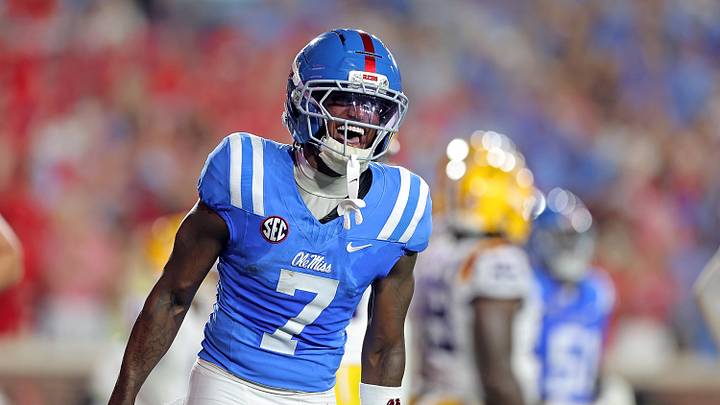
Each week, Table for 12 serves up the results, performances and plot twists shaping the College Football Playoff picture.
The Magnolia Bowl is one of college football’s great rivalries, but Lane Kiffin may have given it a spot in the pantheon. It’s hard to generate such a visceral reaction from 70,000 people for the entire duration of a football game, let alone the hours before for early-morning tailgates and College Gameday on The Grove. Kiffin does that.
Kiffin’s betrayal will be adjudicated continually until the end of his coaching career, but Week 3 in Oxford, Pete Golding, Trinidad Chambliss and the fans inside a packed Vaught-Hemingway Stadium delivered their verdict: “Hotty ******* Toddy!”
1. Trinidad Chambliss made Lane Kiffin wrong on his LSU bet
- First course: A Trinidad Chambliss special
- Tasting note: Temper burned hot and revenge was served cold in Oxford on Saturday night.
- The takeaway: Kiffin took almost everything he wanted from Ole Miss to LSU, but he couldn’t get the one thing he most needed: Chambliss. And his former QB made him pay all night in a 32-24 win for the No. 8 Rebels over the No. 7 Tigers.
Kiffin left Ole Miss for LSU because he believed he had a better chance of winning a national championship in Baton Rouge, with institutional support that extends to the governor of the state and one of the best in-state talent pipelines in the country. Historically, he’s right: You do have a better chance to win a national championship at LSU. But in the modern era, he may have given up the best chance he’d ever have by walking away from Chambliss.
NIL, revenue-sharing and the transfer portal have flattened the top of college football. Even with a few teams, including LSU, outspending the rest, the gap between the best and the rest is considerably smaller than it was when Nick Saban and Dabo Swinney were hoarding all the five-star talent in the 2010s. With those thinner margins, truly great players can more easily serve as the rising tide lifting their program to greatness, as Fernando Mendoza did a year ago.
This season, Chambliss is that player. It was on display in Week 1 against Louisville, and in Week 3, he staked his claim as the best player in college football with a masterful performance with the highest possible regular-season stakes. Chambliss’s anticipation, accuracy and ability to throw off-platform are all elite. His composure is otherworldly and probably the biggest difference between he and Sam Leavitt, Kiffin’s consolation prize.
While Leavitt couldn’t reset his feet in the pocket to hit his wide-open tight end for a potentially game-tying touchdown on third-and-goal in the waning seconds, Chambliss was nails in every big spot: 10-for-11 for 129 yards and seven first downs on third down and 7-for-9 for 62 yards with the game-winning rushing touchdown in the fourth quarter.
Chambliss is a much more polished quarterback than his counterpart, more of a twitched-up athlete with a propensity to turn the game into backyard football; Chambliss was even better than him at his own game.
Week 3 | Chambliss under 2.5 sec | Leavitt under 2.5 sec | Chambliss over 2.5 sec | Leavitt over 2.5 sec |
|---|---|---|---|---|
DB | 31 | 16 | 23 | 19 |
Comp/Att | 22/30 | 12/16 | 11/19 | 4/11 |
Yards | 195 | 110 | 168 | 48 |
YPA | 6.5 | 6.9 | 8.8 | 4.4 |
TD/INT | 0/1 | 0/1 | 2/0 | 1/0 |
Rating (NFL) | 76.4 | 67.2 | 122.3 | 80.9 |
Whether it’s John David Baker or Charlie Weis Jr. calling the plays, this Kiffin-inspired offense will give the quarterback a lot of easy answers, but what you do outside of that structure is the differentiator. Leavitt was additive as a scrambler, but Chambliss consistently makes throws like this one, which made me stand up and declare to no one in particular that I don’t care how tall he is: Trinidad is worthy of a top-10 pick in the 2027 NFL Draft.
TRINIDAD CHAMBLISS ARROGANT ARM pic.twitter.com/PiN89NJRIM
— NFL Draft Files (@NFL_DF) September 20, 2026
2. Texas Tech has too much talent for Houston and the rest of the Big 12
- Second course: Lubbock’s special spicy tortillas
- Tasting note: The tortillas flying in Lubbock this year are just a little bit spicier with all of the Red Raiders' explosive playmakers.
- The takeaway: No. 13 Texas Tech is far from perfect and didn’t get the same return on its investment in Year 2 of Cody Campbell’s spending spree, so Joey McGuire’s coaching staff may need to go deeper into its bag. But on Friday night, the talent gap was still big enough to hold off No. 22 Houston 28-26.
There’s one team in the Big 12 that is spending like a serious national title contender, and that’s Texas Tech. According to The Athletic’s NIL report this week, this Red Raiders roster is estimated to cost between $38-42 million, which is nearly double TCU, the second-highest spender in the league.
However, unlike many of the other most robust NIL operations in the country, like Alabama, USC and Tennessee — a few of the programs clustered around Texas Tech — the investment in Lubbock is very recent, largely centered around activating super-booster Cody Campbell heading into the 2025 season. That means Texas Tech is more heavily reliant on the transfer portal than most other contenders, and that it is, at least until the talent pipeline fills with young talent, more subject to year-over-year volatility.
This year’s transfer portal haul is good, but it doesn’t include three Day 2 NFL Draft picks along the defensive line, including the No. 2 overall pick. So, the same low-blitz rate approach isn’t working nearly as well, and because of that, the defense is indisputably taking a step back. Losing Jacob Rodriguez at linebacker hasn’t helped either.
The thing is, when your roster costs almost double the next most expensive in the conference, your margin for error is so wide. This year, it looks like the offense can carry this team, even without Brendan Sorsby at quarterback. The coaching staff needs to get more imaginative on both sides of the ball, but even when they’re outcoached, as they were on Friday night, more often than not, it’s not going to matter. This play sums it up perfectly:
Loved this pressure from Houston against Texas Tech.
— Josh Yourish (@JYourish3) September 19, 2026
Manufacture the one-on-one with the RB and get the quick pressure on Will Hammond. Kenny Johnson just makes it not matter.
Red Raiders skill players are its biggest separator this year. pic.twitter.com/1JwFmTHi0R
There are far too many playmakers on the Texas Tech offense for most Big 12 defenses to handle. Houston had the perfect pressure package, and wide receiver Kenny Johnson made them wrong. Will Hammond averaged 9.5 yards per attempt with a 14-percent explosive pass rate.
3. Jeff Brohm and Louisville leveled up with Lincoln Kienholz
- Third course: A big Louisville win in a pseudo-CFP elimination game vs. SMU
- Tasting note: An electric talent is reviving the CFP hopes that seemed to slip away in Week 1.
- The takeaway: Jeff Brohm is the sport’s most underrated QB whisperer, but he’s never had the ear of a talent like Lincoln Kienholz. With Brohm’s system and Kienholz’s problem-solving, the No. 23 Cardinals have proven they can score with any team in the country, beating No. 19 SMU 41-31.
Jeff Brohm can make a viable quarterback of just about anyone, but taking Miller Moss last year, who didn’t work out under Lincoln Riley at USC, was a Dion Waiters-level heat check, and it just never clicked. This year, rather than a retread, Brohm went for a high-ceiling first-year starter, adding Lincoln Kienholz from Ohio State. And through three weeks, it’s pretty clear why Julian Sayin had such a tough time beating him out last offseason.
Kienholz is far from a finished product. He’s not comfortable sitting from the pocket or reading through progressions, which is exactly what Brohm is for. He is, however, a dynamic athlete, which Brohm has really never had. Kienholz went just 14-for-27 for 117 yards and two touchdowns, with 42 yards and a touchdown on 12 carries. Those numbers don’t jump off the page, but Kienholz’s problem-solving ability jumps off the screen.
Jeff Brohm went out and got himself a problem solver in Lincoln Kienholz. That combination can score with any team in the country. @TheBigRedLouie pic.twitter.com/gXPWTwAlx8
— Josh Yourish (@JYourish3) September 20, 2026
Multiple times, SMU had Kienholz dead to rights; nearly every time, he turned it into a positive play. He wasn’t sacked once, has just a 14.9-percent pressure-to-sack rate this year and has one throwaway all season.
Brohm is going to scheme a lot up. Even last season with Moss at QB, the Cardinals had a good early-down offense. But the explosive plays in the passing game were gone, and the out-of-structure playmaking was non-existent. Kienholz elevates what Louisville has always done well while providing an element of problem-solving it hasn’t had.
Louisville Offense | 2025 (Miller Moss) | 2026 (Lincoln Kienholz) |
|---|---|---|
Early-down EPA/play | 0.11 (42nd) | 0.24 (31st) |
Late-down success rate | 40% (113th) | 44% (61st) |
Explosive pass rate | 7% (101st) | 9% (57th) |
That’s scary, and why, even with a shaky secondary and a troubling problem with penalties, Louisville is the biggest threat to Miami in the ACC. It's also why I’m irresponsibly high on this team.
4. Alabama QB Keelon Russell
- Head of the table: The best individual performance of the week earns a seat at the head of the table.
- The resume: 23/30 320 yards, 3 TD, 3 rush, 56 yards, 1 TD
- The takeaway: Keelon Russell is the five-star QB we’ve been waiting for. The game is slowing down for the No. 2 QB in the 2025 class, and after his performance in No. 10 Alabama’s 50-36 lightning-delayed win over Florida State, he might already be a top-5 quarterback in the country.
Nico Iamaleava, Jackson Arnold, DJ Lagway, Dylan Raiola, Bryce Underwood: It’s not unanimous, but it feels like most of the five-star quarterbacks who see the field early in their careers are struggling to adjust to the college game. A few have failed outright, and even guys like Dante Moore and Arch Manning needed some additional seasoning. Russell sat his true freshman year in 2025, but he won the job over Austin Mack in fall camp. Three weeks in, he’s as good as advertised (and maybe even a little better).
Russell is an elite athlete; he showed as much on his 57-yard touchdown run on Saturday. But the primary way he uses athleticism is to buy time in the pocket or create outside of it to push the ball downfield. He’s drawn Jayden Daniels comparisons, and stylistically, it’s hard not to see it, but Daniels didn’t start operating from the pocket with high-level accuracy and anticipation until his fifth year in college. Russell is doing it now, as a 19-year-old, and I’m not sure I was ready for that.
Just a sick cutup of throws from Keelon Russell vs. FSU pic.twitter.com/HIzncGvK7Y
— Josh Yourish (@JYourish3) September 20, 2026
On dropbacks over 2.5 seconds, Russell went 11-for-15 for 173 yards (11.8 yards per attempt). Everyone knew he had that in his game with his howitzer for an arm, a lightning-quick release and enough fluidity to throw from any platform. In the quick game, however, he went 9-for-10 for 125 yards (12.5 YPA) and 3 touchdowns. That’s what’s most impressive right now.
5. Mike Elko’s magic can only carry Texas A&M so far
- Bad spill: It’s not a party until somebody spills, and these teams might need a change of clothes after their major mishaps.
- The mess: Ahead of a trip to Baton Rouge next week, the No. 9 Aggies let Kentucky push them around at Kyle Field in a 31-21 outright upset as 17-point favorites.
Texas A&M set a program record with 10 players selected in the 2026 NFL Draft. That group included four offensive linemen and three defensive linemen. The Aggies dipped into the transfer portal to replace them, but largely added good players; none were the top-of-market splashes you’d necessarily expect Texas A&M to make.
It’s not for a lack of spending — this roster reportedly costs between $45 and $50 million — but it seems the Aggies whiffed in a few key spots. Tyree Adams allowed five pressures, while Wilkin Formby surrendered three. More surprisingly, Elko’s typically vaunted defense pressured Kentucky quarterback Kenny Minchey on just three of his 23 dropbacks, fortunately converting two for sacks.
When kept clean, Minchey carved the Aggie secondary, completing 14-of-18 passes for 252 yards and two touchdowns, and he would have had more if not for a brutal Kenny Darby drop in the first quarter. Kentucky’s offensive line played well, but Stein also did an excellent job of slowing the pass rush with play action, bootlegs and stressing the edges by hitting throws to the flat off pre-snap motion.
Just look at this beauty on the goal line. Line up the tight end at left tackle, motion the left tackle into the backfield, then slip the tight end out for a touchdown.
ALL TIED UP AT 7 😼@kenny_minchey find @henryboyer17 for an EASY touchdown 🙌 pic.twitter.com/KsCdzATWaz
— Blue Chips Media (@BlueChipsBBN) September 19, 2026
Elko is one of the best in the country at generating pressure with stunts and games, but Kentucky’s heavy personnel and straightforward run game were designed to punish those slants and twists. A&M ended the day with an 8-percent havoc rate (19th percentile), and allowed a 91st percentile offensive output by EPA/play.
For as bad as Marcel Reed was, Kentucky whipping A&M in the trenches and Stein beating Elko on the chalkboard are the more significant developments when you think about upgrading Kentucky and downgrading Texas A&M, a team I already believed was massively overrated primarily because I expected a few games like this (26-of-49, 236 yards, 4.6 YPA, 1 TD, 2 INT) from Reed.
6. Game script is everything for Beau Pribula and Virginia
- Bad spill: It’s not a party until somebody spills, and these teams might need a change of clothes after their major mishaps
- The mess: It appears No. 25 Virginia’s time as a CFP contender was short-lived after a 38-27 loss to West Virginia, but with no Miami on the schedule and a 1-0 record in ACC play, the Wahoos aren’t paying their check and leaving the dinner party just yet.
Maybe, looking back, this game will say more about Rich Rodriguez 2.0 and West Virginia, especially after a dominant offensive performance from Michael Hawkins Jr. (whom Oklahoma would certainly like to have back right about now) with a ludicrous 28-percent explosive pass rate. However, we’ll focus on the Cavaliers, who, after pounding NC State in Week 0, became an ACC darling once again.
Simply put, Beau Pribula needs to play with a lead. When he does, he can lean into his dual-threat ability and attack downfield off play action. Through his first two games at Virginia, Pribula had a 53.3-percent play-action rate and was 12-of-13 for 246 yards and two touchdowns. In Week 3, a game in which UVA trailed for most of the second half and all of the fourth quarter, Pribula had a 17.1-percent play-action rate, going 3-of-6 for 26 yards.
It’s why Penn State and Missouri both moved on. Pribula can lead a devastating rushing attack, but he’s limited as a dropback passer.
7. Lincoln Riley and USC still haven’t solved Big Ten travel
- Send it back: Sometimes when a meal just isn’t right, you’ve got to send it back, and in this category, these head coaches feel that way about their team’s performances
- The problem: The No. 12 Trojans rode a hyper-efficient offense to a 42-35 shootout win over Rutgers in Week 3, filled with enough missed tackles to make DC Gary Patterson sick.
Since joining the Big Ten in 2024, USC is now 3-5 in games played east of the Rocky Mountains and 1-7 against the spread, with four outright losses as a favorite. The lone cover was a 10-point loss to Notre Dame in 2025 as a 10.5-point underdog. On Saturday, the Trojans rolled into Piscataway as 23.5-point road favorites over the 0-2 Scarlet Knights and legitimately got all they could handle from a team that convincingly lost to UMass two weeks ago.
Offensively, USC had no issues, but the other prevailing narrative surrounding the Trojans' time in the Big Ten, other than travel, emerged on the other side of the ball. Lincoln Riley's team missed 14 tackles, allowing Rutgers running backs to average 2.88 yards after contact per carry with a 67-percent rushing success rate, up 30 percent from losses to UMass and Boston College.
Does this ugly outing mean USC is no longer a CFP contender? Of course not, especially considering two of its three remaining trips east are to Penn State and Indiana — two teams it could afford to lose to while maintaining a legitimate at-large case. And maybe this was just the last dying breath of Greg Schiano’s second tenure at Rutgers. But that Riley seemingly hasn’t solved either problem now in Year 3 in the Big Ten is noteworthy.
8. Oklahoma’s offense is broken, and Ben Arbuckle might be out of chances to fix it
- Send it back: Sometimes when a meal just isn’t right, you’ve got to send it back, and in this category, these head coaches feel that way about their team’s performances
- The problem: John Mateer is hardly a good quarterback, but with a jarring lack of running back talent, OU's problems run far deeper.
Coming off a seven-point outing last week against Michigan, John Mateer came out with something to prove against New Mexico, and on the very first drive, he broke the pocket, bought time ... and threw an interception right to a Lobos linebacker. That was the first of two ugly INTs on the evening, and while I’m not a Mateer believer by any stretch, even I can admit that he is not the biggest problem with this Ben Arbuckle offense.
For two years, Arbuckle, who brought Mateer with him from Washington State, has been unable to give his quarterback a reliable run game. Oklahoma spent all offseason preaching its new 12-personnel approach with tight ends coach Jason Witten, and it has done nothing to provide an edge on the ground. The tight ends have been more additive in the passing game.
Rather than the hiring of Witten, we probably should have focused on Lloyd Avant, who was the RB2 at Colorado State last year, winning the starting job for the Sooners. That seemed like a bad sign, and it turns out that it was a bad sign. Offensive line injuries haven’t helped either, but whichever flaw you choose to fixate on, it’s a failing unit nonetheless.
Oklahoma running backs generated -10.59 EPA in Week 3 and, after stripping out a Week 1 blowout of UTSA, are averaging 1.84 yards after contact per carry. That’s down from 2.67 last year, which ranked last in the SEC.
That’s a personnel failure, but Arbuckle will likely be held responsible. Two years ago, Brent Venables fired Seth Littrell just seven games into his tenure as OC. Arbuckle is 13 games in, and it appears he’s running out of leash fast.
9. Darien Mensah’s 24 straight completions are a Miami masterpiece
- Hors d’oeuvres: A little something to chew on from the week that was in college football
- Nutrition facts:
- Darian Mensah started 24-of-24 in Friday night’s 33-20 win over Wake Forest
- Between Weeks 2 and 3, Mensah completed 35 straight passes, surpassing Mitch Trubisky’s ACC record of 30
- Mensah has completed 89.9 percent of his passes this season (FBS record for full season: 77.4 percent by Mac Jones in 2020)
Darien Mensah is one of the best pure distributors in college football, and he has one of the most talented pass-catching groups in the country to maximize that skill set. He’s poised in the pocket, and through three weeks he’s thrown more touchdowns (11) than incompletions (8). On top of that being absurd, it’s also immensely valuable — because even when a defense like Wake Forest commits to taking away explosive plays, forcing Mensah into a 4.7-yard average depth of target, he can paper-cut his way down the field.
The entire philosophy behind defenses across all levels of football living in a two-high shell is that if you dare the opposing offense to orchestrate 10-, 12- and 15-play drives consistently, they’re going to eventually make a mistake. Most do — but not Mensah.
Miami generated 0.44 EPA/dropback when you strip out explosive plays in Week 3. That’s absurd. Through two games against FBS opponents, Miami is at 0.20 non/explosive EPA/dropback. In 2025, Ohio State led the country by that metric at 0.05, the only team with a positive EPA. In 2024, Texas State led the country at 0.04, and Ole Miss posted the high-water mark among Power 4 offenses at 0.00.
10. Jadan Baugh is a one-man advertisement for explosive plays
- Hors d’oeuvres: A little something to chew on from the week that was in college football
- Nutrition facts:
- Outside of 53-yard and 33-yard TD runs, Jadan Baugh averaged 3.2 ypc and -0.1 EPA/play
- Baugh finished with 6.88 EPA and 0.16 EPA/play in Florida’s 44-39 win vs. Auburn
The value of running backs has been hotly debated, but the simplest way to think about it is that the floor of your run game is set by the offensive line and play-caller — the context around the running back — but the back sets the ceiling. And Jadan Baugh gives you an incredibly high ceiling.
Baugh wasn’t great on a down-to-down basis against Auburn, and neither was the Florida offense. But a 14-percent explosive play rate will cover up a lot of faults.
JADAN BAUGH ON FOURTH DOWN 🔥
— SEC Network (@SECNetwork) September 20, 2026
53 yards to the house 😤 pic.twitter.com/I1IKpXq4AY
11. Can CJ Carr keep carrying Notre Dame?
- Dessert: Whether it’s a rich play design or a decadent athletic display, here’s a sweet football treat
- Tasting note: An unfamiliar flavor bursting with promise, but unclear if it can hold up on its own with the weight of Michelin star expectations
Last season, CJ Carr had two of the best running backs in the country to shoulder the pressure of the offense. This season, even with a reliable offensive line that has most of its key pieces back, Notre Dame is one of two teams in the country (Arkansas) without a run of 20+ yards so far this year. It seems Aneyas Williams and Nolan James Jr. are having a tough time fitting into Jeremiyah Love and Jadarian Price’s shoes, so the onus will fall on Carr to make more throws like this one:
Micah Gilbert, oh my goodness!
— NBC Sports (@NBCSports) September 20, 2026
📺 Michigan State at Notre Dame on NBC & Peacock pic.twitter.com/MMN3rrGk6B
Still, early indications aren’t great through three games. Carr has a late-down passing success rate of 32 percent, one of the clearest indicators of quarterback play in disadvantageous circumstances.
12. Big-game Billy Napier score a big win for James Madison out west
- Kid’s menu: The CFP saves one spot at the big kids’ table for the Group of Six
- The takeaway: James Madison’s 26-13 win over San Diego State gives the Dukes and the rest of the Sun Belt a critical data point when it comes to comparing G6 conference strength.
James Madison will have a tough time getting back to the College Football Playoff as long as it's in the Sun Belt. However, the Dukes did a nice job scheduling this season, because they were able to take a bite out of Conference USA with a Week 1 win over Liberty and take down one of the Pac-12’s top contenders in Week 3 on the road against San Diego State.
Camden Coleman appears comfortable operating Billy Napier’s offense, which is more well-suited to take advantage of his newfound talent edge in the Group of 6 than it was to trade punches in the SEC. JMU will likely need to run the table to have a shot, but a win over the Pac-12 will open the door if Boise State slips up and the American cannibalizes itself.
 Add us as a preferred source on Google