
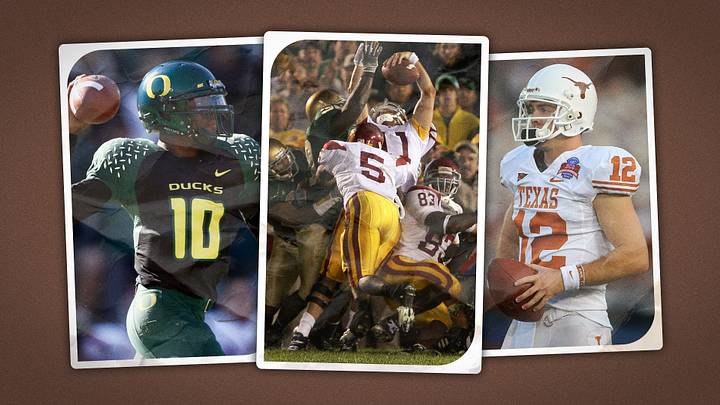
The Butterfly Effect can be defined as the theory that a small, initial change can cascade and have massive alternative impacts on later events. In college football, champions as we know them could be perennial basement dwellers if one play or one game in the past had gone differently.
Here we're going to explore some of the biggest what ifs in the sport's history. Which programs could've hung a banner had it not been for a catastrophic injury? Which coaches could've altered the landscape of an entire conference had they stayed or landed elsewhere?
One caveat: Issues of law enforcement and conduct violations have too many strings attached for this kind of exercise. We're going to stick to on-field and official business outcomes instead.
20. What if Michigan didn't have trouble with the snap in 2015?
In 2015, No. 7 ranked Michigan State stunned No. 12 ranked Michigan when a botched punt on the final play allowed Jalen Watts-Jackson to return the loose ball 38 yards for a game-winning touchdown.
What if Michigan punter Blake O'Neill doesn't have trouble with the snap? What if he gets off a solid punt to pin No. 7 ranked Michigan State in their own half with just a couple seconds left on the clock. The Spartans would have suffered a 23-21 defeat, their first of the season. Perhaps they still go on to lose to Nebraska two weeks later. Maybe that creates a season slide that Ohio State exploits and avoids being left out of the Big Ten title game. Maybe Michigan State doesn't make its first College Football Playoff appearance and maybe the Mark Dantonio era is ushered to a quicker close than 2019.
19. What if Michael Vick went to Syracuse over Virginia Tech?
According to an interview former Orange quarterback Donovan McNabb gave in 2014, Michael Vick was going to commit to Syracuse in 1998. However, Vick's mother wanted her son to stay closer to home, which prompted the future NFL great to choose Virginia Tech instead.
Rather than the Hokies exploding onto the college football scene and reaching the 1999 national title game, what if Vick inherited McNabb's throne, and the Syracuse program avoids a decades-long slump? Just imagine him throwing to guys like Amani Toomer and providing run insurance for a defense led by Dwight Freeney.
18. What if Colt McCoy doesn't get injured in the 2010 BCS National Championship?
On Texas' very first drive of the title game, near the redzone, McCoy ran straight into the brick wall that was Alabama lineman Marcell Dareus, resulting in a severe pinched nerve in his throwing shoulder. True freshman Garrett Gilbert was then called in and the Longhorns offense suffered as a result, leading to a decisive 37-21 win for the Alabama Crimson Tide. It was the program's first title since 1992.
What if McCoy threw the ball out of bounds and lived to see another drive? Gilbert wouldn't have been called in, and the Longhorns offense would have given its defense much needed rest from the Crimson Tide onslaught. Nick Saban would have been denied his first national title with Alabama, and Texas wouldn't have entered the dark age it's still trying to claw out of 16 years later.
17. What if Arizona State won the 1997 Rose Bowl?
The Sun Devils took a late 17-14 lead with a clutch touchdown drive led by Heisman Trophy finalist Jake Plummer and looked poised to hold off Ohio State in the remaining minute or so of regulation. However, two pass interference calls -- questioned by ASU fans to this day -- aided the Buckeyes in getting close enough to the endzone with enough time for quarterback Joe Germaine to find a wide open receiver who scored to win the game.
What if the refs swallow the whistle in the final minutes of the fourth quarter, as they had most of the game? Germaine would've been forced to earn every yard downfield in his attempt to overcome the three-point deficit with just over a minute remaining. With Pat Tillman and Co. on the other side of the ball giving the Buckeyes fits most of the contest, accomplishing that would've been unlikely. The Sun Devils could've claimed their first Rose Bowl victory since 1986 and finished as the only undefeated team in the country, likely earning at least a share of the program's first-ever national championship. Maybe it wouldn't have taken ASU nearly three decades to get back to a position to compete for a title.
16. What if USC was flagged for the 'Bush Push' against Notre Dame in 2005?
It was already illegal for running back Reggie Bush to assist QB Matt Leinart over the goal line (if that's what you saw that night). The future Heisman winner allegedly pushed Leinart into the end zone on a quarterback sneak that helped USC clinch a last-second 34-31 win over rival Notre Dame in South Bend. It was a controversial play that was discussed on every sports program imaginable for several days after.
If a flag was thrown, there would've been three seconds left on the clock with the Trojans backed up to the six-yard line. That would've forced head coach Pete Carroll to call a pass play and with the Notre Dame defense locking down Leinart all game, an incompletion would've been likely. USC would have suffered its first loss of the year and it would've been a consequential one had it been their only fault. Penn State (10-1) finished third in the final AP poll ahead of the national championship game that year and could've had an argument to play Texas for the BCS title instead of USC.
Additionally, the "Bush Push" controversy sparked a nation-wide conversation that eventually resulted in the legalizing of such a play across football. Thus, if the original penalty had been enforced, there wouldn't have been a snowball effect that gave birth to the Philadelphia Eagles' signature "Tush Push" today.
15. What if the 'Curse of the No. 2' didn't exist in 2007?
The 2007 season was deemed the year of the upset because so many top ranked teams faltered, leaving the AP polls looking drastically different week-to-week. Specifically, seven No. 2-ranked teams were defeated -- three of them in the same week the No. 1 team also went down -- creating serious doubt around whether a truly dominant champion would emerge. That year a Les Miles-led LSU lifted the national championship trophy but would they still have if top teams took care of business? Perhaps Missouri would've played in the title game instead of the Tigers or even preseason favorite USC. Things could have been a lot different across the board with different conference championship matchups and bowl invites probably doled out to different programs.
14. What if Dennis Dixon didn't tear his ACL in 2007?
The Ducks were 7-1 entering a crucial Pac-10 contest against No. 6 Arizona State. They emerged with a win and were poised to have the conference title wrapped up but star quarterback Dennis Dixon's knee was without an ACL. The public didn't know that and the team cleared him to play two weeks later against Arizona. His knee gave out during that game and he was lost for the season. Oregon went on to lose three straight games and saw a national championship bid go out the window.
Dixon was a Heisman Trophy favorite at the time and had his knee stayed intact, the Ducks would've probably finished the regular season 11-1. That would have sent Oregon to the national championship game to face Ohio State and given how dominant the team was with Dixon under center, the program would've emerged with its first title. That would've saved Ducks fans a lot of pain and teasing over the last 20 years.
13. What if the Pac-12 successfully added Texas and Oklahoma in 2011?
The college football landscape as we currently know it -- an 18-team Big Ten, 16-teams in the Big 12 and SEC, Stanford and California in the Atlantic Coast Conference -- exists because the Pac-12 imploded on itself in 2024. Ten teams departed because conference officials couldn't organize a new and lucrative television rights package. Yet, that situation could've been avoided had the Pac-12 successfully courted now-SEC powers Texas and Oklahoma to join back in 2011.
Had negotiations not hit roadblocks over travel and revenue sharing, the Longhorns and Sooners could've brought other members like Oklahoma State, Texas A&M, Texas Tech and Colorado (who eventually joined on its own) along with them. Instead of the Big Ten and Big 12 absorbing the defectors, the latter league could've been the one on the verge of dissolution -- the Aggies and Missouri were planning to jump to the SEC a year later anyways. What a world it would be to live in where the Pac-12 of all conferences was the first super league.
12. What if the College Football Playoff expanded to 12 teams a decade earlier?
The NCAA allowed the College Football Playoff to replace the BCS National Championship (based on the AP poll) starting with the 2014-15 season. It was only four teams but it allowed some kind of "prove it" competition to determine an "undisputed" national champion. Of course, complaints about snubs caused an expansion to 12 teams in 2024-25 and that's the reality we all live in today.
Had the sport immediately began the playoff era with a larger bracket, the days of committee snubs would've been practically non-existent. Fun wild cards like Baylor or TCU in 2014, or undefeated UCF in 2017 would've been automatically included and potentially could've upset a contender or title-winning team. Coaching legacies would've been severely altered as well. James Franklin would've had at least one playoff appearance on his resume prior to 2024 but patience may have run out quicker without a title in hand. That being said, the clamor for a 24-team bracket may have also been louder and today's postseason much more convoluted.
11. What if the Big East accepted Penn State in 1982?
The basketball-centric conference turned down the Nittany Lions' application by a 5-3 vote out of fear the school's football prowess would distract from the league's desire to dominate on the hard court. That fear was shortsighted as Penn State went on to win the 1982 football national title and joined the Big Ten in 1990. The Big East's dependency on basketball was what eventually sunk it to non-power conference status and eventually eliminated from football -- the biggest revenue sport -- completely.
Had Penn State joined, the Big East probably would have lasted a bit longer on the gridiron but hard court power houses like Georgetown, Villanova, St. John's and Providence (all with FCS or no football team at all today) may have seceded anyways to focus on basketball. It looks to have been a blessing in disguise for the Nittany Lions to face that rejection and find a brighter future in the Big Ten.
10. What if the Big Ten never rejected Notre Dame's applications to join the conference?
The Western Conference (as the Big Ten was called then) had the opportunity to include Notre Dame among its ranks in the early 20th century. Infamously in 1926, Michigan athletic director Fielding Yost fiercely objected to admitting the school over a feud with Fighting Irish head coach Knute Rockne (and also Yost's anti-Catholic prejudices).
If the Wolverines program didn't have the pull to keep Notre Dame out, the Big Ten would've brought in another titan of the game. However, losing its independent status could have also had the opposite effect with Notre Dame losing its ability to schedule whoever it wanted. There would be no rivalries with USC, Navy or Stanford. Those future title runs in the 1940s may never have happened if the Irish were locked into a conference with Ohio State, Michigan and Minnesota.
9. What if the Southern Conference never banned bowl game participation in 1951?
The modern ACC wouldn't exist if the Southern Conference didn't detonate itself with a singular decision in 1951. In an attempt to de-incentivize schools from prioritizing athletics and fight the rise of sports gambling (sound familiar?) the league banned its members from participating in postseason bowl games for the 1951-52 football season. Maryland and Clemson ignored the ban and accepted bowl invites, prompting a revolt that caused multiple members to secede and create the ACC. Had the Southern Conference embraced football's increasing value and influence across the country, the path for today's power conferences would've looked a lot different.
8. What if Knute Rockne never died in a plane crash in 1931?
Notre Dame's legendary head coach tragically perished when his plane went down in a Kansas field while he was on his way to help produce the film The Spirit of Notre Dame. Had death not come for him until a more natural time, the Fighting Irish's pursuit of a third consecutive national title would've been very alive. Instead, the program went through about a decade of mediocrity mourning Rockne until Frank Leahy was hired and the team's golden era through the 1940s began (four national titles and five undefeated campaigns). Would that stretch have been sacrificed for potential success in the short term with Rockne still at the helm? Or could the program have established a wide-ranging dynasty no other school would ever top?
7. What if Rich Rodriguez accepted the Alabama job in 2006?
One man's declination decided the fate of college football (and the NFL) for the last 20 years. Rich Rodriguez told Alabama its six-year, $12 million contract offer wasn't enough to pull him from his beloved West Virginia. Yet he still departed Morgantown for Ann Arbor and the Michigan job a year later. It's infamously a canon event in college football's lore. Why? Because it opened the door for a man named Nick Saban to take the helm in Tuscaloosa and ignited a super dynasty that has sustained the SEC's hunger for dominance to this day.
If Rodriguez leads the Crimson Tide (to what success, who knows), Saban probably would have stayed with the Miami Dolphins and perhaps rolled the dice on QB Drew Brees. That means there probably would've been no feel good post-Hurricane Katrina championship for the New Orleans Saints and probably a premature end to the now-Hall of Famer's career. The SEC wouldn't have the type of case it points to today in justifying the special treatment its teams deserve because of high competition and multiple recent championships.
6. What if Bob Stoops was hired at Iowa instead of Oklahoma in 1998?
According to reports, the Hawkeyes were interested in Stoops -- a team alum -- after his success at Florida but athletic director Bob Bowlsby wanted to interview some dude named Kirk Ferentz first. The delay in the process caused Stoops to consider and accept Oklahoma's offer before ever getting to speak with Bowlsby (he probably would've turned Iowa down anyways). The Sooners got nine conference championships and the 2000 national title out of him while Iowa -- with no disrespect toward Ferentz -- has just two conference titles and many also-rans in the race for College Football Playoff qualification.
The recruiting story would've been a lot different for the Hawkeyes with Stoops at the helm and perhaps the dominance of Ohio State and Michigan in that era would have been stifled considerably. Oklahoma perhaps doesn't have the pull it did with Texas in the decade-long tug of war with the Big 12 and their jump to the SEC too.
5. What if Florida State hired Vince Lombardi as head coach in 1952?
The Florida State coaching search committee was recommended Lombardi, who was an assistant under Red Blaik at Army at that point. The school passed on him, citing a lack of head coaching experience which was a fair point. Instead it went with VMI's Tom Nugent, who had beaten the Seminoles earlier the previous season. Lombardi went on as an assistant for the New York Giants until he was hired by the Green Bay Packers and the rest is history.
If he had been chosen to lead Florida State, he would have had some success. His inexperience may have also been a detriment. We may never have gotten the Packers' dynasty and the iconic Super Bowl trophy would never have been named after him. The Tom Landry trophy just doesn't have the same ring to it, does it?
4. What if NIL existed for the entire 'modern era' of college football?
This one's a bit broader. The "modern era" of college football is technically defined as 1992 onwards. Name, image and likeness payments were only permitted in summer of 2021 where players could be paid for schools and businesses utilizing those three elements of their persons. Today, that allowance has exploded into multi-million dollar deals and, arguably, more schools being able to draw in high-caliber players to boost their chances of competing. Last year's national champion, Indiana, was just the latest example of those benefits.
What if players were given NIL rights as early as 1992 though, when bowl games and national championship prowess were beginning to peak? What about even earlier, say, the 1960s onward? The biggest scandals involving pay-to-play would have been entirely avoided. SMU wouldn't have gotten the college football death penalty in 1987, USC wouldn't have had to vacate 14 wins and Reggie Bush wouldn't have lost his Heisman Trophy, and Jim Tressel wouldn't have been forced to resign in 2011. A lot of championships would've been altered and many coaching legacies left untarnished. Yet, more complications could have risen especially considering how the sport is struggling with it today.
3. What if the Airplane Conference actually formed in 1959?
In the 1950s, a proposal for a cross-country conference was tossed around the sport. It would have united Pacific coast powers such as USC, UCLA, Washington, Stanford and California with prominent Eastern independents Notre Dame, Pittsburgh, Penn State and Syracuse, plus the three major service academies (Army, Navy and Air Force). By 1961 the idea was dead in the water due to leadership disagreements and the Pentagon forbidding its branch academies from considering it.
This could've been the sport's first super conference with an insane stock of rivalries. USC-Notre Dame would have been pivotal for a title race every year, the Army-Navy game (plus the Commander-in-Chief Trophy) would count toward standings and the core of the Pac-Eight (as it was called then) would've been absorbed entirely. However, we still got some of that original vision today with Stanford and Cal as members of the ACC (All Coasts Conference) and with Army and Navy joining the American Athletic Conference.
2. What if college football rules were never changed in 1905 and 1980?
The game of football as we know it today is the cumulative result of ever-changing rules. Changes seen today are mostly tweaks but the core methods employed only exist because of innovative minds coming to agreements in 1905 and 1980. First, at the turn of the century, multiple additions were made to the rule book for player safety. The line of scrimmage and requiring six "linemen" was meant to prevent "mass momentum wedges" in which players were constantly sustaining serious injuries. The forward pass was also legalized, introducing a whole new strategy to the game, plus the 10-yard first down and a 60-minute regulation period. Originally, football was a 70-minute game needing just five yards to get a fresh set of downs.
In 1980, more safety alterations were made, most notably allowing offensive lineman to block using their hands while retreating rather than just putting up forearms and no extension. Chop blocks were outlawed and direct blows to the head or neck were penalized. Without these, the modern game would be a lot more violent and defensive strategy would involve a lot less finesse. Could you imagine the sack totals for guys like Reggie White and Myles Garrett if offensive lineman couldn't use their hands or extend their arms?
1. What if the Supreme Court ruled against Oklahoma in 1984?
NCAA v. Board of Regents of the University of Oklahoma is quite literally the catalyst to college football existing the way it does today -- Saturdays glued to your television, bowl season, the CFP, NIL and the transfer portal -- all of it can be sourced to one Supreme Court ruling. The Court ruled in favor of Oklahoma, which sued the NCAA over what it believed was a television rights monopoly, and introduced the era of individual schools and conferences negotiating broadcast deals. ESPN, SEC Network, Big Ten Network and even the now defunct Pac-12 Network and Longhorn Network (RIP) only existed because of this ruling.
That has since resulted in the near-out of control avalanche of consequences from the House v. NCAA ruling last year which leaned heavily on the NCAA v. Oklahoma precedent. Had the Supreme Court determined the NCAA was not a monopoly and, like the NFL, was operating under the same exception in the Sports Broadcasting Act of 1961, then schools would be at the behest of media deals the governing body negotiated for them with television networks. On one hand, there may be less games on TV now but it also may have prevented the overwhelming choice and price hikes that came with the development of the streaming and specialty network era.
 Add us as a preferred source on Google