
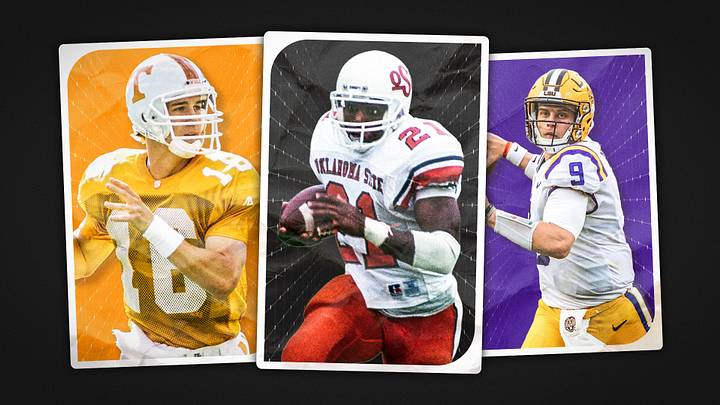
The game of college football is 157 years old, which means there have been thousands upon thousands of players to touch the gridiron and compete for collegiate institutions. Only a select few have earned distinctions worthy of being remembered for eternity — Heisman Trophy, Doak Walker Award or Davey O'Brien Award winners to name a few.
And while those names are etched in trophies and the annals of the sport, there are so many who deserve recognition. But we’ve ranked the 50 greatest players in college football history, weighing their dominance, accomplishments and lasting impact on the sport.
50. Joe Burrow, QB, LSU (2018-19)
Burrow earned his way into the Top 50 because he was undeniably spectacular in his final year and established himself as the go-to face of college football for the last decade. He set several records while leading the Tigers on one of the most dominant national championship runs ever. Multiple publications considered his 2019 campaign as the greatest ever by a college quarterback.
49. Eric Dickerson, RB, SMU (1979-82)
Dickerson was probably the only thing pure about the SMU program during an era where the entire Southwestern Conference flaunted the NCAA rule book. He rushed for 4,450 career yards and 47 touchdowns, still topping the program's record books in those two categories. It's a shame he never earned a Heisman Trophy for his Herculean talent.
48. Ricky Williams, RB, Texas (1995-98)
This man was the definition of speed and versatility at the running back position during his era. Williams set the NCAA Division I-A records for career rushing yards (6,592) and all-time scrimmage yards (7,580) while also leading the sport in touchdowns during his final two years in college. The "Texas Tornado" earned the 1998 Heisman Trophy while breaking the NCAA record for career points scored (428).
47. Howard "Hopalong" Cassady, RB, Ohio State (1952-55)
Cassady was a slippery runner, averaging 6 yards per carry on 349 rushes in his last three seasons at Ohio State. Yet, he was also the model for guys like Travis Hunter by playing both sides of the ball. Cassady recorded 10 career interceptions and sealed the 1955 Heisman Trophy vote with a dominant 146 rushing yards in a 17-0 win over Michigan at the Big House.

46. Larry Fitzgerald, WR, Pittsburgh (2002-03)
Football was Fitzgerald's destiny growing up in Minnesota. He quickly became one of college football's greatest receivers in just two seasons at Pittsburgh, averaging 16.6 yards per catch and setting an FBS record with at least one touchdown in 18 consecutive games. He won the Walter Camp and Biletnikoff awards and was a unanimous first-team All-American in 2003, finishing second in the Heisman Trophy voting that year.
45. Adrian Peterson, RB, Oklahoma (2004-06)
The future NFL great can easily be crowned the greatest Sooner running back to grow up in Texas. He rushed for 4,045 career yards and 41 touchdowns in Norman. The team rode his back to the 2004 national championship game and ran into the USC dynasty. Though his 22 100-yard rushing games are just mind boggling on their own.
44. Jack Tatum, DB, Ohio State (1968-70)
Tatum was a two-time All-American and placed seventh in Heisman voting as a senior in 1970. His tackling and hard-hitting abilities were underappreciated despite helping lead Ohio State to a 10-0 season and a national title clinched at the Rose Bowl in 1968. In fact, it was then-assistant coach Lou Holtz who convinced head coach Woody Hayes to move Tatum from running back to the defensive side of the ball. The rest is history.
43. Jim Plunkett, QB, Stanford (1968-70)
Kids these days should watch Jim Plunkett highlights from his Stanford days. The Cardinal didn't always used to be a West coast bottom feeder and he was a big reason why. Yet, he was almost moved to the other side of the line of scrimmage. Plunkett proved coaches wrong with 7,544 career passing yards, 52 touchdowns passes and the 1970 Heisman Trophy.
42. Lawrence Taylor, LB, North Carolina (1977-80)
The greatest defensive player in football history (go argue with a wall) was just as fearsome as a college player. However it wasn't until his junior season that he broke out as the dominant taclker he was drafted so high as. Taylor set a program record with 16 sacks during the 1980 season, the last time UNC claimed an outright ACC title.

41. Charles Woodson, DB, Michigan (1995-97)
Woodson was mostlly a defensive player but he was the biggest two-way star since Deion Sanders at the time. He recorded 18 career interceptions and scored six career touchdowns (offense and defense combined). A two-time All-American, Woodson won the Heisman Trophy, Walter Camp Award, Bronko Nagurski Trophy, Chuck Bednarik Award and Jim Thorpe Award in 1997 -- the same season Michigan won its first national title since 1948.
40. Marcus Allen, RB, USC (1978-81)
There is no argument to keep Allen off this list. He managed to convince USC coaches to move Ronnie Lott to defense in order to give him the starting tailback job. Allen was the ultimate glue guy during his sophomore year in 1979, leading blocks for teammate Charles White to win the Heisman that season. He'd earn his own flowers in 1981 by beating out Herschel Walker for the Heisman as a senior.
39. Johnny Rodgers, KR/WR, Nebraska (1970-72)
Johnny "The Jet" was Nebraska's first ever Heisman winner in 1972 after helping lead the program to back-to-back national titles the previous two seasons. His eight punt and kickoff return touchdowns are tied for the NCAA record and he still holds the school's mark for all-time touchdowns with 25 and punt return yards (1,515). Folks these days may not remember his name but he's worth looking up and appreciating.
38. Eddie George, RB, Ohio State (1992-95)
George apparently dreamed of playing ball for Penn State growing up. Joe Paterno took one look at him and declared him a linebacker. Instead, George went to Ohio State where he was handed the ball and rushed for 3,768 career yards, 44 touchdowns and an additional 516 receiving yards. He won the 1995 Heisman Trophy as a senior which included a massive win over, you guessed it, Penn State.
37. John Lujack, QB, Notre Dame (1943, 1946-47)
The 1947 Heisman Trophy winner led the greatest era in Notre Dame football history. Lujack's squads went a combined 26-1-1 and won national championships in each of his three seasons in South Bend. Though his most memorable play for the program came against Army in 1946 where he made a touchdown-saving tackle at Yankee Stadium to preseve a 0-0 tie -- the eventual final score of what was dubbed the Game of the Century.

36. Marshall Faulk, RB, San Diego State (1991-93)
Another rusher who, like Dickerson, should've won his own Heisman Trophy, Faulk racked up 4,589 career rushing yards and 62 touchdowns for the Aztecs. He averaged more than 1,500 rushing yards across his three-year career but voters unfortunately tied their doubts surrounding San Diego State's lack of serious competition to him. He finished ninth in Heisman voting his freshman year, followed by second and fourth place finishes the next two seasons.
35. Jonathan Taylor, RB, Wisconsin (2017-19)
If you had to give Burrow a partner in being the best college players of the last decade, Jonathan Taylor should be the automatic choice considering he's still fourth all-time in NCAA rushing yards (6,174). He's also the only player in history to win two Doak Walker Awards as the nation's best rusher. Taylor also holds the NCAA records for most career 200-yard rushing games (12) and most seasons with more than 1,750 rushing yards (3).
34. Randy White, DT, Maryland (1972-74)
White's college career is mostly forgotten by the mainstream for some reason. This guy was drafted by the Dallas Cowboys second overall ahead of one Walter Payton. There were a few good reasons for that including his winning the 1974 ACC Player of the Year, the Outland Trophy and Lombardi Award behind 24 tackles for a loss his senior year.
33. Lee Roy Selmon, DL, Oklahoma (1972-75)
If you're not familiar with the Selmon brothers, it's time to learn about arguably the most dominant of the three. Lee Roy was a two-time All-American in 1974 and 1975, won the Lombardi and Outland awards as a senior and was the No. 1 overall pick in the 1976 NFL draft. He and his siblings helped lead the Sooners to a 32-1-1 record and two national championships during his college career.

32. John Elway, QB, Stanford (1979-82)
It took a decade for Stanford to find its next Jim Plunkett. Elway smashed his career touchdown record with 77 but his overall tenure in Palo Alto was marred by a mediocre supporting cast. That was mostly because previous head coach Bill Walsh departed to take the San Francisco 49ers job. You can play the "what if" game all day about how things could've been different but Elway still made a more than respectable legacy for himself at the school. Unfortunately, he was the starting quarterback that seemed to play so well that the Stanford band prematurely marched onto the field against rivals California in 1982, Elway's final career game.
31. Jerry Rice, WR, Mississippi Valley State (1981-84)
Rice single-handedly put Mississippi Valley State on the map. He led the entire NCAA with 102 catches in 1983 and 27 touchdowns in 1984. Rice finished ninth in Heisman voting his senior season which doesn't seem all that impressive until you remember he was playing at the equivalent of the FCS level (Division I-AA). To this day, Rice holds the FCS records for most catches in a game (24), single-season touchdowns (27), yards per game in a season (168.2) among many more.
30. Bubba Smith, DE, Michigan State (1964-66)
Smith was quite literally a giant for his time on the gridiron. At six-foot-seven, 283 pounds he towered over offensive opponents and fellow defenders. His senior year he was an All-American defensive lineman during the very start of the fully legal two-platoon era of the sport. While Smith represented the Spartans in East Lansing, Michigan State went 19-1-1 and gave up an average of 8.1 points per game.
29. Chuck Bednarik, C/LB, Penn State (1945-48)
Before he was a college football legend, Bednarik served his country during World War II right out of high school. He flew 30 bombing missions over Nazi Germany with the Army Air Force and returned to dominate the offensive line for the Nittany Lions. Bednarik finished third in Heisman Trophy voting in 1948 but earned the Maxwell Award. "Concrete Charlie," as he was called, got his own award named after him in 1995 which is today handed out to the best defensive player, ironically.
28. Sammy Baugh, QB, TCU (1934-36)
Quarterbacks who make their living on their ability to sling the ball downfield can thank Baugh and TCU head coach Dutch Meyer for revolutionizing the forward pass. Mike Leach (rest in peace) and his "air raid offense" wouldn't exist without "Slingin' Sammy. The 1936 consensus All-American became the standard future passers would be judged against for an entire generation. His 3,384 career passing yards and 39 touchdowns were trailblazing and he probably should've won the inaugural Heisman Trophy in 1935 but players west of the Mississippi River were shockingly ineligible.
27. Doug Flutie, QB, Boston College (1981-84)
Flutie may have his iconic Hail Mary in 1984 but his 10,579 career passing yards were eye-popping for his era before things like the "air raid offense" were invented. Without his Baugh-like abilities, Boston College potentially would've faded into college football obscurity. He led the Eagles to a major bowl game for the first time in 42 years which put them on a path to the Big East Conference a decade later and eventually Power Conference status in the ACC. Flutie's stats don't do his impact to the sport justice.

26. Deion Sanders, DB, Florida State (1985-88)
Sanders tops the list as the best two-way player in college football history, maybe even football history period. He was electifying as a cornerback and punt returner, redefining what it meant to be fast. Sanders led the FBS in punt returns averaging 15.2 yards per return in 1988 and broke school records with 126 career punt returns for 1,429 yards and three touchdowns. Of course, those skills translated to his dynamic professional career and "Prime Time" moniker.
25. O.J. Simpson, RB, USC (1967-68)
Simpson is a difficult memory for most now. But there was a time when he was revered for his skills on the gridiron. Simpson won the 1968 Heisman Trophy and was the model for running backs of the era. The year before he had an iconic 64-yard rushing score against No. 1 UCLA that propelled No. 4 USC to the 1967 national title. Across his college career Simpson totaled 3,124 rushing yards and 33 touchdowns.
24. Davey O'Brien, QB, TCU (1936-38)
If you can believe it, O'Brien actually sat on the bench behind Baugh before the latter graduated in 1936. He recorded 3,481 career yards of total offense, 2,628 of them through the air -- 1,457 of those were thrown during the 1938 season which led the nation and earned him the Heisman Trophy that eluded Baugh by technicality. O'Brien was the sequal that was actually better than the original and that's why the best quarterbacks in the nation today are awarded his trophy.
23. Doak Walker, RB, SMU (1945-49)
The Cotton Bowl Stadium is referred to as "The House that Doak Built" for a reason. It was expanded twice during his time at SMU where Walker was an all-around unique talent. He racked up 3,582 total yards of offense by rushing (1,928 yards), passing and receiving. Walker scored 57 career touchdowns and won the 1947 Heisman Trophy by being a dominant force on offense, special teams and defense. He intercepted five passes that year, averaged 42.0 yards per punt and completed over 50 percent of his passes back when that was an exceptional accomplishment.
22. Billy Cannon, RB/KR/DB, LSU (1957-59)
The two-time consensus All-American and 1959 Heisman Trophy winner was a legend of the one-platoon era of the game. Cannon led the Tigers to the 1958 national championship by dominating both sides of the ball. He totaled 1,867 rushing yards, 24 touchdowns, 965 return yards and intercepted seven passes. On top of his football prowess he was also wicked good at shot put.

21. Peyton Manning, QB, Tennessee (1994-97)
Of course there was going to be a Manning on this list and don't be surprised it's not Peyton's dad. Despite leaving college without a national championship to his name, Manning won the Maxwell Award, Davey O'Brien Award, Sullivan Award and Johnny Unitas Golden Arm Award during his senior season in 1997. He probably should've won the Heisman that year too. People only remember the winner, Ryan Leaf, today because Manning was the runner up. He totaled 11,201 career passing yards, 89 touchdowns and completed 62.5 percent of his passes.
20. Billy Sims, RB, Oklahoma (1975-79)
The 1978 Heisman Trophy winner could've been the second repeat winner in 1979 but USC's Charlie White beat him out. Sims still had a fantastic career without the second trophy, racking up 3,813 rushing yards and 50 touchdowns. The bulk of those totals came during his junior and senior seasons when he practically was the Oklahoma Sooners offense. Hardcore college fans will recognize his name but those familiarizing themselves with the annals of the game should take the time to appreciate Sims' contribution to the sport.
19. Reggie White, DE, Tennessee (1980-83)
"The Minister of Defense," as he was known in the NFL, began his journey in Knoxville as the most fearsome pass rusher in Volunteers history. White had 32 career sacks, 293 tackles and recovered four fumbles. He set the Tennessee single-season record with 15 sacks during his senior campaign in 1983. The consensus All-American was named SEC player of the year and probably had a good case to beat out Nebraska RB Mike Rozier for the Heisman that season.
18. Glenn Davis, RB, Army (1943-46)
Davis, also known as "Mr. Outside," was small for a rusher at five-foot-nine, 170 pounds even way back then. He didn't let that stop him from whizzing by defenders and impressing coaches he played for. Davis racked up 2,957 career rushing yards and scored 59 touchdowns at West Point. That earned him three consensus All-American honors and the 1946 Heisman Trophy, the second consecutive Army back to earn the award.

17. Tony Dorsett, RB, Pittsburgh (1973-76)
Dorsett was practically setting records every year of his college career. He broke the NCAA freshman single-season rushing record with 1,586 yards, then set the school record for career rushing yards as a sophomore. He earned the 1976 Heisman Trophy his senior year with 1,948 rushing yards which aided Pittsburgh in its undefeated quest for that year's national championship. Dorsett managed the rare feat of rushing for at least 1,000 yards in all four of his college years.
16. Walter Payton, RB, Jackson State (1971-74)
In the era of Archie Griffin, Joe Washington and Anthony Davis, Payton managed to draw the attention of national media while playing for an NCAA Division I-AA school -- the equivalent of the FCS today. If it weren't for the SEC's sluggish approach to integration, Payton could've contributed his 3,563 career rushing yards and 66 touchdowns (maybe more) for Mississippi or Mississipi State. His impressive abilities got folks to pay attention to HBCUs at their peak in college football and earned him Heisman votes in 1974.
15. Ernie Davis, RB, Syracuse (1959-61)
Davis inherited Jim Brown's No. 44 jersey two years after the latter graduated. It was well deserved as Davis led Syracuse to the 1959 national championship and owned the school's rushing and scoring records by the time he departed. The 1961 Heisman Trophy winner -- the first African American player to earn it -- sadly passed away from leukemia two years later. Davis rushed for 2,386 career yards and 35 touchdowns.
14. Bronko Nagurski, T, Minnesota (1927-29)
He's the only player to ever be named an All-American at two positions in the same season. Nagurski dominated his senior season at defensive tackle and fullback for the Golden Gophers. He only rushed for 557 career yards and six touchdowns but he also played in what was essentially the opening era of football as a key piece of Americana. The (likley) apocryphal stories surrounding Nagurski's career are legendary but he was truly one of one and that's why the nation's best defensive player is given his trophy each year. Also, there aren't many other guys out there with a name that just sounds like it was meant for a football player.
13. Doc Blanchard, RB, Army (1944-46)
Blanchard actually began his college career at North Carolina before World War II began. He received an appointment to West Point in 1944 and was one part of the triumvirate that made up the greatest backfield in the game during that era. Blanchard joined Glenn Davis and quarterback Arnold Tucker to lead Army to a 27-0-1 record across his tenure. The academy finished atop the national rankings twice and Blanchard, known as "Mr. Inside," won the 1945 Heisman Trophy, finishing his career with 1,666 rushing yards, 38 touchdowns and seven interceptions when he played the opposite side of the ball.
12. Hugh Green, DE, Pittsburgh (1977-80)
Green, a three-time first-team All-American, won the Maxwell Award as the country's best player, won the Lombardi Award as the best lineman and earned the Walter Camp Trophy as the nation's most outstanding player -- all in the 1980 season. South Carolina's George Rogers beat Green out for the Heisman Trophy that year but his second place finish was the highest-ever by a full-time defensive player at the time. Pittsburgh went 39-8-1 during Green's tenure, assisted by his 49 career sacks and 441 tackles.
11. Gale Sayers, RB, Kansas (1962-64)
Sayers could easily be in the Top 10 but there are plenty of running backs in that section already. The "Kansas Comet" became the first player in college football history with a 99-yard rush which contributed to his career 2,675 yards and 20 touchdowns. Sayers was a consensus All-American in 1963 and 1964 but, unfortunately, never won the Heisman Trophy. He was, however, inducted into the College Football Hall of Fame and deservedly so.
10. Roger Staubach, QB, Navy (1962-64)
In three years at the helm of the Midshipmen offense, Staubach threw for 3,571 career passing yards, 35 touchdowns and rushed for another 682 yards. "Roger the Dodger" earned the 1963 Heisman Trophy, the Maxwell Trophy and the Walter Camp Memorial Award for his efforts in leading Navy to a 9-2 record, an East Division championship and the No. 2 ranking in the final AP poll. Staubach would serve four years in the service, including a tour to Vietnam, before beginning his Hall of Fame career with the NFL's Dallas Cowboys.

9. Barry Sanders, RB, Oklahoma State (1986-88)
One of the greatest rushers in all of college football was this close to committing to Tulsa before Oklahoma State swooped in at the last minute. Sanders accrued 3,556 career rushing yards -- 2,628 of which came in a single season and still stands as the FBS record -- and 54 touchdowns while in Stillwater. His 1988 campaign alone is what earns him the most credit (he set 34 NCAA records) but many forget Sanders sat behind another formidable rusher in Thurman Thomas. While acting as Thomas' understudy, Sanders led the nation in kickoff returns (31.6-yard average) which made him a deadly special teams player too.
8. Dick Butkus, LB, Illinois (1962-64)
Butkus redefined what it meant to truly tackle someone. The two-time All-American flattened rushers who attempted to get through the Illinois defensive line and earned Big Ten MVP honors during the 1963 season. In a game against Ohio State that same campaign Butkus set a school record with 23 solo tackles. He'd only follow that up by finishing third in Heisman Trophy voting the very next year. In 1985 the trophy awarded to college football's best linebacker was named after him and rightfully so. Also, you can't have a name like Dick Butkus and not be an absolute football monster.
7. Earl Campbell, RB, Texas (1974-77)
The Longhorns got an all-time gem -- or rather a "Tyler (Texas) Rose" as Cambell was known -- when it landed the Lone Star State native. Campbell racked up 4,443 career rushing yards and 40 touchdowns in four seasons, averaging 5.8 yards per carry which made him practically a walking first down. Despite a regressive junior season in which it seemed like he had lost his touch, even missing three games, Campbell's senior campaign was his most dominant (6.5 yards per carry) and earned him the Heisman Trophy. The idea of running downhill was perfected by Campbell and no defender wanted to be on at the bottom.
6. Red Grange, RB, Illinois (1923-25)
No player in college football history -- nor its future -- will have as great of a first quarter in any game than Red Grange did against Michigan in 1924. First, he ran the kickoff back 95 yards for a touchdown. Over the course of the next 10 minutes of game time, he broke off three separate runs of 67, 56 and 44 yards. He'd finish the game with a measly five touchdowns and, oh, he threw for one himself too. Grange was a three-time consensus All-American and inducted as part of the inaugural class of the College Football Hall of Fame. Talk about having a "Tungsten Arm" O'Doyle-kind of career.

5. Jim Thorpe, Back, Carlisle (1907-12)
The multi-sport phenom was such a mythical character of college football. Wild stories are told of his pulling off incredible feats that they had to be outlawed -- such as his supposed punting of a ball, sprinting to catch it and then running in for a touchdown. He was a beast of a man coached by Pop Warner (yes, that Pop Warner) while at Carlisle Indian School and helped lead an upset victory over Harvard, the Crimson's only loss from 1911-15. Thorpe racked up 3,616 career rushing yards and 53 touchdowns, earning consensus All-American honors in 1911 and 1912. He joined Red Grange in the inaugural College Football Hall of Fame class.
4. Archie Griffin, RB, Ohio State (1972-75)
He's still the only player in the entire history of the sport to win two Heisman Trophies. Consider the rest of the names on this list and how impressive that is. Griffin was breaking Ohio State records in his freshman year and it just kept getting better from there. He averaged 121.5 rushing yards per game which aided him in accruing 5,589 career yards, yet he only found the endzone 27 times in four years. Among his many accolades, Griffin was the first player to start in four Rose Bowls and earned back-to-back Big Ten MVP honors and unanimous All-American selections. It took until Jonathan Taylor in 2019 for another player not named Griffin to lead the conference in rushing yards three consecutive seasons.
3. Bo Jackson, RB, Auburn (1982-85)
Bo knows and every college football fan should know his name. The 1985 Heisman Trophy winner accrued 4,303 career rushing yards and scored 43 touchdowns at Auburn. Jackson was a key factor in the Tigers' 1983 national title run and in the year before, his iconic "Bo Over the Top" touchdown sent legendary Alabama head coach Bear Bryant off to retirement with the Crimson Tide's first Iron Bowl loss in nine tries. As a freshman Bo called his shot by claiming No. 34, the same number worn by a junior prodigy barreling over SEC defenders for the Georgia Bulldogs...
2. Herschel Walker, RB, Georgia (1980-82)
... and his name is Herschel Walker. The conference and sport practically had whiplash with Jackson following up Walker's incredible college career. The Bulldogs benefited mightily from his ground and pound abilities, going 12-0 and winning the national championship off the back of his 1,616-yard and 15-touchdown freshman year efforts. In fact, Georgia only lost three games while Walker was a Bulldog (33 wins). He earned the Heisman Trophy in 1982 and his career total 5,259 rushing yards and 52 touchdowns were among the 41 school, 16 conference and 11 NCAA records he stamped his name on. Running backs as we know them today were shaped in Walker's image.

1. Jim Brown, RB, Syracuse (1954-56)
Thorpe set the standard for what an all-around athlete looked like then Brown perfected it. He earned 10 varsity letters in four different sports at Syracuse but the gridiron is where he thrived. Brown only finished with 2,091 career rushing yards and 26 touchdowns, in an era where running the ball was the bread and butter of an offense, but he was much more than a rusher. He led the nation in kickoff return average in 1955 and also acted as Syracuse's placekicker. In a 61-7 victory over Colgate in 1956, Brown accounted for 43 points (then an NCAA record) on six touchdowns and seven extra points. The No. 44 jersey is worn by so many running backs nowadays in his honor and it's easy to understand why.
 Add us as a preferred source on Google