
Wisconsin erased a 17-point deficit and beat No. 13 Penn State in Beaver Stadium on Saturday, and almost immediately, the conversation became about Penn State. What's wrong with the Nittany Lions? How did they blow that lead? Is Matt Campbell's offense good enough? What does this mean for Penn State's season? Those are all valid and reasonable questions. But here's another one: Why can't Wisconsin just win a football game?
Somewhere along the way, college football stopped treating upsets as something the underdog accomplished and started treating them primarily as evidence that the favorite wasn't as good as we thought.
If the NFL can have any given Sunday, then we need to allow any given Saturday for college football, too.
Every upset has become evidence that somebody was a fraud

The modern reaction cycle to an upset is as predictable as a Nick Saban lecture on "rat poison." A ranked team loses and within minutes:
- Overrated.
- Coach can't win big games.
- Quarterback isn't good enough.
- Ranking was a joke.
- Conference was exposed.
- Playoff hopes are dead.
We immediately search for the flaw that explains why the favorite lost. And yes, sometimes those criticisms are completely legitimate. Penn State absolutely should answer for blowing a 17-point fourth-quarter lead. But that still begs the question:
If every favorite that loses was secretly bad all along or incredibly overrated, did the underdog actually accomplish anything? We have become much better at explaining losses than appreciating wins.
Sometimes the underdog just played better

Wake Forest went to Louisville and beat the No. 16 Cardinals, 30-27. Carlos Hernandez had a huge afternoon, and Wake's defense produced critical late stops, including a blocked field-goal attempt in the final seconds.
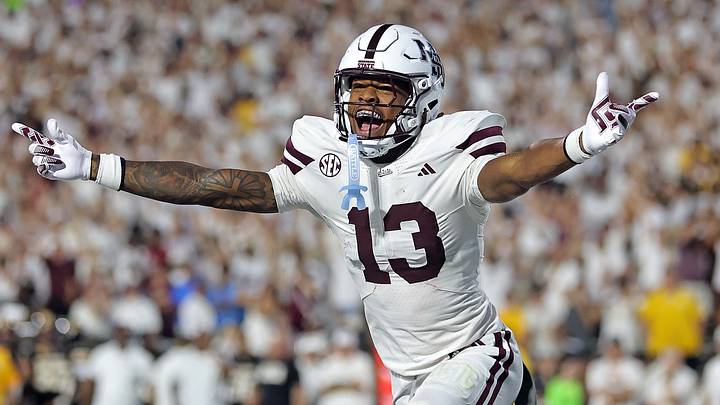
Mississippi State beat No. 19 Missouri 31-24, overcoming a seven-point fourth-quarter deficit with 14 unanswered points and producing 499 yards of offense. It was a statement win for the Bulldogs and a true coming-out party for Kamario Taylor.
Immediately, all eyes turned to the Cardinals and the Tigers, with multiple explanations of what went wrong. Here's a news flash: Something went right on the other side, too.
A win and a loss are not singular. They don’t exist in a vacuum, and one must complement the other. Louisville can have problems, AND Wake Forest can deserve credit. Missouri can make mistakes, AND Mississippi State can have earned a win. Penn State can collapse, AND Wisconsin can have contributed to the collapse.
Those ideas aren't mutually exclusive. The favorite making mistakes and the underdog earning the win aren't competing explanations. They are the cheese and the macaroni. One needs the other to be complete.
Rankings have trained us to watch every game from one team's perspective

When the television graphic says, “No. 13 Penn State vs. Wisconsin," our brains immediately establish the outcome. Penn State will continue to roll, and Wisconsin is nothing more than an obstacle — a speed bump on the way to a better matchup. If Penn State wins, that's what was supposed to happen.
But if Wisconsin wins, the question becomes, “What went wrong with Penn State?”
Same thing with No. 16 Louisville vs. Wake Forest. The number beside one team's name subtly, even subliminally, tells us which team we're supposed to evaluate and dissect.
The expanded College Football Playoff has only intensified this phenomenon. We don't merely watch Penn State and Wisconsin play a football game anymore. We're simultaneously calculating what it means for rankings, resumés, conference races, and December football.
So when the favorite loses, our first instinct is to diagnose the damage and take and inventory of all the possible mistakes and miscalculations. The underdog becomes secondary in its own upset when, in truth, they should be the story and the focus of our attention.
That's the entire magic trick. The rabbit is pulled out of the hat, and instead of just enjoying the show, we try to analyze and break down what kind of chicanery the magician used to make it happen.
College football fans have become obsessed with proving they were right

We make preseason predictions, we buy into preseason polls, we start arguing about the Top 25 rankings, power rankings, FPI indexes, playoff projections, and eventual champions before the first leaves have fallen from the trees in September.
And then? Social media gives us receipts. We become victims of our own ice-cold takes and vehemently defend our acumen rather than admit to our own hubris.
Nobody wants to simply cop to the truth of, “Maybe I was just wrong”.
So when something unexpected happens, there's a natural urge to rationalize it. Penn State didn't lose because Wisconsin was better on Saturday. Penn State was exposed. Louisville wasn't beaten by Wake Forest in a thrilling game. Louisville was overrated.
Those explanations protect the original paradigm because they turn the surprise into something that supposedly should have been obvious all along.
An upset is allowed to change what we think we know. When we are presented with new information, we should evaluate both sides, not just assume that the failure fell squarely on the favorite. That's one of the reasons we watch sports.
Explaining every upset away is slowly killing what makes them fun

Think about how we remember some of the most classic college football upsets.
- Appalachian State beating Michigan, thwarting the Wolverines' comeback with a blocked field goal.
- Boise State shocking Oklahoma in the Fiesta Bowl with gadget plays and last-second dramatics.
- Stanford upending USC at the Coliseum as a 41-point underdog
We don't remember those games because somebody immediately produced a multi-point diagram and diatribe explaining why the favorite was actually fraudulent. We remember that they weren't supposed to win, and then they did, and it was emotionally draining even to watch as a bystander, let alone as a fan of one of the teams.
College football's vast talent disparities are actually part of why an upset feels different here than in many sports. Sometimes the team with fewer blue-chip recruits, less NIL money, a smaller stadium, and lower expectations walks onto the same field and wins anyway.
You know, any given Saturday.
And our immediate response shouldn't always be, “Well, actually, here's why that wasn't surprising.” Just ... let it be surprising.
Penn State has problems to fix. Louisville has questions to answer. Missouri can spend this week figuring out what went wrong in Starkville. We'll have plenty of time to break down and wax philosophical about all of it over the coming weeks.
But Wisconsin, Wake Forest, and Mississippi State won on Saturday. Those aren't merely data points proving something was wrong with the teams they beat. They're magnificent accomplishments that deserve recognition.
College football is supposed to occasionally make absolutely no sense. That's not a flaw we should even attempt to explain away. It’s a selling point. Sometimes the biggest story isn't that the favorite failed, but rather that the underdog simply beat them.
 Add us as a preferred source on Google