
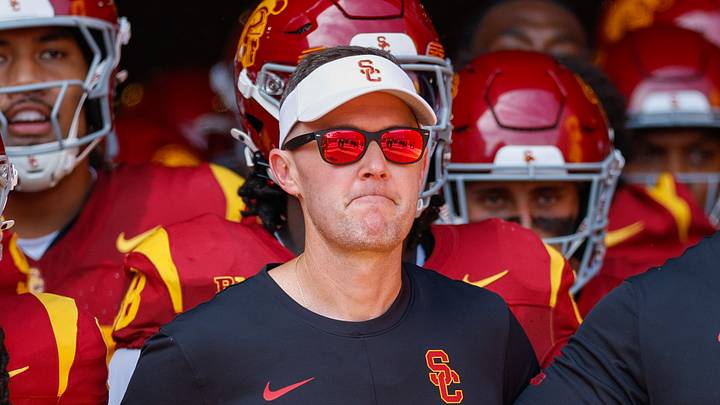
Four days after USC football's Week 0 victory over San Jose State, we're still talking about attendance. That's what happens when you're the only blue blood to play in Week 0 and pictures of a sparse crowd at the Coliseum become the main talking point on social media. Then the relatively inconsequential story gets legs because 1) Rival fans enjoy the trolling, 2) USC fans argue back and 3) Lincoln Riley is a lightning rod.
USC announced attendance of 51,144 for their 42-26 victory. That's 25,000 or so under capacity for the Coliseum. And it's far more than actually turned up based on the pictures of the crowd. There were extenuating factors. The game was scheduled for noon in the middle of a heat advisory. The heat wave hitting LA all week set heat and humidity records across the Southland. It was miserable and, for many, potentially unsafe to spend hours in a stadium with zero shade under the midday sun. The mother of freshman receiver Boobie Feaster suffered blisters and passed out in the medical tent, according to Feaster's father. He described the experience on X: "We are from The Boot & we Live in TX. but Saturday was a different type of Heat in LA."
The Coliseum at kickoff of USC’s season opener with San Jose State pic.twitter.com/4bOhMY487b
— Ryan Kartje (@RyanKartje) August 29, 2026
For many college football fans who live in places with miserable weather, the heat isn't an excuse to miss a game. Attendance numbers across the South certainly reflect that mindset. It shouldn't matter that the weather was bad. It shouldn't matter that the opponent wasn't a marquee name. It's embarrassing that USC can't sell out under any circumstances, right? It's embarrassing alright, but not for the reason a lot of those fans are focusing on.
The difference between an explanation and an excuse is how it's received. As a USC fan who was born, raised and still lives in Los Angeles, I can explain the whys of USC attendance and broader Los Angeles sports culture as a whole. But I don't want to make excuses for the true problem at the Coliseum.
Above all, this story is about one thing: Competition. Competing for eyeballs and being (or not being) a competitor.
So let's talk about competition, the Los Angeles sports landscape, and then, the Lincoln Riley of it all.
Los Angeles sports culture is uniquely competitive
There are 10 media markets in the United States with at least one team from each of the Big 5 sports leagues and an FBS program.
Market | FBS Programs | Big 5 teams |
|---|---|---|
New York | Rutgers | 11 |
Los Angeles | USC, UCLA | 10 |
Chicago | Northwestern | 6 |
Dallas-Fort Worth | SMU, TCU, North Texas | 5 |
Boston | Boston College | 5 |
Washington, DC | Maryland | 5 |
Philadelphia | Temple | 5 |
Minneapolis-St. Paul | Minnesota | 5 |
Miami-Fort Lauderdale | Miami, FIU | 5 |
Denver | Colorado State, Colorado | 5 |
Los Angeles has twice as many Big 5 franchises as most of those markets, with not one but two teams in each. New York is the only comparable city in terms of competition for eyeballs. In terms of college football prestige, Miami is the closest to USC.
Why does any of this matter? It's simple. Fans from elsewhere in the country accuse USC fans of lacking loyalty. In Los Angeles, loyalty is earned, because it has to be.
In Auburn, Austen, State College, Lincoln, Columbus or Norman, there is only one option for local sports loyalty. Auburn, Texas, Penn State, Nebraska, Ohio State and Oklahoma are the only football ticket in town. If any of those teams falter, there's nowhere else to go. It's easy to be loyal when there are no other options and everyone you know is also loyal only to one team. Football games become an integral part of the social fabric of a city.
It's more complicated in a city like Los Angeles, where the tie between success and attendance has always been irrevocably linked. There are diehards, of course. Those are the (I'd guess) 40,000 or so USC fans who actually turned up on Saturday despite the heat and the opponent. But the average sports fan in Los Angeles can get their sports fix without the misery. Remember, there are 10 major pro sports teams in the region, including two NFL teams. And another Power 4 program across town.
If USC doesn't give fans a reason to show up, they can easily spend their money and time elsewhere. And there's little social penalty for paying more attention to the Rams or Chargers or Dodgers or Lakers because Los Angeles as a city is inherently fragmented. A significant portion of the population are transplants from other states. Your friend group could just as easily include Packers or Cowboys fans as Rams or Chargers fans. The Dodgers and Lakers are the only dominant brands in the city. Games are not at the center of everyone's social calendar.
USC fans, and the broader Los Angeles sports scene, shouldn't be embarrassed about how sports culture takes shape in their city. It's a unique landscape that only one other city in the country can even grasp. And New York is most certainly not a CFB town. The fact that USC managed to become a blue blood at all is extraordinary.
That said, USC's attendance, not just on Saturday but over the past decade, is an embarrassment. But that's because a winning USC program doesn't have this problem.
Why attendance embarrassment lies solely with Lincoln Riley

Here's what is actually embarrassing about his whole attendance conversation: USC has spent the 16 years since Pete Carroll's departure presenting an uncompetitive product relative to the other sports brands in a sports city that punishes losers.
What's embarrassing is that USC is five years into paying a head coach top 5 money in CFB and has nothing to show for it.
What's embarrassing is that Lincoln Riley hasn't built the kind of good will and excitement around his program necessary to convince fans that it's worth coming to the Coliseum regardless of weather or opponent.
What was the difference between Saturday's attendance of 51,000 against San Jose and the 2009 game between the same teams in similarly miserable heat, which drew 84,000? One game came after three consecutive seasons with a midling record and consistently infuriating defensive performances. The other followed seven straight seasons in which USC finished ranked in the top 5.
So it all comes back to competition. More specifically, is USC a competitive team, both in terms of market share and contention for championships? The answer, for far too long, has been no.
Riley responded to the criticism on Wednesday.
“I think that comes from a lot of people who don’t follow our program, most of those who have never stepped foot in the Coliseum," he said. "The reality is during my years here attendance has gone up every single year.”
He's right about one thing. Most of the criticism is coming from people who don't understand how attendance works at USC and Los Angeles.
He's wrong about the second thing though. USC's average home attendance did rise from 64,484 in 2022 to 66,071 in 2023 and then peaked in 2024 at 71,571. But in 2025 it dipped back to 67,782. Park of that dip was the relative lack of marquee opponents on the home slate, but games against Michigan and UCLA weren't sellouts.
How does USC start to sell out the Coliseum again? The sports culture in LA isn't going to change. So it's very simple: Deliver results and they will come.
 Add us as a preferred source on Google