
As the streaming boom saturates us with more content than we know what do to with, sports have begun to receive the prestige TV treatment, from docs like The Last Dance to fiction adaptations like Winning Time. But the trend had yet to really take on baseball — that is, until now.
According to a report from Variety, Netflix and MLB Studios are teaming up for a scripted drama series on the history of the New York Yankees. Jason Bateman's production company is also attached, with Josh Wakely developing the concept. Variety doesn't offer much information about what the show might actually be like, or what stories it'll choose to tell: "Details about the project are minimal so far, other than the fact that the series will take on 'one of the most decorated franchises in American sports' and take place across the team’s several eras."
But that doesn't have to stop us from speculating. Presumably, this is going to take the long view of Yankees history, jumping from one point in time to another. If that is in fact the case, here are five eras they absolutely have to tackle.
The Babe Ruth trade

Could you start anywhere else? The Yankees began play back in 1903 as the New York Highlanders, but they didn't really become the Yankees until Ruth arrived from Boston in the winter following the 1919 season. They hadn't made a single World Series appearance in nearly two decades without Ruth; with him in pinstripes, they won four titles — and built a spanking new ballpark in the Bronx to boot. It's impossible to tell the story of this franchise without starting with the Babe.
Of course, it doesn't hurt that it's also one heck of a story. It's not quite as simple as Boston owner Harry Frazee needing an infusion of cash to produce his many theatrical productions, although that certainly played a role in his decision to sell Ruth to New York. It also involves Ruth playing hardball with the Red Sox as he became one of America's first true sporting stars, Prohibition and a Yankees owner who was also a former lieutenant colonel in the army. Yes, please.
The 1961 home run chase

Granted, we already saw this dramatized once in the Billy Crystal film 61*. But it deserves to be dramatized for a new generation, because the race between Mickey Mantle and Roger Maris to break Babe Ruth's single-season home run record had a little bit of everything.
There's the interpersonal drama, with Mantle the established fan favorite and New York socialite Maris the less charismatic interloper from Kansas City. There's the pathos of Mantle, in his 11th pro season, making a run at history despite already feeling the ill effects of his hard-charging lifestyle. And then there's the discourse around what it means to break one of sport's most hallowed records with what many consider to be an asterisk — while Ruth hit 60 homers in a 154-game schedule, Maris didn't hit No. 61 until the final day of the 162-game schedule adopted for the '61 season.
The 1977 and 1978 World Series runs

Of all of New York's 27 World Series titles, arguably none of them were wilder than 1977 and 1978. The former was the team's first championship in some 15 years, and came amid utter turbulence in New York City — from the search for the Son of Sam killer to blackouts and widespread looting that summer to the infamous fires in the Bronx and even filing for bankruptcy. And then, in October, Reggie Jackson became Mr. October with three homers in Game 6 to defeat the Dodgers.
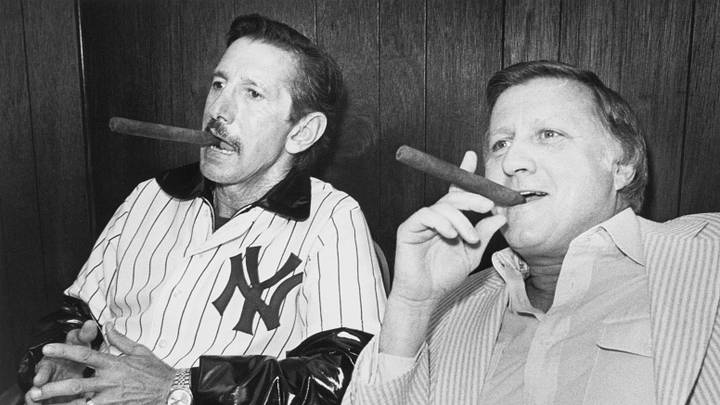
The 1978 season didn't see quite as much drama off the field, but it saw even more on it. The Yankees dug themselves a 14-game hole to the rival Red Sox, only to storm back and break Boston's hearts on Bucky Dent's three-run homer in a one-game playoff for the AL East title at Fenway Park. Oh, and did we mention that Jackson and manager Billy Martin got into a physical altercation so acrimonious that it led Martin to resign midseason? (Really, you could make an entire series just about Martin's relationship with the Yankees and George Stienbrenner).
George Steinbrenner's ban from baseball

If you're going to tell the story of the Yankees — and of the owner who helped turn them into a global icon — you need to tell the whole story. And that necessarily includes Steinbrenner getting permanently banned from day-to-day management of his team in July of 1990, after he was found to have paid a mobster to dig up dirt on former star outfielder Dave Winfield during a contract dispute.
That "permanent" ban wound up lasting just three years, during which time the team was run by Steinbrenner's business partner Robert Nederlander and later his son-in-law Joe Molloy. If that sounds like a ban in name only, well, you're not wrong, and in 1993, Vincent's successor Bud Selig lifted it adn welcomed Steinbrenner back into MLB's good graces. That is, provided he dropped his several active lawsuits against the league. Eat your heart out, Ryan Murphy.
The 1990s dynasty

While the Dodgers might have something to say about it in a few months' time, it remains the last time a team won three consecutive World Series, the modern dynasty to which all others are measured. And while it didn't take long for Derek Jeter, Mariano Rivera and Co. to become public enemy No. 1 throughout baseball, their rise from the ashes of the late-80s/early-90s Yankees is genuinely compelling on the merits. Plus, the 1996, 1998, 1999 and 2000 title runs feature indelible moments from the Jeffrey Maier game to the Subway Series.
 Add us as a preferred source on Google