
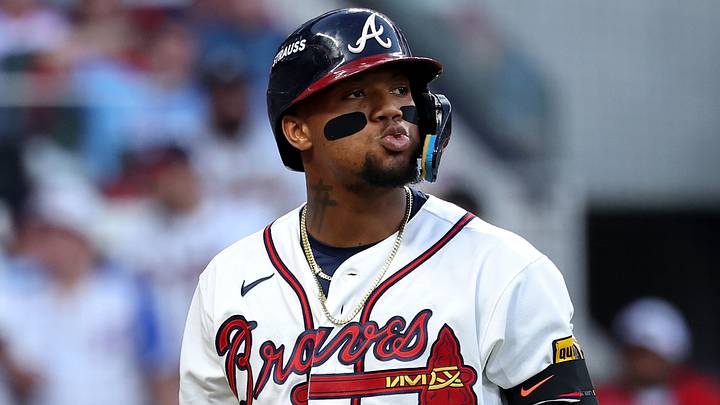
Beating the Los Angeles Dodgers in the postseason is easier said than done. There's a reason why the Dodgers are two series wins away from winning a third straight World Series title. With that being said, the Braves allowed a total of 14 runs in four games - an average of a little more than three per game - yet were sent home in four games in the best-of-five series.
The pitching staff performing as well as it did and the Braves still going home is an infuriating outcome, and one that these seven individuals should be blamed for.
OF Ronald Acuña Jr.

Let's start with the obvious one. Ronald Acuña Jr. has won an MVP award. When healthy, he's one of the best players in the sport. He also hasn't hit a home run in the postseason with fans in the stands since 2019. He entered this season with more MVPs than postseason RBI since 2020, and somehow, that remains the case after this series.
Acuña went 2-for-15 with four strikeouts and no extra-base hits in this series. To put it simply, that is not close to good enough, especially when considering he was their best hitter down the stretch. It's really hard to win in the postseason when your stars don't show up, and Acuña just didn't perform to expectations.
1B Matt Olson

It's even tougher for a team to survive when its best player doesn't show up when other stars don't do their jobs either. Matt Olson is one of those guys. Olson is one of the National League's premier sluggers, having launched as many as 54 home runs in a single season and hitting 41 of them in 2026. He's as consistent as they come in the regular season, but he's been consistently underwhelming in the postseason, and that trend continued in this series.
Olson went 2-for-16 with six strikeouts, and he, too, did not record a single extra-base hit against L.A. That's just impossible to overcome, even when the pitching staff did as solid a job as Atlanta's did against a very capable Dodgers' offense.
C Drake Baldwin

Drake Baldwin might only be 25 years old, but he's already established himself as one of the best catchers in the league. He won the NL Rookie of the Year award in 2025, and was an All-Star in 2026. He was Atlanta's primary leadoff hitter in the postseason. Unfortunately, he didn't play like an ideal leadoff hitter against L.A.
Baldwin went 1-for-14 with five strikeouts. He did draw three walks, but again, one hit? Really? This is a guy who hit .284 in the regular season. The Braves just got nothing out of their best hitters, and that made scoring runs incredibly difficult.
3B Austin Riley

Austin Riley had the worst season of his career in the 2026 regular season, but he hit a massive game-winning home run in Game 1 of the Wild Card series against the Phillies and had some really encouraging at-bats against Philadelphia. Whatever strides he made in that series quickly vanished in the NLDS, as Riley was somehow even less productive at the dish than the other hitters mentioned.
Riley went 0-for-13 with six strikeouts and one walk, and to make matters worse, he was the man at the plate who recorded the final out of the Braves' season. Riley is the highest-paid Brave, having signed a 10-year, $212 million extension in 2022. He didn't look like a player who remotely deserved that contract in the Braves' biggest series of the year.
President of Baseball Operations Alex Anthopoulos

It wasn't all bad from Alex Anthopoulos, who made some shrewd additions. Mauricio Dubon was an extremely valuable utility man for the Braves and eventually became a staple in their starting lineup. Robert Suarez was one of the best relievers in the National League when healthy. Tyler Mahle might've been the best player traded at the deadline, given how well he performed with the Braves.
The misses were glaring, though. Spending $20 million on a Ha-Seong Kim reunion backfired spectacularly. The Mike Yastrzemski signing proved to be hit-or-miss at best. Most frustrating of all, Anthopoulos did not add needed starting pitching depth, and that hurt them in this series. The Braves started openers in Games 1 and 2, and while they were able to steal Game 2, not having enough starting pitching impacted them.
Anthopoulos has done a ton of good in Atlanta, but it feels like things have become stagnant. It feels like this same group, with just a few changes every year, has been together, even when they've proven to not get the job done in October. Not making enough changes hurt the Braves yet again when it mattered most.
Manager Walt Weiss

Walt Weiss had an outstanding regular season for the Braves, leading a team ravaged by injuries, particularly on the pitching side, to the playoffs. Plus, there isn't much he could've done when his lineup simply could not get going. What's he going to do, bench Acuña? Something Weiss does deserve blame for is his handling of the pitching staff.
Using Chris Sale to close out the Phillies in the Wild Card series simply didn't make much sense, as not only was he using an oft-injured 37-year-old on one day of rest for four outs, but he did so with the Braves up by four runs. Doing so in a one-run game, as the Padres did with Michael King, is one thing. Using him up four runs felt like overkill, and it cost the Braves, as Sale was pushed back to Game 3 and was not used in their elimination game in this series the next night as a result.
Using Robert Suarez, who had made just four appearances since June, in the biggest spot of Game 4, over Raisel Iglesias was another questionable call. I understand that Iglesias is their closer and is accustomed to pitching in the ninth inning, but he's their best reliever. Why is he not pitching in a tie game with the bases loaded and two outs over Suarez, who has barely seen the field in over three months? Even sticking with Didier Fuentes (who was admittedly uncharacteristically wild in this game) would've made more sense.
The Braves would've likely lost this series no matter what, with how poorly their offense performed, but Weiss didn't exactly help their cause.
LHP Chris Sale

Using Chris Sale in that winner-take-all Game 3 felt like the wrong decision in real time, yet it still could've worked. Somehow, the Braves won a game featuring the likes of Ray Kerr and Grant Holmes in the early innings in L.A., evening up the series at a game apiece, with the series shifting to Atlanta for Game 3. Waiting in Atlanta was Sale on four days' rest, eager to give the Braves a 2-1 series edge.
Instead, Sale didn't meet the moment. He allowed home runs to Enrique Hernandez and Freddie Freeman in the fourth inning of what was a scoreless game, giving L.A. a 3-0 lead. He wound up allowing three runs in five innings, which isn't awful, but he had allowed three runs or more just six times in 27 regular-season starts.
Knowing that Yoshinobu Yamamoto was on the other side and his offense was struggling, Sale had to be nearly perfect, and he wasn't. Perhaps this is an unfair standard to set, but Sale, a likely NL Cy Young finalist, is the reason why the standard is so high. Braves fans expected more from their ace in what wound up being a season-defining loss.
 Add us as a preferred source on Google