
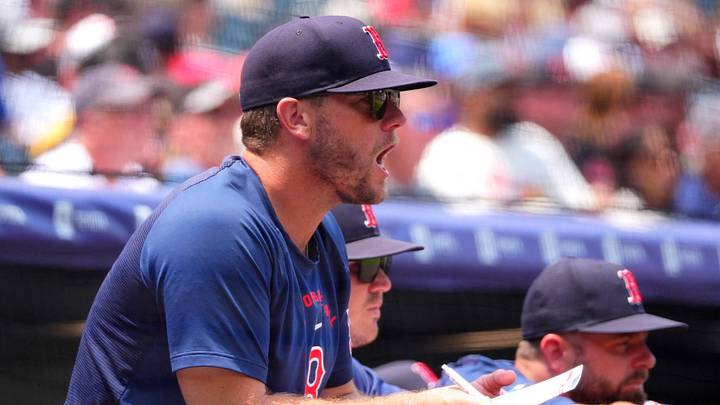
Chad Tracy had the same dream as most other young baseball players. However, he also had a backup plan that is working quite well.
Drafted in the third round in 2006 by the Texas Rangers from Pepperdine University, Tracy spent nine seasons in the minor leagues as a first baseman, including four at the Triple-A level. He never made it to the major leagues, though — at least not until he was named interim manager of the Boston Red Sox.
Why the Red Sox replaced Alex Cora with Chad Tracy

Tracy is now in the big leagues and making quite an impression as the Red Sox’s interim manager. The Red Sox are second in the American League wild card standings and have a 5 ½ game lead over the Texas Rangers for the last wild card.
Baseball Reference gives the Red Sox a 97.8% chance of making the playoffs for a second straight year. That is quite a turn of events because Boston looked like it was taking a step backward when it fired popular manager Alex Cora on April 25 following a 10-17 start and replaced him with Tracy, who was managing Triple-A Worcester.
The Red Sox dropped 14 games under .500 at 32-46 on June 24 in a road loss to the Colorado Rockies. It appeared that Tracy would be just a caretaker while Boston played out the string.
Instead, Tracy is a candidate for AL Manager of the Year. The Red Sox have gone 34-12 since that loss in Denver despite dropping seven of their last nine games.
Red Sox have improved in all phases

So, how have the Red Sox done a 180-degree turn on their season? Tracy insists he has no magic wand.
“I get asked that question a lot, and you can’t just pinpoint one thing because there’s a lot of things,” Tracy said. “Our starting pitching has been outstanding all year. Our bullpen's been great. We started to hit more, which I felt like we would eventually. We started hitting more home runs. We had new guys come in and started to play more small ball. So, I think it was an accumulation of a lot of things.”
Cora was considered one of the best managers in the game and led the Red Sox to their most recent World Series title in 2018, and his firing so early in the season was a surprise. Cora and Tracy had known each other for years. Cora played for the Los Angeles Dodgers when Tracy’s father, Jim, was their manager.
Red Sox management knew it would likely take some time for Chad Tracy to settle in. Yet Chief Baseball Officer Craig Breslow believed the 40-year-old Tracy had the baseball acumen and leadership skills to succeed. A bonus was that many of the Red Sox played for Tracy in the minor leagues.
“I think the biggest reason for our success is the group believing in themselves,” Tracy said. “I give all the credit to the players because everything we’ve asked them to do, they executed. So, we had execution in all phases of the game for a long period of time that helped turn things around.”
The players say Tracy’s biggest strength is his positivity.
“He really loves all his players,” Red Sox rookie left-hander Jake Bennett said. “He has great relationships with us, and he really wants us to succeed. You know he’s always behind you.”
Chad Tracy got into managing thanks to his dad, Jim

Tracy was always on a dual career path. While he hoped to play in the major leagues, he also had a goal of managing in the big leagues.
Tracy’s interest in managing came at a relatively young age as he was a teenager when his father landed his first managerial job with the Dodgers in 2001. Jim Tracy managed in the majors for 11 seasons from 2001-12, also having stints with the Pittsburgh Pirates and Colorado Rockies.
“When he took the job in LA, I’d watch every game, and we’d have conversations on strategy, and he’d tell me why he did this and why he did that,” Chad Tracy said. “I knew then that when I was done playing that I’d want to be a coach or a manager. I love baseball that much. I love the strategy.”
Tracy and his father communicate almost daily.
“Most days, he’ll shoot me a text, and we’ll talk on the phone once or twice a week,” Tracy said. “I know he’s always watching. He’s watching every game.
However, Jim Tracy does not often offer much managerial advice. He wants Chad to stand on his own.
“He just enjoys watching the games and watching the strategies unfold,” Tracy said. “He just gives you a thumbs up to keep going, to keep pushing. So, it’s just being supportive, just being a dad.”
 Add us as a preferred source on Google