
Key Points
Bullet point summary by AI
- Several MLB teams overlooked a high-impact slugger during free agency despite his potent offensive profile and reasonable contract demands.
- The player has already outperformed multiple established stars while maintaining a balanced approach despite high strikeout rates.
- This missed opportunity now looms large for teams struggling to produce run-scoring and offensive consistency in the early going this season.
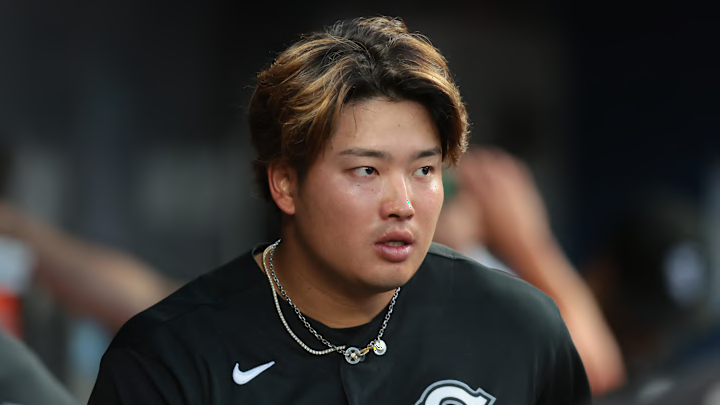
The Munetaka Murakami narratives ran rampant this past offseason. He can't hit velocity. He strikes out too much. He's a negative defender. Many statistical arguments were mounted against the 26-year-old slugger as he came over from Japan, some more valid than others. The end result was a former NPB home run champ and MVP signing a two-year, $34 million contract with the Chicago White Sox, of all teams. Interest in Murakami was minimal at best. He was perceived as too volatile, too risky, a one-dimensional slugger whose one dimension might not translate.
So far, the White Sox are laughing all the way to the bank. Murakami has seven home runs and 14 RBI with a hearty .909 OPS. He's outpacing Kyle Schwarber at the moment.
Munetaka Murakami vs. Kyle Schwarber comparison??
— Chuck Garfien (@ChuckGarfien) April 19, 2026
Sure, why not.
Murakami
7 HRs 14 RBIs 20 BBs 29 K’s .209/.386/.522
Schwarber
6 HRs 12 RBIs 13 BBs 32 K’s .211/.364/.507
Murakami will definitely strike out a lot. He's literally in the bottom percentile for whiff rate (40.6 percent). But he draws a ton of walks and he does not chase, which is critical. And in today's MLB, the home run is king. Batting average and strikeouts are old news; if Murakami is finding ways to get on base and drive in runs, the White Sox will happily stomach a heavy dose of swing-and-miss. So would these teams, if they could have a free agency do-over.
Baltimore Orioles

The Baltimore Orioles were in the mix for Schwarber and ultimately landed Pete Alonso on a monster five-year, $155 million contract. It was nice to see the O's spend some money, but $30 million-plus annually on an aging, right-handed first baseman is not necessarily a smart investment by the book. Sure enough, Alonso has stumbled out of the gate for Baltimore, with a .672 OPS and 94 OPS+.
He will get those numbers up eventually, and his defense at first base has been a pleasant surprise. Long term, however, the O's probably don't feel great about the lifespan of that contract. Murakami is basically the lefty mirror image of Alonso in terms of offensive profile, but he's five years younger and he was much cheaper. This feels like a missed opportunity.
A core of Gunnar Henderson, Samuel Basallo, Jackson Holliday and Murakami, all relatively on the same timeline, would have given the O's an incredible foundation to build upon.
Toronto Blue Jays

The Toronto Blue Jays were dealt the short end of the stick this offseason, whiffing on Kyle Tucker and losing Bo Bichette. Their pivot was to sign Japanese free agent Kazuma Okamoto to a four-year, $60 million contract. There was much debate over which Japanese star would translate better to MLB. Okamoto offered better contact metrics and still generated plenty of power, but Murakami was on a whole different planet in terms of home run pop.
So far, Okamoto looks completely overwhelmed in the box. He has had his moments, but overall, his .576 OPS and 63 OPS+ puts him among the worst regular hitters in baseball. Most worrisome is his 33.8 percent strikeout rate, which is actually slightly worse than Murakami (33.0 percent). Okamoto was supposed to handle the velocity and variety of MLB pitching more effectively than Murakami, with the latter painted as more of a boom-or-bust bat. So far, that's just not how it's playing out.
Okamoto has a better glove than Murakami, but the former hasn't been good enough (-2 Outs Above Average) at third base to compensate for the vast disparity in offensive performance. With George Springer hurt (and due for free agency at season's end), it wouldn't be hard for Toronto to DH Murakami, if necessary. The struggling Jays could really used Murakami's power as a chaser to Vladdy Jr. in the middle of the lineup.
Pittsburgh Pirates

The Pittsburgh Pirates made real strides in the offseason, acquiring Brandon Lowe from the Rays and signing Ryan O'Hearn in free agency. After whiffing on Schwarber, however, the Bucs went with Marcell Ozuna as their DH. It was an understandable buy-low addition at the time, but Ozuna currently has a .546 OPS and 53 OPS+. It's early — he's already starting to turn it around a bit — but you know the Pirates would gladly outbid Chicago's $17 million AAV for Murakami if given a second chance.
Murakami in the cleanup spot, with Oneil Cruz breaking out and Konnor Griffin on the rise, would really transform this Pirates lineup into a wagon. Lowe and O'Hearn are both mashing. Pittsburgh also has one of the best rotations in the National League from the looks of things. Murakami's age and the Pirates' apparent willingness to hand out longer-term investments now means Pittsburgh could've solidified the heart of its order for years to come.
There wouldn't be a more showtime duo in the National League right now than Cruz and Murakami. Pittsburgh is already on a very promising trajectory, but man, not even wading into the Murakami waters — especially after the price point plummeted — looks bad in hindsight.
Philadelphia Phillies

The Philadelphia Phillies were understandably bullish on Bo Bichette, which ultimately didn't pan out. Murakami would have made a lefty-dominant lineup even more lopsided, and the Phillies didn't necessarily feel the pressure to take a risk on a player with Murakami's mixed reputation. Alec Bohm, for all his shortcomings, has been a consistent source of contact in the heart of Philadelphia's lineup over the years.
Fast forward to mid-April, however, and Bohm is completely lost at the plate. His .413 OPS is the second-worst among qualified MLB hitters. Philadelphia, meanwhile, has a complete power void in the lineup behind Schwarber and Bryce Harper. The Phillies are struggling against lefties in particular, but Murakami has a .743 OPS and two home runs in 17 at-bats against southpaws this season. He wouldn't be harming the Phillies in that department.
Defensive concerns at third base are valid, but Philly's defense is a total mess right now. It couldn't get much worse. Murakami would at least provide a jolt in the lineup, presumably in the cleanup spot, where the Phillies have struggled to find stable production over the years. His age and potential for longevity would also be a nice perk on an older roster. Oh well.
Boston Red Sox

The Boston Red Sox did a lot this offseason. The Willson Contreras, Johan Ovideo, Sonny Gray and Caleb Durbin trades. The Ranger Suárez signing. Craig Breslow was active. Whether those moves will coalesce into a competitive team, however, remains to be seen. Durbin was basically Plan Z after Ketel Marte, Bo Bichette and other infield options fell through. Four of Boston's nine regular hitters — Durbin, Trevor Story, Jarren Duran and Carlos Narvárez — are negative-fWAR players so far.
This Sox lineup completely lacks juice. Their 12 combined home runs ranks dead last in MLB. Roman Anthony won't stay cold all season, nor will Duran. But the Red Sox clearly needed a more potent bat to replace Alex Bregman, and even that probably wasn't the only thing the Red Sox needed. In hindsight, Murakami — favored to land in Boston once upon a time — was the obvious solution at third base.
Again, the defensive concerns are real. And like Philly, the Red Sox didn't necessarily need another lefty bat in the heart of the lineup. Sometimes talent trumps all, however, and Murakami's profile would play beautifully at Fenway. There'd be a lot more confidence and optimism around the Red Sox team right now if Murakami was raking near the top of the order.
More MLB news and analysis:
 Add us as a preferred source on Google