
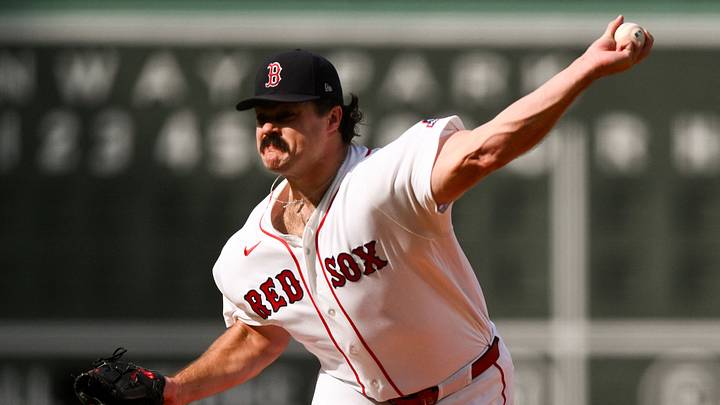
The peak of the Boston Red Sox-New York Yankees rivalry of the 1990s and early 2000s was sneakily defined by starting pitching matchups. There was the whole Roger Clemens fiasco, Pedro Martinez and Mike Mussina, Curt Schilling throwing down 7.8 WAR in 2004, Derek Lowe becoming a folk hero, Andy Pettitte with as many stints on the Yankees as Ts in his name — there was just a lot of intrigue. This year, with both teams careening toward a second consecutive three-game Wild Card series against each other? There figures to be yet more intrigue.
Part of that is because I’m not even sure who each team is going to start in each game. The Yankees have a definite (and abjectly terrifying) one-two of Cam Schlittler and Max Fried, but they could really go either way with Gerrit Cole or Carlos Rodon as the third guy. The Red Sox would probably run Sonny Gray and Ranger Suarez out there in Games 1 and 2, but many, many Red Sox fans would hate to have Payton Tolle sitting idle if the team gets bounced in two games. Everyone who could be starting is having a tremendous season, and a three-game engagement is probably where both of these units are at their strongest.
A Red Sox vs. Yankees Wild Card series should be a battle of starting pitchers
Even without Gerrit Cole and Garrett Crochet figuring in, Red Sox/Yankees three-game pitching matchup looks like an absolute war pic.twitter.com/75JuD5Ji3N
— Oliver Fox (@oliversfox) September 12, 2026
Then there’s Garrett Crochet, the ultimate X-factor about whom we have absolutely no information and thus about whom I will offer only two sentences on his possible return. Crochet and manager Chad Tracy have been epically non-committal about if he will return in 2026; if he can and will be full-strength Crochet, he is the Red Sox’s undisputed ace. If he can’t or is somehow limited, Boston’s rotation will navigate the playoffs exactly as they have this entire year: very well without him.
Rodon is objectively the worst pitcher of the six I threw out there, but he’s also been ripping hot since the All-Star break, having really gotten his walk rate under control. I truly do not know if Cole or Rodon would start Game 3; the “Aaron Boone is an old-school baseball guy” part of my brain tells me that he would trust Cole’s pedigree perhaps to his own detriment, but Rodon’s underlying metrics (particularly his ability to avoid loud contact) feel much more playable in a winner-take-all environment.
Schlittler and Tolle are the most analytically sound of the bunch, with Fried close behind

So how about some numbers? Well, swing-and-miss stuff is always the most bankable aspect of a pitcher’s performance, and Schlittler tops the field with a 31.4 percent K rate followed by Tolle’s 28.9 and Rodon’s 26.9. Rodon won’t be able to make use of that skill if he starts walking the order again, but Tolle’s stuff really plays, and he’s been better than even Schlittler at mixing swing-and-miss with creating weak contact.
Speaking of weak contact, Suarez and Fried (our likely Game 2 starters) are President and CEO of Weak Contact Inc. Suarez is a bit more of a gamer than Fried in that he’s trying to nibble around the edges and trick you with looping breaking balls, whereas Fried is more comfortable pitching to contact and produces tons of ground balls (he also has a shockingly low barrel rate of just two percent). Fried hasn’t pitched that many innings this year because of some injuries, so it almost feels like an outlier.
Eventually, the matchup will come down to individual execution
Gray is the strangest case analytically, since his underlying numbers don’t look like a Game 1-of-a-three-game-series starter, but he’s also won 17 games this year and has pitched through some tough situations. He's a veteran with the experience to handle the pressure of that spot — Boston's other options might be shakier. And if you’re here for a hot take before we go, I would start Tolle Game 2 over Suarez; I just couldn’t fathom leaving someone with his upside and competitiveness to sit and watch things all go wrong.
Sonny Gray in 2026 is a textbook case of this conversation:
— Oliver Fox (@oliversfox) September 12, 2026
ERA: "he got better!"
xFIP, FIP, SIERA: "did he tho?" pic.twitter.com/ObyA2W5oNP
I’m a big analytics guy, as most of you probably know. But in the playoffs, baseball really becomes about who you trust to go out there and execute what you know they can do rather than what your models expect them to do. Models can’t predict performance in one game with any kind of accuracy, but one game is what both of these teams will need from all six of these guys.
That’s why we love sports. We have all this math and machine learning and AI-driven algorithms driving betting odds and predictions markets and god it’s all so optimized (heart-eyes emoji) … but eventually … someone just has to go out there and hoop. Four to six of these guys will have the chance.
 Add us as a preferred source on Google