
As MLB owners and players brace for a potential lockout on Dec. 1, the salary cap debate is reaching a fever pitch. Owners would naturally love to put an artificial cap on spending. They will say it helps to promote competitive balance, but it would also help jack up profits and line pockets. Players, on the other hand, want to maximize their earning potential. As they should.
The players are in the right. MLB owners who want to contend should pay more. They are all capable — or they can sell their teams to someone who will. That said, MLB owners will undoubtedly cite the inflated risk of unchecked spending. It starts with these seven players who are vastly underperforming their exorbitant contracts.
Willy Adames, San Francisco Giants

Contract details: seven years, $182 million ($26 million AAV)
The Giants tried and failed to land Shohei Ohtani. They tried and failed to land Juan Soto. And Yoshinobu Yamamoto. And Aaron Judge. San Francisco has instead pivoted to outsized investments in second-tier star free agents, like shortstop Willy Adames. Such ill-fated splurges have left the Giants rudderless, with a weighty cap sheet that's hard to maneuver around — even when the on-field results demand seismic changes.
San Francisco expected Adames to provide a 30-plus home run threat with Gold Glove-caliber defense at shortstop. In just his second season with the organization, Adames has battled injuries and been little more than league average at the plate, with a career-worst .713 OPS and 97 wRC+ this year. He has also struggled in the field, verging on a comedy of errors. His -17 OAA (outs above average) ranks in MLB's bottom percentile, with 18 errors to his name. He's three shy of the MLB leader (Trea Turner with 21 errors) in 28 fewer games.
For teams with limited capital like the Giants, a contractual misfire on the scale of Adames can sink an organization for years.
Kris Bryant, Colorado Rockies

Contract details: seven years, $182 million ($26 million AAV)
In five seasons with Colorado, Kris Bryant has not appeared in more than 80 games once. That includes missing the entire 2026 campaign with lumbar degenerative disk disease. He appeared in just 11 games last season, too. It's been a while since Bryant was healthy, not to mention productive. This does not seem like an injury that will blow over either. Bryant has tried experimental procedures with no success.
The Rockies could simply waive him; he's no longer part of their short- or long-term plans. It's unclear if he would even have a spot in the lineup were he magically healthy tomorrow. But his contract is fully guaranteed, which means Bryant is still — technically — a Rockie. This is the absolute worst-case outcome for a contract like this. Colorado is a small-market club that is extremely conservative with its spending. Their one major expense blew up almost immediately. It's not hard to see how the Rockies got to the point of four straight 100-loss seasons.
Austin Riley, Atlanta Braves

Contract details: 10 years, $212 million ($21.2 million AAV)
The Braves inked Austin Riley to a 10-year extension in 2022, coming off of his best individual campaign in the Majors. He was 25. Few GMs in baseball have a better track record of extending young stars at an opportune time than Alex Anthopoulos. Riley's annual average value, however, is second-highest on Atlanta's payroll behind Chris Sale, a veteran ace on a short-term deal.
Riley's offense has gradually slipped every year since he put pen to paper, but it has reached new lows in 2026. Riley currently has a .651 OPS and 80 wRC+, well below league average, with a gaudy 31.6 percent strikeout rate and middling defensive metrics at third base. It's hard to derive value from Riley's profile; his expected average (.213) sits even lower than his actual average (.220), so the Braves can't even subscribe to the notion of bad luck.
The Braves are too deep, too talented and too smart for this to sidetrack them, but Riley is becoming a black hole toward the end of their lineup, which could be problematic in October.
Kyle Tucker, Los Angeles Dodgers

Contract details: four years, $240 million ($60 million AAV)
Kyle Tucker passed on decade-plus offers in free agency to sign a short-term, high-AAV deal with the Dodgers, hoping to pocket $120 million in a two-year span before opting out to sign a $500 million-plus, long-term contract in 2028 free agency. Only Tucker's production has fallen off a cliff despite no shortage of protection in L.A.'s superpowered lineup. He has experienced a long overdue resurgence in September, but Tucker's season-long output — a .726 OPS and 102 wRC+ with porous right field defense — falls hilariously short of his contract. Only Shohei Ohtani makes more annually, and Ohtani's contract is almost entirely deferred.
Tucker probably has better days ahead and the Dodgers' limitless spending is why the salary cap debate has taken center stage in recent years. Yet even the Dodgers may struggle to fully compensate for Tucker's regression, should it continue. And if he opts in to the full four years, which he will if next year is not a dramatic turnaround, then L.A. is in a real tricky spot. The Dodgers actually benefit from no salary cap, but Tucker's contract is quickly becoming an argument in favor of one.
Xander Bogaerts, San Diego Padres

Contract details: 11 years, $280 million ($25.5 million AAV)
Xander Bogaerts is a four-time All-Star and five-time Silver Slugger with two World Series titles under his belt. It's no wonder why San Diego paid up. Unfortunately, Bogaerts' bat has imploded since he left Boston in 2022. That's not to say Bogaerts has been uniformally bad for the Padres, but he's especially inconsistent right now. His .667 OPS and 93 wRC+ aren't cutting it. More worrisome, Bogaerts is approaching his 34th birthday. He is signed through 2033, his age-40 season.
If the decline has already started, history tells us it will probably continue. Bogaerts' contract is rapidly approaching sunk cost territory for the Padres, whose lack of depth at the farm level has left GM A.J. Preller relegated to expensive free agent contracts or cheap midseason pickups to improve a flawed roster.
Bogaerts is still a plus defender at shortstop, but for how much longer? He's still a smart hitter, working deep into counts and avoiding strikeouts, but his once-standout power has dissipated. There are some bad luck indicators, so Bogaerts is not completely a lost cause. But the cliff is coming sooner than later, which the Padres can ill afford.
Trea Turner, Philadelphia Phillies

Contract details: 11 years, $300 million ($27.2 million AAV)
Trea Turner finds himself in a similar (if slightly more expensive) boat as Bogaerts — a World Series champ and three-time All-Star shorstop who's locked up through his age-40 season. The Phillies, just like the Padres with Bogaerts, always knew that contract would age poorly. But how poorly, and how quickly the tide would turn, were open-ended questions. If Turner could put an MVP-caliber season or two together and help the Phillies win a title, the rest of the money is far easier to stomach.
Unfortunately for the Phillies and their fans, Turner has become borderline unplayable less than halfway through the contract and Philadelphia has, time and time again, flamed out in the playoffs. It feels like the exit comes earlier every season. That is, perhaps, a mild overstatement. Turner finished fifth in NL MVP voting a year ago. Sometimes the bad years are a true one-off. Turner still has elite speed; his defense has declined, but he followed up a brutal defensive campaign in 2024 with elite glovework in 2025.
That said, Turner's .679 OPS and 84 wRC+ mean he is a net-negative presence at the plate. There aren't a ton of reasons for optimism either. He's not hitting the ball hard to the wrong spots. He strikes out too often but does not compensate with walks. His swing decisions are a mess. His confidence is shot. The trends are extremely worrisome.
Vladimir Guerrero Jr., Toronto Blue Jays

Contract details: 14 years, $500 million ($35.7 million AAV)
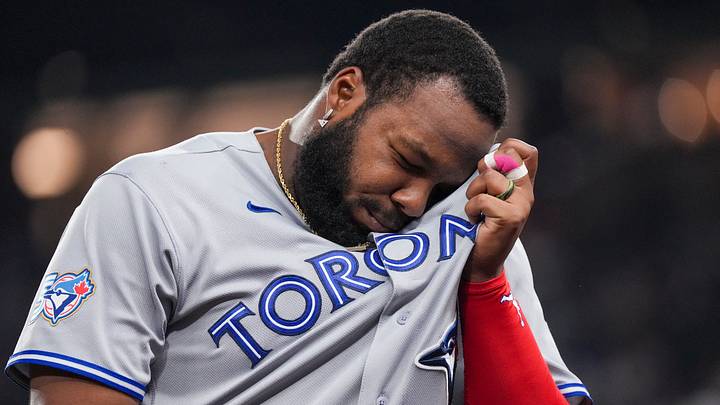
It's much easier to talk yourself into an imminent bounce-back for Vladimir Guerrero Jr., who's only 27 years old. Time is on his side. That said, he's also in year one of a 14-year, half-billion dollar extension. For his production to bottom out like this, down to a .695 OPS and 97 wRC+ with only nine home runs, is concerning. Even more concerning are his recent comments.
"I want people to understand one thing. The money they gave me wasn’t for what I’m going to do. It was for what I already did. They didn’t pay me because I’m going to hit 40 [home runs] every year. They paid me for what I already accomplished."
Vladimir Guerrero Jr. opens up on his slump year: “They didn’t pay me to hit 40 every year. They paid me for what I already did.”
— Master Flip | Phillip Feliz 🇩🇴 (@Masterflip_) September 23, 2026
I want people to understand one thing. The money they gave me wasn’t for what I’m going to do. It was for what I already did. They didn’t pay me… pic.twitter.com/ALPlCgmKjw
That ... is not true, Vladdy! The Blue Jays probably didn't expect 40 home runs every season through his 40th birthday, but they probably expected close to a decade of elite production through his late 20s and early 30s before the contract curdled. Toronto was in the World Series a year ago. The expectation was that Vladdy could keep them in that conversation for the foreseeable future.
Guerrero Jr. still generates plenty of hard contact. He will have better years, almost certainly. But he's also a right-handed first baseman with a negative defensive profile, which is not an archetype that teams typically value. Guerrero Jr. was viewed as an outlier due to his youth and his production and his importance to the organization. If he's suddenly just a fine hitter, the next decade-plus could get rocky. Fans have already lost their patience and the vibes around Toronto are less than ideal. This is a five-alarm fire for the Blue Jays.
 Add us as a preferred source on Google