
Key Points
Bullet point summary by AI
- The Seattle Mariners have pioneered a new pitching strategy that could reshape how rotations are built.
- The approach pairs two starters in the same game to manage workloads and keep arms fresh.
- Piggybacking's success in a tight division race may convince other clubs to adopt the same innovative model.
Openers became a thing in 2018. The Tampa Bay Rays started the trend by using relievers Sergio Romo and Ryne Stanek for one inning to begin games. Then the starting pitcher — or more accurately, a bulk reliever — would enter the game in the second inning.
Openers have become mainstream today, the reasoning being that they enable the use of a reliever in a high-leverage spot right at the start of the game, and then, optimally, gain a platoon advantage for an inning or two before bringing in the bulk reliever. Perhaps the next big thing is the piggyback system, in which two starting pitchers split the innings in a game.
The Seattle Mariners have been at the forefront of that trend.
Why would teams use piggyback starters?

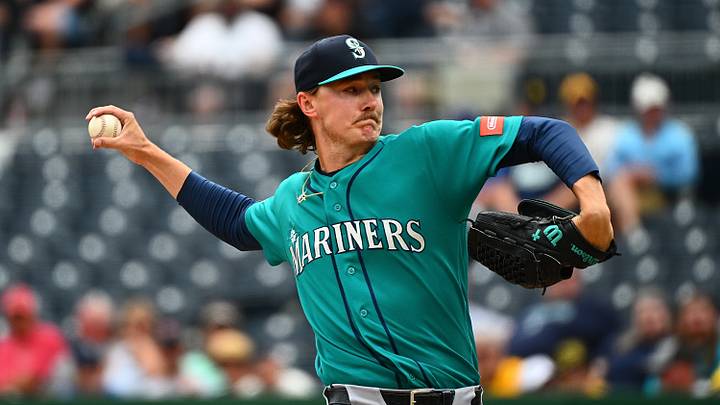
There are a few reasons. In the Mariners’ case, they have piggybacked Bryce Miller with fellow right-hander Luis Castillo three times. The rationale was to ease Miller back into action after he began the season on the injured list with a strained left oblique.
Starting pitchers are creatures of habit, and most don’t like their regular routine interrupted during the season. However, Miller doesn’t mind being in a piggyback situation.
“I think it really helped coming back from my injury,” Miller said. “I didn’t have to pace myself, just go out and let ‘er rip and find out how I feel.”
The Mariners also have the luxury of having six pitchers for five spots in their rotation as Miller and Castillo are joined by Logan Gilbert, Emerson Hancock, George Kirby and Bryan Woo. Manager Dan Wilson planned to pitch Gilbert and Hancock in tandem last Saturday against the Cleveland Guardians, but opted against it because Gilbert has been pitching well and was the American League Pitcher of the Week last week.
However, the Mariners plan to use all their starters at least once in a piggyback situation over the next two weeks leading into the All-Star break, which begins July 13.
“I think for us, the benefit is you're keeping a couple of guys stretched out a little bit more, and you don’t necessarily have to give them an extra day of rest between starts,” Wilson said. “That's really the impetus for why we have done it. What we've seen from some of this is that both guys are getting 60-70 and they’re just letting it fly, letting it rip. There is a benefit in getting them some rest but still getting the best out of them, even if it’s a little more limited than a regular start.”
Will piggybacking go mainstream?

Piggybacking has long been practiced in the minor leagues. It is done primarily to limit young pitchers’ innings totals.
The Pittsburgh Pirates piggybacked starters at the major league level last season, primarily pairing then-rookies Braxton Ashcraft and Bubba Chandler with veteran starters.
When right-hander Jared Jones was activated from the injury list on May 30 after missing last season because of internal brace elbow surgery, he was paired with right-hander Carmen Mlodzinski for four starts. While Mlodzinski was initially upset about being removed from the rotation, he has embraced the role — at least publicly.
Since every team is looking for more innovative ways to try to win and develop young pitchers without overworking them, could piggybacking become more common? Pirates manager Don Kelly isn’t so sure.
“I think it all depends on the totality of the situation and what you have going on — starters, bullpen and everything — and how it makes sense,” Kelly said. “I know that we did it a little bit last year and more so in September when we had the extra arm. I think just depending on the pitching staff, it can be something that works, but you have to take the whole situation into account and see how that's going to pan out.”
The Mariners are confident that piggybacking will yield dividends down the stretch because their starting pitchers will be theoretically fresher.
Seattle can use every advantage it can get in a tight American League West race. The Mariners trail the division-leading Texas Rangers by ½ game while the Houston Astros are one game back and the Athletics are two games behind.
“It doesn’t necessarily give us a strategic advantage because teams are always prepared to face everyone on the staff,” Wilson said. “We think the payoff is going to come later in the season. We’ll see how it all turns out.”
Other teams will be certainly watching the Mariners.
"It's an interesting idea but I'm not so sure it's right for most teams," an executive from an MLB team said on the condition of anonymity so he could speak candidly. "You know how people in baseball and sports in general are. If something works, then you'll see copycats."
More MLB news and analysis
 Add us as a preferred source on Google