
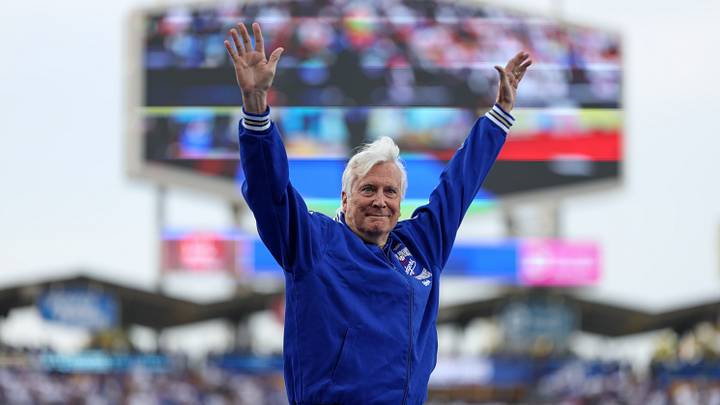
Mark Walter owns baseball's back-to-back champion in the Los Angeles Dodgers, and this year he's been acting like someone under real pressure. He's been selling off marquee assets, restructuring the insurance side of his business, and doing it all while a federal criminal investigation and a parallel SEC probe dig into how his companies handle billions of dollars of other people's money.
None of that means the Dodgers are for sale, and nobody has been charged with anything. The questions are legitimate, they're not going away, and Dodgers fans deserve to understand what's actually being looked at instead of just watching headlines fly by. This story has already changed shape more than once since it first surfaced, and it'll likely change again before it's resolved. We are going to explain what has happened in plain English, following the evidence as far as it currently goes.
Mark Walter's money machine in 30 seconds
People buy insurance policies and annuities from companies Walter controls, mainly Delaware Life Insurance Co. and Clear Spring Life and Annuity Co.
Those insurers take the money collected from policyholders and invest it, the same way any insurance company does, so it can cover future payouts and grow.
Some of that investing came in the form of private loans to other businesses.
Billions of dollars’ worth of those loans went to companies connected to Walter's own broader business network.
Investigators believe some of that money passed through a handful of intermediary firms before landing with Walter-linked businesses on the other end.
Federal prosecutors and the SEC want to know whether those connections were properly disclosed, and if not, why.
A few terms from that list are worth unpacking before you go further. An annuity is a retirement product: a customer gives an insurance company a lump sum or a series of payments now, and the company promises to pay them a guaranteed income later, sometimes decades later. That's why insurance companies are supposed to invest conservatively. They're not managing their own money, they're managing a promise to real people who are counting on that money showing up on schedule when they're 75. "Private loans" or "private credit" just means the insurer isn't buying something that trades on a public market, like a regular stock or bond anyone can look up a price for. It's a direct, custom loan to a specific business, which makes it much harder for an outside regulator, or a policyholder, to check whether the deal is actually a good one.
Why does an insurance company have anything to do with the Dodgers?

Walter's fortune was built on the insurance side long before he owned a baseball team. He bought the Dodgers in 2012 using wealth generated through Guggenheim Partners and the insurers he controls. That connection has actually drawn legal scrutiny before. Back in 2014, two annuity holders filed a federal racketeering lawsuit accusing Guggenheim, along with Walter, Todd Boehly, and a business associate, of using insurance company money as a "cash machine" to help fund the Dodgers purchase, alleging more than a billion dollars in policyholder funds went toward the $2.15 billion price tag. That suit was dropped the day after it was filed, without any public explanation ever surfacing (Jeff Passan mentioned this on his podcast this week). A separate, similarly themed lawsuit from a policyholder was dismissed by a Kansas judge in 2019.
So this isn't the first time someone has raised questions about the line between Walter's insurance business and his sports ownership.
Did Mark Walter basically lend himself money?
Sort of, but the more accurate way to put it is that Walter's insurance companies lent money to businesses that had ties back to Walter, and didn't properly flag those ties. That distinction matters more than it might seem. Related-party lending itself isn't automatically illegal or even unusual in the insurance and finance world. Companies do it all the time, for perfectly ordinary reasons.
What the law actually requires is disclosure: insurers have to report those deals so regulators can confirm the terms are fair and there's no conflict of interest, basically making sure the company isn't quietly writing itself a sweetheart deal at the policyholders' expense.
Skip that disclosure step, and there's no way for anyone outside the company to know whether a loan is a normal business decision or one company sitting on both sides of a deal, as lender and as borrower, with the terms set to benefit whoever controls both sides.
That's exactly the question hanging over Walter's current situation, and it's why federal prosecutors and the SEC are the ones asking now.
What exactly is Mark Walter being investigated for?

Two issues have grown into one. Delaware Life and Clear Spring received grand jury subpoenas in February from the U.S. Attorney's Office for the Southern District of New York, working alongside the SEC. The core question is whether the insurers failed to correctly label loans as "affiliated" or "related-party" transactions, and whether that failure was sloppy compliance or something more deliberate.
After the subpoenas landed, Delaware Life ran its own internal investigation and found what it's calling errors in its financial reporting. The company had originally reported that about 3% of its investment portfolio was tied to Walter-affiliated businesses. By the company's own restated figure, that number came in at 42% of invested assets, more than $16 billion. Fitch Ratings has said that's the highest concentration of affiliated investments of any North American life insurer it reviews. A jump like that doesn't happen by accident. It means the company's own books looked nothing like what it told regulators a year earlier.
More recently, the Wall Street Journal reported that investigators have narrowed in on four specific businesses that may have played a role in that gap: Miami-based ABS Capital, an investment firm called Amistad Financial, commercial real estate broker Bradford Allen, and a firm called Hudson Trading.
The Wall Street Journal is now reporting that federal prosecutors are investigating whether Mark Walter committed fraud by using intermediaries to redirect customer funds back to himself without disclosing the loans as related party transactions. pic.twitter.com/3OUz2vYQRH
— Joe Pompliano (@JoePompliano) August 16, 2026
There is a lot there, so we will break it down in plain terms: money from a Delaware Life or Clear Spring loan goes out to one of these four firms first. That firm then directs the money onward to a business Walter has ties to. On paper, the insurer just made a loan to an independent, unrelated company, since technically it did.
What investigators want to know is whether that middle step existed for a real business reason, or whether it was there mainly to keep the loan from being flagged and disclosed as money going to one of Walter's own ventures. Nobody has been charged, and Walter's team says the businesses haven't been accused of any crimes.
Separately, prosecutors have also been examining Guggenheim Partners, the roughly $362 billion asset management firm Walter runs as CEO, over whether the firm gave outside parties inaccurate information about its revenue.
Both the Wall Street Journal and Bloomberg have reported that a whistleblower complaint about how Guggenheim Investments booked revenue from its dealings with the insurers is what set the whole investigation in motion, sometime in 2025, before the insurer-side subpoenas ever went out.
In September 2025, the FBI executed a search warrant aboard a private plane at Chicago's Midway Airport and seized a phone and laptop belonging to Walter. Seizing a high-profile executive's devices is a serious step, though it doesn't by itself mean anything has been proven.
Potential criminal exposure
If this moves from investigation to charges, here's what that could look like in practice, based on how federal prosecutors typically build cases like this one.
The most likely charge, according to white collar defense attorneys who've spoken publicly about the case, is mail or wire fraud. Those carry up to 20 years per count. The legal theory would be that Walter or his companies knowingly misrepresented the true nature of these loans to regulators, and that the misrepresentation itself is the crime, regardless of whether any insurer ever failed or any policyholder ever lost a dime. One attorney put it plainly: the entity's survival isn't a prerequisite for a crime when the conduct was intentionally misleading.
Running alongside any criminal case would be the SEC's own civil track. Since Guggenheim operates as a registered investment adviser, that side of things would likely focus on whether the firm made false or misleading statements in official filings, and whether it accurately represented its revenue to outside parties, the very thing that first drew a whistleblower's attention.
There's also a state-level angle separate from anything happening in Manhattan. Delaware's own insurance code carries criminal penalties, including prison time, for a company officer or director who knowingly files false paperwork with the intent to deceive. That's a distinct legal exposure tied to how Delaware regulates its insurers, and it would run through Delaware's own system rather than federal court.
Think of all this as a map of what's legally possible, not a forecast of what's coming. No charges have been filed against Mark Walter or anyone connected to his businesses. Investigations like this one, even ones involving subpoenas, seized devices, and years of scrutiny, frequently conclude with no charges at all.
Why did Mark Walter sell the Lakers?

Walter hasn't explained his reasoning publicly, but the timing lines up with pressure he's been under to clean up his insurers' books. The sale is now finalized: former Disney CEO Bob Iger and Thrive Capital's Joshua Kushner agreed to buy the team for a record $12.5 billion, a huge jump from the $10 billion valuation Walter paid for it barely a year earlier. Dodgers president Stan Kasten has said he was surprised by the move and that Walter had no plan to sell going in.
The sale created an unexpected family fight that has nothing to do with the federal investigation. The Buss family, which retained a minority stake when Walter first bought in, voted to sell their remaining 17.8% share alongside Walter's stake. But Jeanie Buss, the team's longtime governor, is contesting that vote, arguing a 2017 court order requires her personal sign-off on any sale of the family's shares. That dispute is over the Buss family's piece of the deal, not Walter's sale of his own controlling stake, but it could still tie up the transaction in court if it isn't resolved.
Why was he trying to get out of the Dodgers and Lakers TV deals early?
Walter is trying to raise cash. Reports indicated Walter approached Charter Communications, which carries the Dodgers broadcasts through SportsNet LA, about a lump-sum payout in exchange for letting Charter out of that media deal early.
The Dodgers' local-TV deal is a profound competitive advantage. Because of a bankruptcy-court ruling, the team will shield more than $1.3 billion from rev sharing over 25 years. What you might not know: They further monetized it through debt deals with Mark Walter-owned insurers. pic.twitter.com/HhwHf09Uc9
— Jeff Passan (@JeffPassan) August 25, 2026
Those talks didn't go anywhere, according to reports at the time. The Dodgers' current deal with Charter is a 25-year agreement signed in 2013 worth close to $8.35 billion, running through the late 2030s and averaging around $334 million a year in revenue, a massive advantage over most other MLB markets thanks to how the deal was structured coming out of the Frank McCourt bankruptcy years ago.
Could Mark Walter be forced to sell the Dodgers?
There's no indication that's happening right now, and Kasten has said directly that the team isn't going to be sold. The Dodgers are Walter's most valuable and most personal asset. Walter told the Los Angeles Times back in 2012 that owning the team was "a multi-generational thing my daughters' granddaughters will own."
What has changed is that Walter's side has taken a real, concrete step to address the underlying problem rather than just promising to. TWG Global, his holding company, agreed to buy up to $6.5 billion of Delaware Life's affiliated investments and give the insurer an equal value of unaffiliated assets in return. Again, this is a lot of information that can be plainly stated as the affiliated loans don't disappear, they move from Delaware Life's books to TWG Global's. Simply put, they go from one Walter-controlled entity to another Walter-controlled entity. What changes is that the regulated insurer holding policyholder money no longer shows that exposure, which is the specific problem the Delaware Department of Insurance wants fixed.
The deal is disclosed in Delaware Life's own regulatory filings, but it still needs the department's formal approval before it can close. Delaware's insurance commissioner has said only that the state will share more "as soon as appropriate." Still, it's a meaningfully bigger commitment than anything on the table a month ago, and it suggests Walter's team is trying to resolve this on the balance sheet rather than by selling off marquee assets.

If ownership ever did change hands, a few things would kick in automatically. Shohei Ohtani's contract includes an opt-out clause that lets him leave if Walter stops being the Dodgers' controlling owner, or if Andrew Friedman stops running baseball operations. More than a billion dollars in deferred money owed to Dodgers players over the next two decades would simply transfer to whoever owns the team next. MLB hasn't commented on the investigation and has never forced an ownership change through a vote of other owners, though the league did apply financial pressure on the Dodgers' previous majority owner, Frank McCourt, during his bankruptcy years ago.
For now, the Dodgers keep winning, the investigation keeps developing, and Walter keeps insisting the two things have nothing to do with each other. None of this is settled. Numbers have already moved once, from 3% to 42%, from one company under scrutiny to four named intermediaries, from talk of selling media rights to an actual $6.5 billion agreement on file with regulators. That's the honest state of a story like this: it follows the evidence, and the evidence keeps showing up. Whatever comes out next, whether it clears Walter or deepens the case against him, will change this picture again. We'll keep updating this as it does.
 Add us as a preferred source on Google