
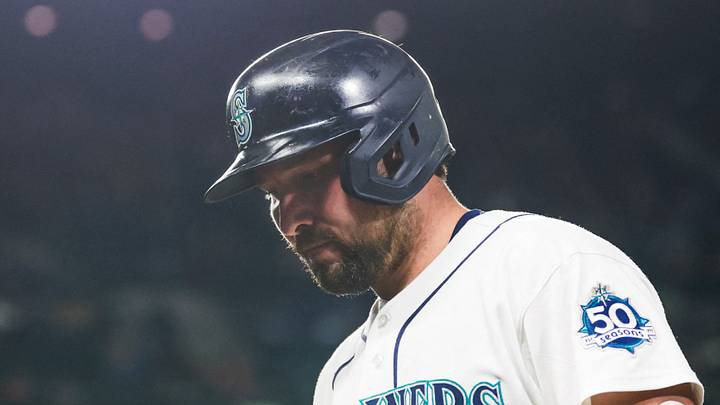
Even before the calendar turned to April, those who placed a futures bet on Seattle Mariners catcher Cal Raleigh winning the AL MVP were likely regretting their investment.
Thankfully for the sake of his mental health, Raleigh is in the final days of what’s proved to be a disastrous 2026 season. His feud with teammate Randy Arozarena during the World Baseball Classic only foreshadowed a six-month stretch marred by injuries, strikeouts and overall regression. Things have been so bad that his “best” can justifiably be called “disappointing.”
Raleigh entered Wednesday hitting .181 with 23 home runs, 68 RBI and a .667 OPS in over 500 plate appearances. All represent his worst since becoming the Mariners' full-time catcher in 2022, and his 1.1 bWAR is over six wins lower than last year's 7.2 mark. He’s also faced mounting questions about his viability both as a long-term catcher and as a clubhouse leader.
Whether the issues are that deep, though, depends on who you ask.
“Teams are just throwing lefties at him as much as possible,” a National League scout told FanSided’s Pat Ragazzo earlier this month. “He also caught a lot last year, and the only teams that played more games than him were the two World Series teams, so there was going to be regression there.”
Will Seattle Mariners catcher Cal Raleigh be the latest one-year wonder?

For the sake of conversation, let’s look at Raleigh’s year-over-year splits. We’ll start off with his numbers against right-handed pitching.
Statistics | Vs. right-handed pitchers (2025) | Vs. right-handed pitchers (2026) |
|---|---|---|
Plate appearances | 500 | 324 |
Batting average | .231 | .188 |
Home runs | 38 | 14 |
On-base percentage | .362 | .302 |
Slugging percentage | .547 | .390 |
Walks | 79 | 44 |
Walk percentage | 15.8% | 13.5% |
Strikeouts | 127 | 95 |
Strikeout percentage | 25.4% | 29.3% |
Interesting. Now, let’s look at Raleigh’s numbers against left-handers:
Statistics | Vs. left-handed pitchers (2025) | Vs. left-handed pitchers (2026) |
|---|---|---|
Plate appearances | 205 | 187 |
Batting average | .281 | .170 |
Home runs | 22 | Nine |
On-base percentage | .351 | .278 |
Slugging percentage | .681 | .346 |
Walks | 79 | 24 |
Walk percentage | 15.8% | 12.8% |
Strikeouts | 127 | 65 |
Strikeout percentage | 25.4% | 34.7% |
We personally love referencing walk and strikeout rates, partly because they offer additional context about a player’s overall plate discipline. So with regard to Raleigh, he has a lifetime 29.5 percent strikeout rate against left-handed pitchers, and that number drops to 28.4 percent when he faces right-handers.
The wear-and-tear argument is interesting because both the Blue Jays’ Alejandro Kirk and the Dodgers’ Will Smith have also battled injuries this season. But Smith played 144 games between the 2024 regular season and playoffs, and he posted a .901 OPS in nearly 450 plate appearances last year.
But maybe the numbers only tell part of the story, and it’s entirely possible that Raleigh is who he is: a strikeout-heavy catcher with plenty of pop in his bat. That’s what the Mariners signed up for when they inked him to that six-year, $105 million extension before his 60-homer campaign.
We’ve repeatedly been critical of Raleigh for his conduct and attitude, and that’s our greatest concern going forward. Even excluding the steroid era and the 2019 juiced-ball season, we’ve seen enough unexpected power bursts over the years, so Raleigh potentially never reaching 40 homers again wouldn’t surprise us.
If Raleigh wants our advice, his best bet is to look in the mirror and ask himself what’s gone wrong beyond the percentages. He could spend the offseason studying his stance, but learning to deal with the pressure and handle a locker room must be a far greater priority.
 Add us as a preferred source on Google