
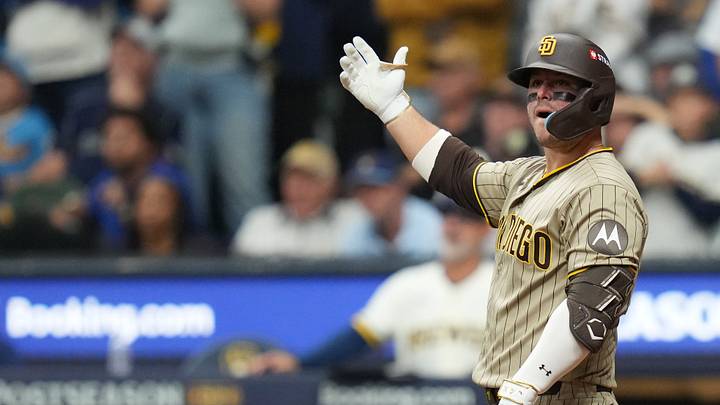
It took less than a week of postseason baseball for our first official controversy to arrive. With the San Diego Padres trailing the Milwaukee Brewers, 3-2, in the top of the ninth inning of NLDS Game 1 on Saturday night, San Diego first baseman Ty France lifted what he thought might be the go-ahead homer high down the left-field line at American Family Field. But instead, the ball caromed off a support beam near the stadium roof ... and landed right in Jackson Chourio's glove for out No. 2.
Ty France is robbed of a potential go-ahead homer as the ball hits the roof and drops back into play 🤯 pic.twitter.com/UkWjHytIEb
— Sportsnet (@Sportsnet) October 4, 2026
One batter later, Milwaukee escaped with a crucial Game 1 win — while San Diego was left wondering what the heck happened.
"You'd think with all the technology and data and everything we have now, you'd be able to make a clear call ... that shouldn't be an out," France told reporters after the game. He also doubled down on Instagram, replying to a fan post that he thought the ball would have been a homer if it hadn't been obstructed.
For the record: Yes, the play was ruled correctly. Ground rules in Milwaukee state that any ball "striking roof, roof truss or roof cable over fair territory" is in play. There's no doubt that the ball was still in fair territory when it made contact, and that, by the letter of the law, France was out.
That won't do much to assuage Padres fans and players, who are understandably irate in the aftermath. But while this absolutely goes down as a bad break, it's hard to really argue that San Diego is a victim here. The ground rules are what they are for very good reason, and the evidence is against the idea that France's fly ball would've actually left the yard anyway.
What Statcast can tell us about Ty France's controversial fly ball
Let's be clear at the outset that this is all very hypothetical. Ball-tracking systems have come a long, long way, but they're still imperfect measurements, and — France's protestations to the contrary — we simply don't have the requisite technology to determine with enough accuracy that his fly ball would or would not have been a home run.
The best we can do is look at past examples of fly balls that fit the batted-ball profile most closely. There were 27 fly balls this season with an exit velocity of 105 mph (France's was 105.3) and a 49-degree launch angle; exactly none of them resulted in home runs. In fact, it's never resulted in a home run in the entirety of the Statcast era.
Is that a smoking gun? Of course not, given that it doesn't take into account atmospheric effects, other park factors and the direction the ball was hit, and we see unicorns in baseball all the time. But a 49-degree launch angle is inordinately high, the kind of thing you hardly ever see on a home run. The odds are against France's ball actually leaving the yard — and that's before we even get to the fact that it looked as though it could very well have been drifting foul anyway. Add it all up, and there's simply too much doubt here for the Padres to act as though they had two clear runs taken off the board.
Brewers ground rules are just fine and shouldn't be changed
Which brings us to San Diego's second line of argument: That regardless of whether France's ball would have been a homer or not, it's unfair to rule him out based on nothing more than a fluke deflection that happened to land right in Chourio's glove. But again, just because something is unfair doesn't mean it's unjust.
What should the ground rule be instead? Change it to a dead ball, a homer or a ground-rule double — all suggestions that were floating around in the aftermath — and you run the risk of an obvious out being taken from the fielding team. There's no perfect solution here; short of outlawing domed stadiums, you're going to have to try and account for balls hitting off of various structures in some way, and simply letting the bounce land where it may is the best available option.
That's bound to screw somebody over now and then. But there were no actual mistakes made on Saturday night, either by the umpiring crew or by rules officials. It was a one-in-a-million play, one that just as likely would've resulted in a loud strike or a flyout as a game-changing homer.
 Add us as a preferred source on Google