
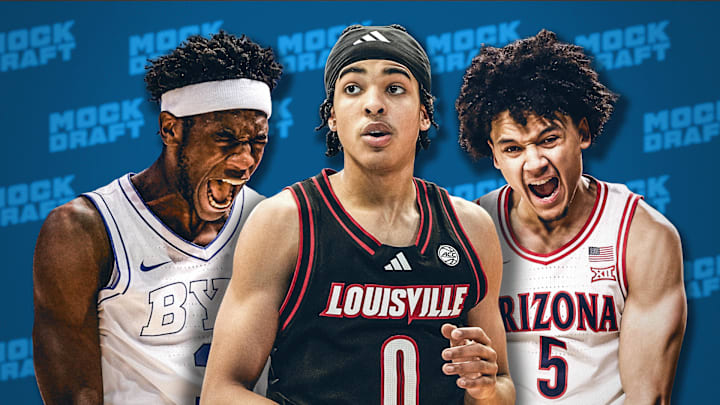
Adam Silver has made it his No. 1 priority to reform the NBA Draft Lottery in an effort to curb tanking. That discourse reached peak frequency this season as teams bottomed out left and right in anticipation of a historically deep prospect class.
Here's what to look forward to.
Adam Silver's new NBA Draft Lottery rules, explained
The league is hoping to adopt a new '3-2-1' lottery framework, which refers to the number of lottery balls each team receives.
The field would expand from the 14 non-playoff teams to 16 teams, including the No. 8 seeds in each conference. The Nos. 9 and 10 seeds in the Play-in Tournament would each receive two lottery balls. The loser of the No. 7-No. 8 matchup will receive one.
For teams who don't crack the Play-in race, the odds are flattened. Every team 4-10 will receive three lottery balls. The three teams with the worst records in the NBA, however, land in the "relegation zone" — which means only two lottery balls. The goal, essentially, is to disincentivize tanking all the way to the bottom, which this proposal accomplishes.
Teams is the relegation zone have a floor of the No. 12 overall pick; every other team can fall as far as No. 16.
ESPN's Shams Charania dropped the initial report with all these details. The proposal could undergo slight tweaks ahead of a vote from the NBA's Board of Governors in late May, but the broad framework has "a majority of the support from teams."
Chaos shall reign. Time will tell if this is even remotely beneficial to the NBA product, but it will make Tankathon spins really fun next season. In the meantime, SportCLT's Dylan Jackson has devised his own simulation tool, which applies these new rules to the current lottery standings. Just to visualize the chaos ahead and give us a sense of what's coming down the road, let's give it a whirl and see how it would theoretically impact the current draft:
1. Memphis Grizzlies: AJ Dybantsa, F, Brigham Young

Okay. This is a fairly normal outcome. Memphis was among the most prominent tankers this season, trading Jaren Jackson Jr. at the deadline and effectively benching Ja Morant due to injury down the stretch. Zach Edey missed most of the year. Memphis just never got healthy enough to climb out of the basement.
AJ Dybantsa has emerged, more or less, as the consensus No. 1 pick in this draft. He was more productive (and available) than Darryn Peterson and he has fewer athletic question marks than Cameron Boozer. Dybantsa's size, dexterity and explosiveness as a wing slasher offers crystal-clear visions of offensive stardom. He's a talented three-level scorer and a better passer than he gets credit for, with unbelieveable craft for such a superhuman athlete.
>> Read our AJ Dybantsa scouting report
2. Charlotte Hornets: Darryn Peterson, G, Kansas

Charlotte jumps up to No. 2 after winning 44 games and losing the 8-9 Play-in matchup against Orlando. This is, in theory, what the league wants: teams going all-out, making real strides toward a better future, and still getting rewarded through the lottery.
Darryn Peterson would join a talented young core with LaMelo Ball, Kon Knueppel and Brandon Miller. The combined versatility of those four offensive skill sets would make Charlotte a real headache for opposing defenses. Peterson was a prodigous off-ball scorer at Kansas, but he was more of a downhill finisher and distributor in high school. He's the most well-rounded guard prospect in over a decade. If the medicals check out, Charlotte would be dancing in the streets with this pick.
>> Read our Darryn Peterson scouting report
3. Oklahoma City Thunder (via LAC): Cameron Boozer, F, Duke

This is an underrated storyline in all of this: teams who traded future picks — especially unprotected picks — just took on a whole new level of downside risk. Oklahoma City has 9.4 percent odds of landing in the top four with L.A.'s pick right now. Their current odds of receiving the No. 1 pick would jump from 2.0 percent to 5.4 percent. Not huge, but also not insignificant. And there's just way more upward mobility.
Cameron Boozer was the most dominant force in college basketball as an 18-year-old. The are fair questions about his defensive projection and how exactly his below-the-rim style translates to the NBA, but Boozer is built like a tank, with incredible scoring versatility and processing skills. He's too smart to fail. He will elevate teammates and fit into whichever role the reigning champs need him to, extending OKC's seemingly endless window even further.
>> Read our Cameron Boozer scouting report
4. Atlanta Hawks (via MIL): Caleb Wilson, F, North Carolina

This new system will really favor teams in Atlanta's situation, with ownership rights to the highest pick of two different lottery teams. The Hawks will get Milwaukee or New Orleans' pick, depending on which lands higher. Under the new rules, that would mean a 16.8 percent chance at No. 1, compared to their current 9.8 percent odds.
Atlanta certainly wouldn't complain about the No. 4 pick either. Caleb Wilson probably isn't the ideal positional fit, but he's too special a player to pass up. Atlanta can envision him sprinting the floor with Jalen Johnson for the next decade — two massive, explosive athletes at the forward position. Wilson has a few fundamentals to clean up, but he's a hellacious defender with real flashes of downhill creation and mid-range shooting, in addition to his myriad veritcal flourishes at the rim.
>> Read our Caleb Wilson scouting report
5. Brooklyn Nets: Darius Acuff Jr., G, Arkansas

Brooklyn avoids catastrophe in this simulation, but these rules will impact bad teams the most — at least in terms of adverse effects. It's already harder than ever for small markets to build through free agency or trades. The CBA severely limits financial flexibility for top spenders. The best way for bad teams to carve out a future is through a few years of hearty tanking and top prospect additions. Now that becomes challenging, if not impossible.
The Nets wouldn't complain much about Darius Acuff, however. He's the most productive and impactful freshman guard since Trae Young. He just completely wrecked college defenses, operating with a level of poise we rarely see from 19-year-old point guards. Acuff is an elite off-ball shooter and connector when he needs to be; he's prolific creating out of the pick-and-roll, with a thick frame and bursty athleticism. He can captain the Nets toward a brighter future.
>> Read our Darius Acuff Jr. scouting report
6. Chicago Bulls: Kingston Flemings, G, Houston

This is the first outcome that is straight-up impossible under the current rules. Chicago jumps up from No. 9 to No. 6, which is especially valuable in a deeper class like this.
Kingston Flemings probably won't fall to No. 9. Chicago gets a new franchise point guard with stellar character traits. Flemings was a on-court leader for a veteran Houston team with tons of experience in the backcourt. He needs to become more consistent as a shooter and finisher, but he's dazzling with ball-on-string handles, unmatched quickness and elite decision-making at full speed. Flemings gets anywhere he likes on the floor and defends with his hair on fire, an added bonus.
>> Read our Kingston Flemings scouting report
7. Milwaukee Bucks (via NOP): Mikel Brown Jr., G, Louisville

With the Bucks' own pick jumping up to No. 4 and conveying to Atlanta, the Pelicans' pick belongs to Milwaukee. This is a favorable outcome for a team expexcted to trade Giannis Antetokounmpo and move in a new direction. Mikel Brown Jr. is a legitimate franchise cornerstone with All-NBA upside if his development breaks right.
A bumpy freshman campaign raised questions about how stable Brown's floor is, but he has positional size, twitchy handles and endless range as a pull-up shooter. Brown will apply pressure on opposing defenses as soon as he crosses halfcourt. His gravity should translate off-ball when needed. He struggled as a finisher and his mid-range repertoire is under-developed, but Brown has super soft touch and he gets to the foul line a ton, so his scoring profile should round into shape eventually. His vision and creativity as a passer is a nice bonus as the Bucks search for a new engine.
8. Utah Jazz: Keaton Wagler, G, Illinois

This would be the furthest possible fall for Utah under the current lottery setup. The strength of this class means Utah can avoid full-blown panic, but next year — when these new rules are actually implemented — the difference between a top-four selection and the No. 8 pick will be far more dramatic. Not every class shares the depth of 2026.
Keaton Wagler was the great surprise of this college basketball season. An unheralded four-star recruit out of Kansas, ranked 150th nationally at 247 Sports, Wagler arrived in Champaign and took Illinois to new heights. His positional size, shot-making and feel all project well toward the next level. He will need to add strength and prove his mettle as a defender, but Wagler is a lights-out shooter from beyond the arc, he doesn't turn it over, and he's a savvy, quick-trigger passer. He can fit in or stand out, depending on what the new-look Jazz need from him.
>> Read our Keaton Wagler scouting report
9. Golden State Warriors: Brayden Burries, G, Arizona

Golden State moves up from No. 11 to No. 9, a reward for scrapping its way to the Play-in Tournament in a cursed season. The Warriors, an older team barely clinging to relevance, are probably chief beneficiaries of a lottery system meant to aid those who are unwilling to bottom out.
Brayden Burries feels like a safe pick. Arizona's Final Four meltdown will not overshadow a strong overall body of work, as Burries was the best player on a top-four team in college hoops. He's older for a freshman and there are valid concerns about smaller off-guards, but Burries is such a committed defender — and so skilled as an off-ball shooter, slasher and connector — that it's hard to imagine he won't have a positive impact. Especially for a team with stars in place, like Golden State.
10. Sacramento Kings: Nate Ament, F, Tennessee

This is the downside of the new rules. The Kings did not purposefully tank. Domantas Sabonis, Zach LaVine, DeMar DeRozan and Russell Westbrook are all well-established vets. The Kings simply weren't good (or healthy) enough. And yet Sacramento tumbles from No. 5 to No. 10, which could set up a desperate and ill-advised gamble on pure upside.
Nate Ament's appeal is straightforward. He's a 6-foot-10 wing with fluid shooting mechanics and a healthy free throw rate. He competes on defense. In the modern NBA, where size and skill reign supreme, it's easy to look at Ament and envision a future superstar. Unfortunately, he operates from a massive strength deficit and he's not very explosive. That leads to a lot of stunted drives and inefficient, contested mid-range shots. He's a poor finisher. If he lands in a bad developmental system like Sacramento (which would not happen with the current lottery rules), it could go poorly for both sides.
11. Los Angeles Clippers (via IND): Aday Mara, C, Michigan

Indiana's gap year tank efforts are in vain, as this pick tumbles from No. 2 to No. 11 and conveys to L.A. as part of the Ivica Zubac trade. This won't dull the sting of watching their pick jump up to No. 3 in favor of OKC, but Clippers fans can at least take solace in Aday Mara as their Zubac replacement.
There are clear similarities, as Zubac stands 7-foot-3 with a gaping wingspan and a unique talent for redirecting traffic at the rim. He's the most imposing interior defender in this class, with underrated skill as a passer on the other end. Mara kickstarts transition offense with hit-ahead passes and frequently locates cutters with his back to the basket, able to survey the floor from the clouds. Whether the Clippers trade Kawhi Leonard or just stick with the current group, Mara is a huge boon for their weakened frontcourt.
12. Washington Wizards: Hannes Steinbach, F, Washington

Washington finished with the worst record in the NBA. Its reward, in this scenario, is the No. 12 pick. Brutal. This is what the league wants, on some level: to make bottoming out an unreliable tactic. Rewarding a bunch of middling teams who tanked their way to the middle instead probably isn't the best way to accomplish that goal, but this is how Adam Silver sees fit to tackle the issue.
After an eternity of watching better teams select better prospects, Washington can probably feel okay about Hannes Steinbach in this spot. It's clear their marriage with Anthony Davis is tenuous at best. He won't be around long. Steinbach is another strong complement (literally and figuratively) to Alex Sarr in the frontcourt. Sarr's rangy rim protection helps cover for Steinbach, who's a more ground-bound team defender. But Steinbach is an elite rebounder and a skillful offensive finisher who can help Washington win more consistently on the margins of a game.
13. Memphis Grizzlies (via PHX): Allen Graves, F, Santa Clara

Phoenix lost the 7-8 matchup before eventually securing the No. 8 seed in the West Play-In. As a result, they get a lottery ball and jump up to No. 13. Their pick belongs to Memphis, but this is a wrinkle that could compromise the competitive integrity of future Play-In games. Most teams vying for the No. 7 seed don't really have championship aspirations. Why not tank into the No. 8 seed — or just duck out of the playoffs entirely for No. 1 odds that are virtually even with other noncompetitive teams? There will be less tanking to the bottom with the new rules, but potentially more problematic examples of tanking to the middle.
Anyhow, Memphis' front office tends to run the numbers quite literally. Allen Graves lights up analytics models as a 40 percent 3-point shooter who became one of two 6-foot-8 players ever with a 4.9 STL% (h/t Jonathan Wasserman). His defensive instincts are unrivaled and he's versatile between roles, even if he's not an overtly special athlete. Last year, Cedric Coward decided against transferring to Duke and kept his name in the draft, despite a limited body of work. Graves could take a similar path to Memphis.
14. Miami Heat: Yaxel Lendeborg, F, Michigan

Miami moves back one spot to No. 14, which is perhaps the most normal-feeling outcomes of this whole exercise. The Heat don't shy away from older prospects and tend to prioritize a certain winning culture or pedigree. Yaxel Lendeborg fits the bill after leading Michigan as a senior.
Lendeborg will turn 24 as a rookie, which puts him in uncomfortable company for a lottery prospect. He has been on NBA radars for a while, however, and his arc of steady improvement bodes well for success at the next level. Lendeborg is a versatile defender, a steady presence on the glass, and he has really come into his own as a Swiss Army Knife offensively. Lendeborg is a proficient spot-up shooter, he's efficient at the rim, he can beat closeouts and deliver slick passes on the move. Miami can expect immediate results, which is what Pat Riley is all about.
>> Read our Yaxel Lendeborg scouting report
15. Dallas Mavericks: Labaron Philon Jr., G, Alabama

Dallas falls from No. 8 to No. 15, a brutal outcome for a team still hoping to add pieces to its core. The depth of this class helps — I've mocked Labaron Philon to Dallas in the 5-10 range in the past — but next year, with in a much weaker draft, this sort of fall could completely undermine a team's future plans.
Philon ends a run of talented guard prospects expected to land somewhere in or around the lottery. He made huge strides as a sophomore, adding lower-body strength to better absorb contact and finish in traffic. He also ramped up his 3-point volume and became a legitimate threat off the dribble, even if his mechanics are unconventional. Philon went from an impactful secondary piece to Alabama's primary engine, and he did so without sacrificing his effort on defense. This is a great pick for Dallas, even if the lottery cards were less than generous.
16. Charlotte Hornets (via ORL): Cameron Carr, G, Baylor

Orlando, as the No. 8 seed, sneaks into the lottery. This pick currently sits at No. 18, so this is an improvement for the beneficiaries in Charlotte, even without a huge leap up the board. The Hornets already added a franchise-changing talent in Darryn Peterson. Now the task becomes finding the right complements.
Cameron Carr was a revelation for Baylor this season. He spent two years riding the bench at Tennessee but blossomed into a star out of the transfer portal. Carr has a reported plus-nine wingspan, with spring-loaded athleticism and a special talent for swatting shots as a weak-side helper on defense. He's also a nuclear shooter, with a high release point that is awfully hard to contest. Between him, Knueppel, Peterson and LaMelo Ball, Charlotte might just bury opponents beneath an avalanche of 3s.
More NBA Draft news and analysis:
 Add us as a preferred source on Google