
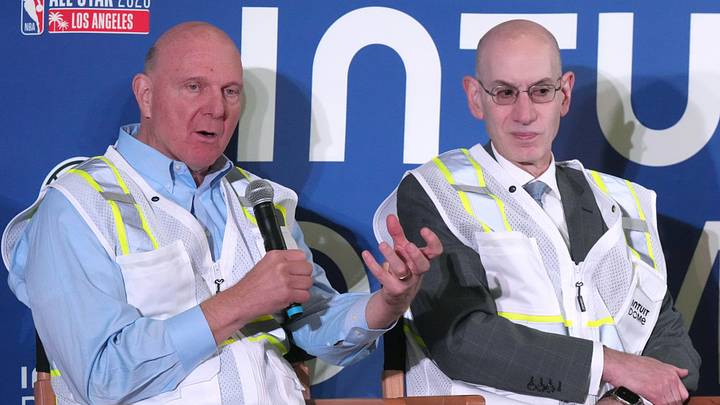
Former NBA commissioner David Stern was many things. TrueHoop's Henry Abbott once described him as both "exceptional" and "ruthless." ESPN's Ian O'Connor wrote that Stern "didn't need to be liked himself. Respected? Yes. Admired? You bet. Feared? Absolutely. But liked was always optional."
His successor as commissioner, Adam Silver, hasn't governed the NBA with the same iron fist since taking over for Stern in 2014. Earlier this year, Tim Alberta of The Atlantic described Silver as "warm and dignified, a people-pleaser who thinks in terms of negotiations and partners, not arguments and adversaries."
We may need to readjust our priors about Silver in the wake of Wednesday's ruling against the Los Angeles Clippers in the Kawhi Leonard salary-cap circumvention scandal. After an independent investigation conducted by the law firm of Wachtell, Lipton, Rosen & Katz "found a pattern of misconduct and multiple significant rules violations by the Clippers organization," Silver didn't just drop the hammer on the Clippers. He dropped Mjolnir itself.
Silver docked the Clippers of five first-round picks, fined the team $30 million and suspended team governor Steve Ballmer for one year, president of business operations Gillian Zucker for one year and president of basketball operations Lawrence Frank for six months. It's one of the harshest penalties levied not only in NBA history but across all of sports history.
In an era where the wealthy and powerful are running amok throughout society without facing any real consequences, Silver's ruling was a breath of fresh air for a beleaguered public. It also sent a clear message to NBA players and teams: Silver might view them more as partners than adversaries, but he isn't afraid to emulate his predecessor when they cross the line.
The not-so-nice-guy commissioner
The Clippers' punishment wasn't Silver's first foray into taking more of a tough-guy approach this year.
During All-Star Weekend in mid-February, Silver told reporters that tanking had become "worse this year than we've seen in recent memory" and he was considering "every possible remedy" to combat the issue. Three months later, he had convinced the NBA's board of governors to completely overhaul the draft-lottery system and reduce the incentive for teams to finish with one of the league's worst records.
Tanking teams effectively forced Silver's hands by becoming increasingly shameless about throwing games. They were pulling starters in the fourth quarter of competitive games in favor of G Leaguers and began liberally resting otherwise healthy players with made-up injuries. Still, Silver could have taken a more incremental approach to fixing the problem. Instead, he took a sledgehammer to the entire draft lottery.
That's what he did with the Clippers, too.
The league's collective bargaining agreement spells out the exact punishments within the commissioner's purview for circumvention violations. Silver went the maximum-pain route. Not only that, but he might have also pulled an end-around on the Clippers by getting the National Basketball Players Association to sign off on the punishments, thereby eliminating arbitration as an option. The Clippers' only remaining option is to fight the NBA in court, according to ESPN's Shams Charania. (Do the Clippers really want to go into the discovery phase of that trial?)
Sure, it's fair to argue that Leonard himself got off relatively easy in the circumvention scandal. If anyone truly believes that his uncle and business manager Dennis Robertson arranged all four of these no-show sponsorship deals without his knowledge, I have an AI data center to sell you. But if that was the cost of getting the NBPA to agree to the punishments—thereby removing arbitration as an option for the Clippers—it was arguably a price worth paying for Silver and the NBA.
Like Stern before him, Silver knows the NBA only goes as far as its stars can carry it. Voiding Leonard's contract was technically within his purview as a consequence of the circumvention findings, but it was likely a non-starter with the NBPA. Instead, the Toronto Raptors can now proceed with their trade for Leonard, while Brandon Ingram and Gradey Dick will soon head to the no-man's land currently inhabiting the Intuit Dome.
Silver is currently juggling multiple foundation-shaking issues—tanking and gambling scandals, to name a few—but cap circumvention is right up there when it comes to the integrity of the league itself. Thanks to the second apron, some teams have already begun to tear down championship-caliber rosters for financial reasons. If other teams managed to get stars to sign below-market contracts by securing them under-the-table side deals with business partners, it would give them an enormous competitive advantage in an era where every dollar spent matters more than usual.
"The overwhelming reaction of the executives I talked to today after the verdict came down was of relief," a former team executive told Howard Beck of The Ringer. "All of us who are involved in the game and care about the league … want to protect the integrity of the game. And I think that that was at risk here."
While the evidence collected by Wachtell was damning, Silver's reaction was still no sure thing. After all, look at *gestures wildly at everything happening in America right now*. David Aldridge of The Athletic, one of the league's longest-tenured, most well-respected scribes, admitted that he "did not believe" Silver would lay down the law against Ballmer and the Clippers. Instead, Silver "was his predecessor's equal, and then some, in the moment," Aldridge wrote.
It's long past time for Silver to bare his fangs and get his league's button-pushing billionaires in line, but better late than never.
 Add us as a preferred source on Google