
Key Points
Bullet point summary by AI
- The first 24 hours of NBA free agency triggered an aggressive spending spree, resulting in several highly questionable and lucrative player contracts.
- The Lakers spent massively on Walker Kessler and Quentin Grimes, while the Hawks overpaid Jock Landale and the Bulls gave a risky extension to Zach Collins.
- These impulsive team-building decisions severely limit future roster flexibility and risk backfiring heavily if these pricey gambles fail to produce.
Almost 10 years ago to the day, the Los Angeles Lakers broke everyone's brains by spending a combined $136 million on four-year contracts for Timofey Mozgov and Luol Deng. They paid homage to that by going on another outrageous spending spree on the first day of 2026 free agency.
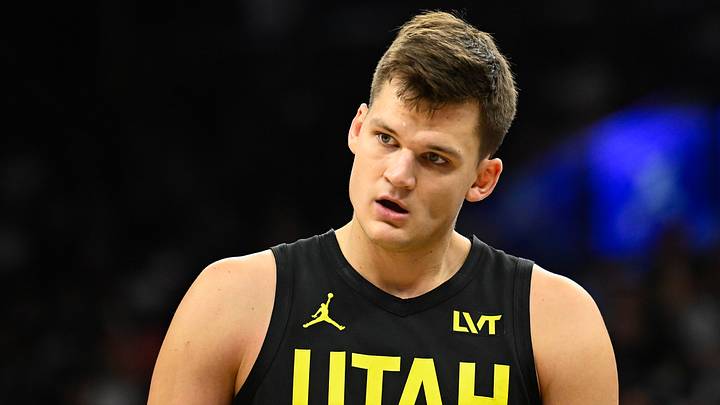
First, the Lakers agreed to acquire center Walker Kessler in a sign-and-trade with the Utah Jazz. Not only are they handing him a four-year, $130 million contract, but they're sending out unprotected 2031 and 2033 first-round picks and a pair of first-round swaps in 2028 and 2030 to convince the Jazz not to match their offer sheet.
The Lakers weren't done there. They also agreed to a four-year, $52 million deal with Sandro Mamukelashvili, a four-year, $60 million contract with Quentin Grimes and a two-year, $19 million deal (via the room mid-level exception) with Collin Sexton.
Not all of those deals were head-scratchers, but a pair of them was. Fortunately for the Lakers, they weren't the only team that handed out a questionable contract on the first day of free agency.
The following four deals could be particularly regrettable in hindsight.
Walker Kessler, Los Angeles Lakers
I say this as a Walker Kessler stan: What the hell are the Lakers doing?
Maybe they've subscribed to the "f--k them picks" team-building philosophy. Maybe they think we're all going to die by 2030, so distant first-round picks are meaningless. But giving up two fully unprotected first-round picks and two first-round swaps just to convince a team not to match an offer sheet is lunacy. Just call the Jazz's bluff on July 6!
Perhaps the Jazz would have matched the Lakers' offer and left them empty-handed. Then again, Jalen Duren is also floating out there in restricted free agency for now, and he doesn't appear particularly close to a resolution, either. Getting Kessler for $130 million—nearly $50 million below his max salary—is preferable to Duren at nearly $180 million, but is it worth giving up two fully unprotected first-round picks and two swaps?
In the Lakers' defense, Luka Dončić made it clear to them that he wanted them to land an "A-list center," according to ESPN's Dave McMenamin. Kessler might not qualify yet, but he has the potential to blossom alongside Dončić and Austin Reaves. The soon-to-be 25-year-old is one of the league's best offensive rebounders and is a dominant shot-blocker. He also shot 6-of-8 from deep in the five games he played this past season before he suffered a season-ending labrum tear.
With that said, the Lakers have no idea what the draft lottery will even look like beyond 2029. Giving up that much draft capital for the right to pay Kessler a hefty sum solely based on his potential rather than what he's done thus far in his NBA career is a gamble that has the potential to backfire tremendously, especially since the Lakers basically have zero draft capital left to trade in the wake of this deal.
Quentin Grimes, Los Angeles Lakers
Did the Lakers watch Quentin Grimes last season, or did they only watch his film from when he put up huge numbers on the injury-ravaged 2024-25 Philadelphia 76ers?
Grimes did briefly overlap with Dončić in Dallas. Perhaps that made a positive impression on Dončić, and he was the driving force behind this signing. Because otherwise… which other team was offering Grimes anywhere close to a four-year, $60 million deal this summer?
Grimes showed the ability to scale his role up following his arrival in Philadelphia, but he struggled to scale back down once VJ Edgecombe supplanted him in the starting lineup. He's a mediocre three-point shooter, and his shot selection and overall basketball IQ can be charitably described as questionable at times.
If the Lakers plan to start Grimes alongside Dončić and Reaves, that's going to put a ton of defensive stress on Kessler. Grimes figures to be the Lakers' main point-of-attack defender, but they'll still have two potential defensive liabilities starting alongside him. And if they envision Grimes as a super-sub, why did they just spend $20-plus million on both him and Sexton?
Lakers president of basketball operations Rob Pelinka assuredly felt pressure to improve the roster around Dončić immediately, particularly following the departure of LeBron James. But it's not clear that the Lakers are markedly better following this flurry of deals, and they are now far less flexible moving forward.
That's not a great combination, to say the least.
Jock Landale, Atlanta Hawks
Hello, balloon deal! With plenty of center-needy teams sniffing around, the Atlanta Hawks spent a majority of their non-taxpayer mid-level exception to re-sign Jock Landale.
The Hawks initially acquired Landale at the trade deadline for cash considerations, and he played well for them before suffering a high ankle sprain that ultimately ended his season. He'll give them some much-needed size behind starting big man Onyeka Okongwu as rookie big men Zuby Ejiofor and Henry Veesaar begin their transition to the NBA.
The Hawks only had non-Bird rights on Landale, which meant they could offer him no more than 120 percent of his previous salary without dipping into a salary-cap exception. They had zero shot of retaining him via those non-Bird rights, but there's a real opportunity cost in eating up a majority of their non-taxpayer MLE just to keep him.
Granted, there's little harm here since this is a one-year deal. The Hawks could look to flip Landale's expiring contract at the trade deadline, or they could keep him and have Early Bird rights on him next summer. They've also otherwise cooked this offseason by taking Aaron Wiggins into their Luke Kennard trade exception and acquiring 2024 lottery pick Devin Carter in a salary dump from the Sacramento Kings.
Still, there's no denying that this is an overpay based on his production to date and projected role next season.
Zach Collins, Chicago Bulls
The market for big men is admittedly drunk so far, so perhaps some team would have offered Zach Collins more than the two-year, $17 million extension that the Chicago Bulls gave him on Tuesday night. But after landing Nic Claxton via a salary dump from the Brooklyn Nets, was this really the best way for the Bulls to spend more of their cap space?
Collins played only 10 games this past season, averaging 9.7 points and 5.6 rebounds and 18.4 minutes per game. A wrist injury sidelined him for the first month of the season, while a toe injury knocked him out after Christmas for the rest of the year.
Collins turns 29 in mid-November. It's a stretch to say that the No. 10 pick from the 2017 draft still has considerable untapped upside at this point of his career. And with the Bulls in the early stages of a rebuild, it's unclear how—if at all—Collins fits into their long-term vision.
Prior to last season, Collins had played in 63 or more games in each of the previous three years. However, he missed the entire 2020-21 campaign due to a stress fracture in his left ankle, and he played only 39 combined games between the 2019-20 and 2021-22 seasons.
Perhaps Collins' injuries last year prove to be an outlier and he can stay on the floor moving forward. But with both Claxton and Jalen Smith already in the fold, he seems like a luxury for the Bulls that they didn't need.
More NBA news and analysis:
 Add us as a preferred source on Google