
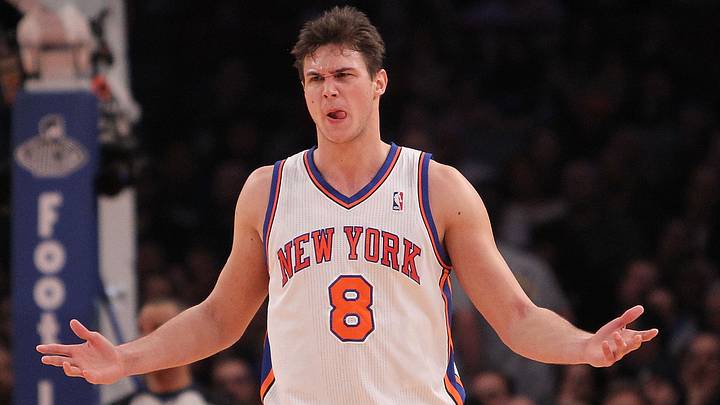
We're at the weird part of the NBA offseason where the NBA Draft and summer league(s) are past us, most of the big names in the free agent pool have been signed, and we aren't in the preseason. So, we have a lot of time to fixate on some controversial takes being spewed by those who are related to the game in some fashion.
In recent days, Danilo Gallinari and Lonzo Ball have made headlines by either directly or indirectly saying that circumstances outside of their control led to them not being able to maximize their careers; AKA they fancy themselves some of the greatest "what-ifs" in NBA history. Galinari even said it explicitly.
Danilo Gallinari says he's likely the biggest "what-if guy" in NBA history. Do we agree or nah? 🤔💭
— TSN (@TSN_Sports) September 10, 2026
If not Gallo, then who? ⬇️
(H/T @hoopshype) pic.twitter.com/V4EMTqS65D
As you predicted from reading the headline, this isn't the case. But it does beg an interesting question: who are some of the biggest what-ifs?
What makes a "what-if?"
Unforutantely, we've had a lot of what-ifs. Basketball is a demanding game that requires a lot of sharp changes in direction and high-speed collisions. So, injuries are inevitable.
With how many seasons there have been and careers shortened by injuries, it isn't enough if misfortune kept you from being an All-Star or high-end starter. It is sad if you couldn't fulfill that promise. But to be one of the greatest what-ifs, you need to have flashed close to MVP potential.
In Ball's case, before a catastrophic knee injury ended his 2021-22 season (and kept him out for another three years after that), he was playing the best ball of his career with the Chicago Bulls. To me, he was in the top-third of the starters in the association, but he wasn't quite at a All-Star level, let alone MVP contender. He was only 24 when this happened, so maybe he had another leap in him. But given his inability to be a volume scorer (his career aveerage is 14.6 points per game), it seems like Ball would have settled in as just a high-level starter.
As for Gallinari, first off, him blaming Kawhi Leonard for the way his career went is pretty unfair. Yes, he was playing very well with the Los Angeles Clippers (averaging a career-high 19.8 points per game), but, at that point, he was already 30 and had never been an All-Star. The chances of him pulling a Norman Powell and developing into a top 25 player late in his career was unlikely.
Injuries also hampered Gallinari at different parts of his career. But even if everything went right for him, he didn't have the upside to be more than a fringe top 25 player in the association.
Who are the greatest "what-ifs" in NBA history?
The easiest one is Derrick Rose. He was the MVP of the league in 2011 before a slew of tragic injuries zapped him of his athletic gifts. Bill Walton suffered a similarly cruel fate. Penny Hardaway Jr. is another good one. He was third in MVP voting in just his third season, but then the injuries started to pile up, and he was never the same after that.
A familiar story played out for guys like Grant Hill and Tracy McGrady. Fortunately for Hill, he was able to reinvent himself as a 3-and-D ace and continue to impact winning for years after his prime.
Zion Williamson has more of a claim to being a GOAT what-if than Gallinari and Ball. In his early years, he was virtually unstoppable when it came to getting into the paint. However, his body has failed him and made it impossible for him to survive the rigors of a full 82 game season and playoffs (he's never even played in a playoff game). He actually played in 62 games last year, but didn't even make the All-Star team.
Yao Ming, Deron Williams, Mark Price, Shawn Kemp, Brandon Roy, Ralph Sampson, all were All-NBA caliber talents (who may have had some room to improve) before injuries took away their superpowers.
It's a sad legacy to have, but the least we can do is honor the potential they once had.
 Add us as a preferred source on Google