
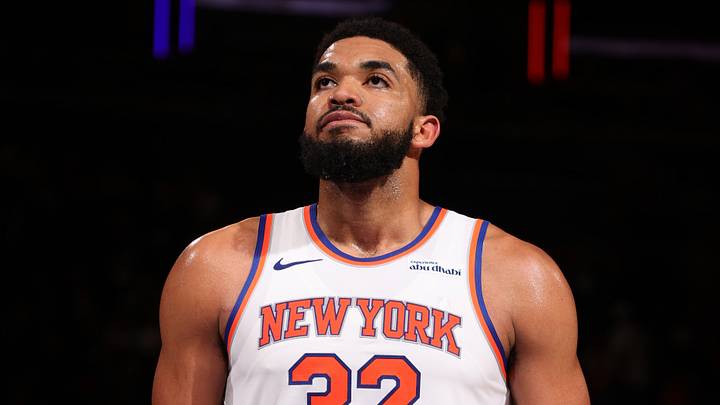
This past spring, Karl-Anthony Towns helped the New York Knicks snap their 53-year championship drought. Despite that, it's still unclear whether he'll become a long-term fixture in New York.
This summer, Towns became eligible to sign a four-year extension worth up to $276 million. But with only a few days to go until training camp opens, talks between Towns and the Knicks "have stagnated," and an agreement "is not imminent and appears unlikely in the short term," ESPN's Shams Charania reported Wednesday.
SNY's Ian Begley added that "there's been plenty of dialogue between the two sides, and those conversations have been positive, with the Knicks making it known they think highly of the big man and want him New York for a long time." They aren't just willing to hand Towns a blank check, though. Begley reported that "the Knicks have discussed extensions starting between $45-50 million a year," which is far below a max deal.
A "league source" (aka, someone affiliated with the Knicks) told Stefan Bondy of the New York Post "there's been plenty of conversations with KAT, and it's all been cordial, all positive. We want KAT to be here [a] long time and just cause a deal isn't done now doesn't mean it can't get done."
The question is whether the two sides can eventually agree on a price point. For now, that remains very much TBD.
What's the right price for KAT?

Towns is set to earn $57.1 million this coming season, and he has a $61.0 million player option for the 2027-28 campaign. If he declines that option, he would become an unrestricted free agent and could sign a five-year contract with the Knicks worth up to $357.3 million or a four-year deal with another team worth up to $264.9 million based on the recent $176 million salary-cap projection for 2027-28. Either way, his max salary is projected to be $61.6 million.
An extension beginning in the $45-50 million range would be more than $10-15 million below Towns' max, which would also bring down his earnings in future years. If his deal started at $50 million flat, he could earn no more than $290 million on a five-year contract with the Knicks.
A handful of teams currently have the ability to carve out max cap space next summer, including the Golden State Warriors, which the Knicks have to be wary of. If they aren't willing to meet Towns' asking price, he can leverage teams like the Warriors, Milwaukee Bucks or Chicago Bulls as potential landing spots to spook the Knicks into raising their offer. Losing him for nothing as an unrestricted free agent would be a disastrous outcome for them.
According to James L. Edwards III of The Athletic, Towns "is willing to play on a deal that isn't the max to help New York, per league sources, but it's still unclear how much he's willing to leave on the table." That right there is the fundamental question that could determine whether the partnership between Towns and the Knicks carries on beyond this season.
After all, extension negotiations aren't made in a vacuum. The Knicks already have OG Anunoby on a deal worth roughly 26% of the salary cap for at least the next two seasons, while Mikal Bridges is just beginning his four-year, $150 million extension, which is worth roughly 20% of the salary cap. Josh Hart is also extension-eligible, although the Knicks have a $22.4 million team option on him in 2027-28, so they can punt that decision down the road for a year.
The bigger issue is Jalen Brunson. He's earning only $37.7 million this coming season and $40.5 million in 2027-28. He then has a $43.3 million player option in 2028-29 that he might as well go ahead and decline right now after what he's done for the Knicks these past few years.
Brunson will become extension-eligible next offseason, and there's no guarantee that he'll be as generous in his next negotiations as he was in 2024. After making three straight All-NBA teams and being named the 2026 Finals MVP, he'll likely look to make back some of the money he gave up when he signed his four-year, $156.5 million extension (which was the most that the Knicks could offer at the time).
Without knowing what percentage of their salary cap that Brunson will take up in 2028-29 and beyond, it may be hard for the Knicks to plan ahead at the moment. If they pick up their team option on Hart next summer and then sign Brunson to an extension, they'll have a much clearer grasp on their long-term financial situation. At that point, they could turn their attention to extending Hart and re-signing Towns.
But if they go that route, Towns would be an unrestricted free agent. He could choose to sign elsewhere, leaving them without an obvious solution at center, particularly after the departure of Mitchell Robinson this past offseason.
The Knicks wouldn't suddenly have $60-plus million of cap space to spend on another big man. Between Anunoby, Brunson, Bridges and Hart alone, they'd already have $144.5 million in salary tied up for 2027-28. Add in Landry Shamet ($5.7 million), Jose Alvarado ($4.8 million) and Mo Diawara ($2.8 million), all of whom are also on guaranteed contracts, and the Knicks would be less about $18.2 million under the projected salary cap with only seven players under contract.
Unless the salary cap rises more sharply than projected or Knicks owner James Dolan backs off his stance of refusing to go into the second apron, the fundamental truth about this Knicks core is that it has a shelf life of two more years at best. Once Brunson's new deal kicks in, the Knicks likely will not be able to afford all five of him, Towns, Anunoby, Bridges and Hart. Something will have to give.
If Brunson and Towns are each willing to take significantly less than their max salaries on their next contracts, that could slightly widen the Knicks' window of keeping this group together. The same goes for Anunoby, who has a $48.4 million player option in 2028-29. But realistically, these Knicks will have two more bites at the apple (at best) before they start to tear down like the Boston Celtics have over the past two summers.
Those are the stakes facing the Knicks as they engage in extension negotiations with Towns, but that isn't necessarily Towns' problem. If he and his agent survey the leaguewide landscape next offseason and believe a max or near-max offer might be forthcoming from the Warriors or another team, they'll likely use that as leverage against the Knicks.
The NBA introduced the second apron to force teams into difficult decisions like these. Commissioner Adam Silver repeatedly preaches about "parity of opportunity" and wanting to make the NBA more like the NFL. A more widespread distribution of talent throughout the league is paramount to that.
Towns — or one of his teammates — might be one of the next dominoes to fall in that regard.
 Add us as a preferred source on Google