
The NBA's second apron tax has fundamentally shifted the way the league works. Only premier talents like Victor Wembanyama are worth taking 25 percent of the cap after three years of service these days. Extension-eligible players with glaring holes do not demand the rookie max.
The Houston Rockets did not max Alperen Şengün after he spun his way to 20 points and nine boards in year three. His defensive versatility and efficiency were enough for Houston to pump the brakes on the max. Şengün's pros and cons got him $185 million over five years. That decision set the standard for flawed but gifted third-year players moving forward.
Some of the late offseason deals practically came at the buzzer. The Thompson twins made their parents grin, and Keyonte George is happy to keep hooping and making a lot of money. Some good players with apparent weaknesses got a bag in September, and we will rank their contract values from worst to first.
For more analysis on the salary cap situations for every NBA team, subscribe to The Whiteboard — FanSided's NBA email newsletter.
Saddiq Bey: 3 years for $55 million

The New Orleans Pelicans extended one of their few bright spots. Bey was coming off a torn ACL and delivered in a major way. Bey averaged nearly 18 points, drilling 151 3-pointers. Bey appeared in 72 games for a Pelicans roster whose stars virtually never crack 70. In Bey's final year of this extension, he will take up 10 percent of the cap.
Bey's extension is not too rich, but it was a bit unexpected. Bey was a solid shotmaker and self-creator at the wing spot, but it is debatable if he would have demanded that on the open market. Bey is not exiting his rookie deal like the following names are. New Orleans could have allowed him to hit free agency in 2028 to see what he is worth.
The Pelicans are banking on Bey outplaying this contract and having a strong 2027 season. He was not the most efficient player on the floor or a plus defender. Those holes likely would have netted him less than what he got on the open market, but the Pelicans locked him down. This is the worst value here due to his age and playing style (needs the ball to cook + not a great playmaker), but it is not an eyesore contract either way. Pelicans need good players, so contextually, if you squint, it makes sense for them.
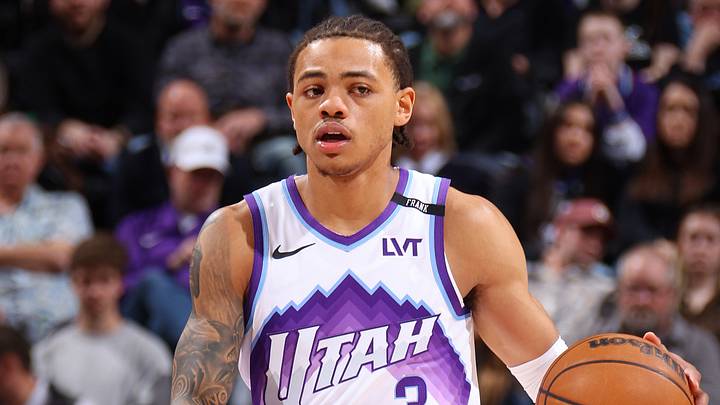
Keyonte George: 5 years, $155 million

The Utah Jazz are attempting to win basketball games. It is a blessing to the NBA community that we can finally see Will Hardy with a win-now roster. There will be tough decisions with Hardy balancing George and Darryn Peterson as ball handlers. Drafting Peterson at pick two raised eyebrows for George's future, but Utah shut down all speculation immediately.
After a 24-point and six-assist season, George is in Utah for the foreseeable future. George will take up nearly 16 percent of the cap in 2032. He made tremendous strides as a driver. George shot a blistering 72 percent at the rim, per Cleaning the Glass. That was one tick ahead of Shai Gilgeous-Alexander. Great company. George's drive-and-kick game will be a staple with Lauri Markkanen and Jaren Jackson Jr. as spacers.
On the other side of the floor, JJJ will be covering for George in a major way. George needs to contain the ball much better, to say the least. Scorers' eyes lit up when George matched up with them last season. Some metrics say he is the worst defender in the league, but the team context is different this year.
George's defensive woes bring his value down, and the uncertainty of whether last year was who he is or a contract year blip remains to be seen. Is he super-dynamic with the ball, or did he just have opportunities on a tanking Jazz team? His value could plummet or skyrocket depending on his off-ball play. Utah did not draft DP to be anything other than a superstar. Those questions determine how George's contract ages.
Pelle Larsson: 4 years, $60 million

From Hassan Whiteside to Gabe Vincent, the Miami Heat always find diamonds in the rough. Those two did not have much success post-Heat but had stellar moments in South Beach. It would not be shocking if Miami was on a deep playoff run and Larsson steps up "out of nowhere." He has quietly been budding, and Miami got him for no more than eight percent of the cap during this contract.
George is a better player than Larsson today, and that could very well be the case throughout their careers. But Larsson has what the Heat needs in this team structure. If he were a lethal shooter, Larsson would start next to Giannis Antetokounmpo and Bam Adebayo, and his extension would be seven figures. That is his flaw; all of these guys are imperfect.
Larsson is flatly one of the best energy bunnies in basketball. Larsson's defensive versatility was a B according to Bball-Index. Larsson guards one through four and hounds everyone. He is a bowling ball attacking the rim and gets opponents in foul trouble. Even in isolation, Larsson was passable and should have more chances to attack with the gravity Giannis brings.
Larsson's catch-and-shoot game is not pretty. Shooting is not the only thing (evident by the two best contacts here), but Larsson would have even more generational wealth if he shot 39 percent instead of 33 percent on the catch. If Larsson's shooting and scoring ever approach his FIBA play, $60M over four years would be a Payton Pritchard-level steal for Miami.
Amen Thompson: 5 years, $208 million

Amen is the better Thompson twin. Full stop. He is second here, but that does not reflect the pecking order of that family. Amen's relentless aggression, constant downhill attacks, center-like rebounding rate, and shooting potential are why he'll take up to 22 percent of the cap for the Houston Rockets.
The shooting is the risky bet Houston took nearly maxing Amen. He may not ever be knockdown, but he has made drastic improvements already. Amen shot 78 percent at the line after shooting 68 percent his first two years. That leap is more head-turning, factoring in that he got to the line much more last season.
Amen puts his shoulder into defenders and does not run from the charity stripe. Amen is the more willing midrange shooter in the family, but he is still below average there. He can make plays from the point guard spot. Driving to the lane and spraying it out for 3 is an Amen special. He collapses defenses with rim-rocking finishes and selfless passing.
The defense goes without saying for Amen. He was an All-Defense snub in 2026 after being a Defensive Player of the Year finalist in 2025. With Fred VanVleet back in the fold, Amen can relinquish a lot of his on-ball responsibilities and focus on cutting, rebounding, and disrupting game plans. If Amen does not improve a lick, this is still a solid contract for a borderline All-Star who makes under the max. He is the better twin, but Ausar's contract is more team-friendly, and there are avenues for him to reach Amen's offensive prowess.
Ausar Thompson: 5 years, $155 million

"I do think the tactical adjustment we made was avoiding Thompson," Cleveland Cavaliers coach Kenny Atkinson said after their playoff series with the Detroit Pistons. "We were just like, if he's near the ball, throw it to someone else. And I've never experienced that in the NBA."
That is a level of praise worth 16 percent of the cap. Ausar is arguably the best defender besides Wemby. In an era with some of the trickiest offensive players, a wing like Ausar who neutralizes the best of them while impacting team defense like a center does not grow on trees. That is where Ausar has Amen beat. Both are elite defenders, but Ausar is on a Pistons Dennis Rodman path in Detroit.
If Ausar had Amen's ball-handling and aggression, their parents would have two $200M children. Ausar has flashed on-ball potential, but the holes were on full display in the postseason. He can go possessions without looking at the rim. Ausar could improve as a finisher. With his jumper likely not coming around any time soon, he has to be more of a threat at the basket. 67 percent at the rim is not bad, but it does not force defenses to say, "hey, we have to get over there." Ausar has passing chops that shine when he's fully engaged. He can draw two but needs to finish better to do that more consistently.
Besides the shooting, he has shown these traits in spurts. Ausar has never played over 30 minutes per game. Some of that is foul trouble, the energy he exerts on defense, and coaches believing he is an offensive liability at times. The impact stats suggest he is clearly Detroit's second-best player, but refusing to look at the bucket while Cade Cunningham has defenders draped on him can make a coach think he needs more shooting out there.
Ausar knows what he needs to work on to be even more than an All-Defense player. The potential is there. If he is more aggressive with a tighter handle, Detroit is looking at one of the best connective players in the league. An all-world defender with offensive upside taking up that little of the cap could be Detroit's saving grace.
 Add us as a preferred source on Google