
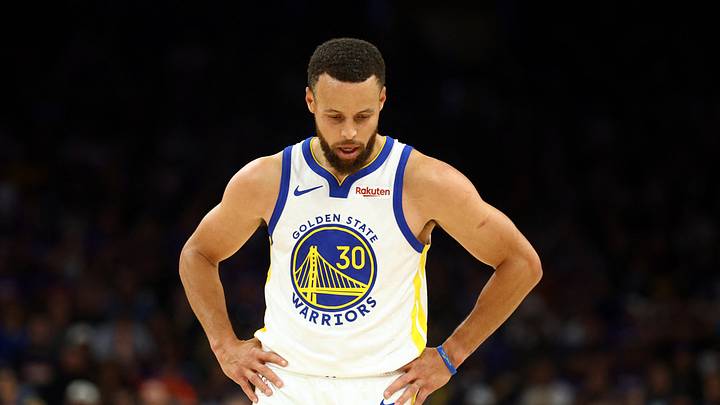
In late September, Golden State Warriors star Stephen Curry told reporters that he planned to sign an extension "at the right time, once I have all the information I need to make the decision that is right." He apparently got that information less than 48 hours later, as he signed a two-year, $116 million extension that was roughly $20 million less than the maximum amount he could have received.
"We're in a very interesting situation," Curry told reporters before he signed. "All the different salary-cap conditions of whether I sign for a max or less or whatever it is, I want to be on a competitive team. I want to have an opportunity to have some flexibility because we haven't had that in years past, the recent past. ... This team should have flexibility to make necessary moves if things happen. Those are always just the considerations."
At media day on Monday, Curry confirmed previous reporting from ESPN's Anthony Slater that the Warriors presented him with a "menu of options," including a full max contract.
"Yes, I was presented the max," Curry told reporters. "Yes, there was everything on the table. Everything that you probably heard was somewhat accurate. For me, it was just processing all of that to get to a decision that was right for me and right for the team."
He said that he chose to sign now to get "clarity of mind for these next two, three years" and to "just let this team play and hoop and get rid of distractions." He added that it "just gives me peace of mind to go play basketball and enjoy what I'm doing."
Given the current state of national NBA media, Curry bypassing an extension until next summer undeniably would have been a distraction for the Warriors this year. With every blowout loss, the likes of Stephen A. Smith and Kendrick Perkins would have bloviated about how Curry will never win another ring in Golden State and needed to flee for greener pastures in free agency next offseason.
However, his taking a deal now — even at a discount from his max — will limit the sort of flexibility that he was hoping to give the Warriors.
For more analysis on the salary cap situations for every NBA team, subscribe to The Whiteboard — FanSided's NBA email newsletter.
A pair of golden handcuffs

Curry undeniable took less than his max, although framing it as a $20 million pay cut isn't quite accurate. The first year of his extension could have started as high as roughly $65.7 million, but he'll instead earn $55.7 million. He then has a $60.15 million player option in 2028-29, which he could decline next summer to begin this same "optionality" song and dance all over again. So, it's really a $10 million discount for now.
Before signing Curry to his extension, the Warriors had only four players on guaranteed contracts beyond this season: Moses Moody ($13.4 million), Yaxel Lendeborg ($6.4 million), Gui Santos ($5.0 million) and Will Richard ($2.5 million). Al Horford ($7.2 million) and De'Anthony Melton ($6.4 million) each have player options for the 2027-28 season, while Kristaps Porziņģis has a $20 million mutual option, only $3 million of which is guaranteed.
Even if Melton and Horford picked up their respective player options, the Warriors could have entered next offseason with only $43.9 million in salary on their books. The cap holds of Curry, Jimmy Butler and Draymond Green would have gobbled up the Warriors' potential cap space until they either re-signed them, renounced them or lost them to another team in free agency, but they could have feasibly entered next offseason with more than $100 million in potential spending power.
Granted, a hefty chunk of that would have been devoted to Curry either way. But had he waited to sign until next offseason, he could have seen what else the Warriors were able to pull off first and then taken whatever was left over. Instead, the Warriors' flexibility is now a bit more capped.
Between Curry, Moody, Lendeborg, Santos and Richard, the Warriors are now poised to enter next offseason with at least $83 million in salary on their books. If Horford, Melton and Porziņģis pick up their respective player options, that would bring the Warriors up to nearly $100 million in salary if they waive Porziņģis and $116.6 million if they keep him.
The NBA recently updated its salary-cap projection for the 2027-28 season to $176 million, according to Fred Katz and John Hollinger of The Athletic, so the Warriors could still have plenty of cap space either way. However, a max deal for someone with 10 or more years of NBA experience — say, a certain disgruntled center in New York, perhaps — is projected start at $61.1 million next season. Signing someone to that type of contract would wipe out most of the Warriors' cap space, and it would require them to renounce both Butler and Green as well.
Perhaps the Warriors will manage to pull a rabbit out of a hat and salvage Curry's last act in Golden State regardless. But Curry repeatedly spoke at media day about wanting to give the Warriors optionality. Signing this extension now instead of next summer runs contrary to that goal.
Curry wouldn't have needed to look far for examples of alternative paths. James Harden spent two months in free-agent purgatory — even though it was an open secret that he'd be re-signing with the Cleveland Cavaliers — to give the Cavs the flexibility to explore ways to add to their roster. They ultimately landed Peyton Watson in a sign-and-trade with the Denver Nuggets, and then Harden took what was left over.
Meanwhile, LeBron James took an even more drastic approach by signing a two-year, $7.9 million veteran-minimum contract with the Philadelphia 76ers. He could have received slightly more from some of his other free-agent suitors, but once he declared that he was leaving the Los Angeles Lakers, he was pot-committed to a massive pay cut.
Of course, having a net worth of $1.4 billion — and taking some prediction-market blood money — can help offset the financial sacrifice James made with his contract. Then again, it's not like Curry is exactly hurting in that regard, either. He's already earned $470 million from his NBA contracts alone, and he has another $62.6 million heading to him this season. Sure, everything costs more these days, and Curry is living in one of the most expensive areas in the country, but he could retire tomorrow and still have generational wealth.
It's unrealistic to expect elder stars to start taking minimum deals like LeBron as a way to counteract the second apron, of course. But for someone who dealt with a pesky knee injury last year that will now create a "new normal" for him moving forward, a $55 million salary could still be an impediment to building a championship-caliber core around him.
In Curry's defense, perhaps the uncertainty over his future would have been a roadblock ahead of this year's trade deadline. Maybe a star would have tried to nix deal behind the scenes for that reason.
But the Warriors only have a few more chances to get Curry back into the championship mix. His decision to sign an extension now instead of waiting until next summer might hamper their ability to do so.
 Add us as a preferred source on Google