
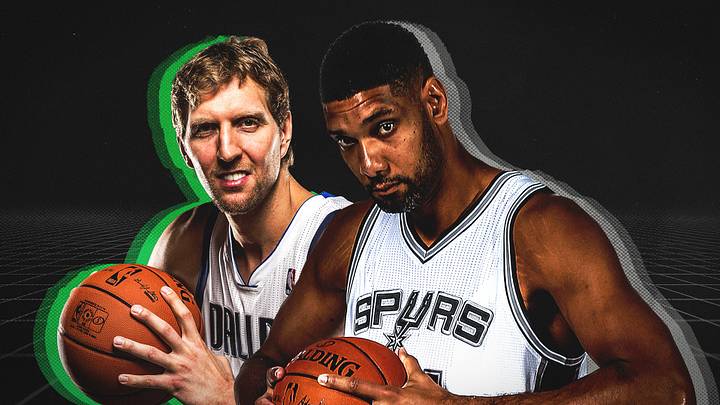
There's something special about a player spending their entire career with a single franchise. It doesn't make them inherently better than any of their peers who changed scenery, of course, but there's a different type of legacy involved with being one of the faces of just one NBA team.
The question of the hour, however, is a bit more difficult to land on: Who are the greatest players in NBA history to spend their entire careers with just one team?
To answer that question, criteria needed to be established. For one: No active players will be included due to the simple fact that they could, theoretically, change teams at any given moment. That makes it difficult but necessary to exclude a legend like Stephen Curry from this list.
There's also an expectation that the players on this list spent at least 10 full seasons with their respective franchises. The final hurdle: Not including players who appeared in a different major league basketball team — the ABA or NBL, for instance. As such, Julius Erving and George Mikan missed the cut.
With this established, the question returns: Who are the 25 greatest players in NBA history to play for just one team?
25. Jack Twyman, Rochester/Cincinnati Royals
Jack Twyman played 11 seasons with the Royals, which called Rochester and Cincinnati Royals home during his tenure. The Royals, of course, became the Sacramento Kings. During his time with the team, Twyman became one of the most prolific forces of his era.
Twyman retired as a two-time All-NBA honoree and six-time All-Star. He peaked at 31.2 points per game during the 1959-60 season, and scored upward 15,000 points during his career. Teammate Oscar Robertson may have been the face of the franchise, but Twyman was a force in his own right.
A scoring forward with a jumper that couldn’t be contained, Twyman is a Hall of Fame for a reason.
24. Manu Ginboili, San Antonio Spurs

One of the pillars of the San Antonio Spurs’ greatest era, Manu Ginboili was a coach’s dream. A superstar talent who went toe-to-toe with the best of the best in the postseason, Ginobili put his ego aside and set the tone for his teammates by selflessly embracing the role of a sixth man.
Ginobili made the All-Star team in two of the three seasons during which he started at least half of the Spurs’ games and played a pivotal role on four championship teams. He defended with vigor, scored with clutch timing, and became one of the most electrifying and dynamic playmakers of his era.
Ginobili may not pass the box score test, but those who watched and played against the Spurs of that era know exactly how special and important he was.
23. Joe Dumars, Detroit Pistons
The Detroit Pistons have won three championships — and Joe Dumars was a part of all of them. He constructed the team that won the 2004 title as an executive, and roughly two decades prior, delivered on the biggest of stages to win the first two in franchise history.
An elite defender, clutch scorer, and selfless teammate, Dumars was leadership personified. He retired as a two-time NBA champion, the first Finals MVP in Pistons history, a three-time All-NBA honoree, and a five-time All-Defense selectee. Even at 6’3”, he guarded taller players better than those who had him beat in height, strength, and length.
Small guards have been given a surplus of legends to follow in the footsteps of, but it’s Dumars who may be the best example of two-way greatness that exceeds expectations.
22. James Worthy, Los Angeles Lakers
There’s an understanding of greatness involved with earning the nickname “Big Game James.” That’s exactly what James Worthy was known as during his 12 illustrious seasons with the Los Angeles Lakers. A transformative force who helped define the Showtime era, Worthy was a star on three championship teams.
That includes the fact that Worthy won the 1988 Finals MVP award. He capped his run to the honor off by going off for 36 points, 16 rebounds, and 10 assists in the decisive Game 7. In addition to sealing the Lakers’ championship fate, it was one of the greatest NBA Finals Game 7 showings in history.
Throw in seven All-Star Game appearances and two All-NBA nods, and Worthy is an easy inclusion on this list as a Lakers lifer.
21. Reggie Miller, Indiana Pacers
For 18 years, Reggie Miller was the Indiana Pacers. Though the franchise didn’t achieve quite as much as it managed in the ABA, it experienced its greatest success as an NBA team with Miller leading the charge. 25,279 points later, his legacy is indisputable.
With Miller leading the charge, the Pacers reached the 2000 NBA Finals and made six separate Eastern Conference Finals appearances. The epitome of a postseason riser, he stepped up to the point of having memorable battles with Michael Jordan, with Indiana being one of just two teams to push the Jordan-led Chicago Bulls to seven games in a playoff series during the 1990s.
An all-time great shooter, fearless postseason scorer, and the face of Pacers basketball, this list would’ve been incomplete without Miller.
20. Hal Greer, Philadelphia 76ers
If the conversation is about underrated legends, Hal Greer should be at the forefront of those discussions. An all-time shooter who didn’t benefit from having a three-point line, Greer made the All-Star Game in 10 consecutive seasons and earned All-NBA recognition in seven straight.
Greer’s greatest claim to fame is what he did during the 1966-67 season. After earning All-Star and All-NBA nods during the regular season, he averaged 27.7 points and 5.3 assists per game as the Philadelphia 76ers secured the second championship in franchise history. Hard as it may be to believe: Greer led the 76ers in scoring during the playoffs—a team that also had Wilt Chamberlain.
Chamberlain’s transition to a playmaking role was the signature development of that legendary 76ers season, but Greer proving up to the task of thriving as a scorer was essential to their success.
19. Sam Jones, Boston Celtics

The Boston Celtics have produced an almost endless list of legendary players, but Sam Jones is among the most important individuals in franchise history. While Bill Russell was the dynasty’s interior anchor, it was often Jones who was tasked with taking the toughest shots in the biggest of moments.
The end result was Jones winning 10 championships, earning three All-NBA selections, and five All-Star Game selections. He twice finished top-five in MVP voting, including a 1964-65 season during which he averaged 25.9 points per game.
As the leading scorer on four of the Celtics’ championship-winning teams, Jones doesn’t get enough credit for the career and legacy he carved out. That includes when he averaged 28.6 points per game during the Celtics’ march to the 1965 title.
18. Paul Arizin, Philadelphia Warriors
Technically speaking, Paul Arizin played for two minor league teams. In terms of top-level professional basketball, however, Arizin spent his entire career with the Philadelphia Warriors. That includes a legendary 1955-56 season during which he earned All-NBA First Team recognition and led the franchise to the championship.
Arizin sat out two NBA seasons as he served in the U.S. Marine Corps during the Korean War, yet he still built one of the best résumés imaginable. With four All-NBA nods, 10 All-Star Game appearances, two scoring titles, and a championship, he was the type of force that transcends generations—including the fact that he averaged 28.9 points per game during the Warriors’ championship run.
This is the most complicated inclusion on this list due to his time with the EPBL minor league, but in terms of major league basketball, Arizin was all Warriors.
17. Kevin McHale, Boston Celtics
Larry Bird may have been the driving force behind the Celtics’ success during the 1980s, but Kevin McHale was right there with him. A generational post scorer and top-tier defender who thrived as both a Sixth Man and a starter, McHale was a pivotal member of three championship teams.
From a pure skill perspective, McHale is everything a team could ask for. His post game was layered and effective in pivotal moments, while his defense became something of an anchor for a dynastic side. Beyond the skills, he was the ultimate team player—deferring to Bird or taking over with equal success depending on what the situation called for.
Arguably the greatest sixth man of all time and just as prolific as a starter, McHale was an all-time great who played all 13 of his seasons with the Celtics.
16. Wes Unseld, Washington Bullets
Wes Unseld began his career better than almost anyone in NBA history. That’s not hyperbolic, either. In 1968-69, Unseld joined Wilt Chamberlain as the only players to win MVP during their rookie season. Nearly a decade later, he added a championship and a Finals MVP award to his résumé.
In many respects, Unseld was a player who set the stage for the legion of bigs who make their mark without being dominant scorers. He was an elite rebounder, screen-setter, and defender, as well as the outlet pass king who even Kevin Love must bow down to.
Unseld effectively bookended his career with an MVP and a Finals MVP, and spent every one of his 13 seasons with a franchise that changed locations and names, but remained under the same banner.
15. Dolph Schayes, Syracuse Nationals
Dolph Schayes spent his entire 16-year career with the Syracuse Nationals, which later became the Philadelphia 76ers. During that time, he earned 12 All-NBA selections, including six First Team nods. Along the way, Schayes joined Bob Pettit as one of the sport’s original stretch bigs.
Skilled beyond the standard for his time, Schayes was capable of burying jumpers from all over the court and operating as a facilitator along the way. Though Finals MVP didn’t exist yet, he likely would’ve won the award after leading the Nationals to the NBA championship in 1955 and leading all players in points and rebounds per game.
An interior force who was ahead of his time, Schayes is a must for any list about the greatest players ever, let alone those who stayed with one team.
14. John Stockton, Utah Jazz

When the phrase “pure point guard” is used, the comparisons being made are typically to John Stockton. The Utah Jazz legend is everything that a point guard is meant to traditionally be, as an all-time great playmaker, game manager, ball hawk, and shooter.
Stockton is the NBA’s all-time leader in both assists and steals. He led the Association in assists in a record nine different seasons and was No. 1 in steals in two. He also became an 11-time All-NBA honoree with two First Team appearances, as well as a five-time All-Defense selectee.
Throw in two NBA Finals appearances and the fact that he revolutionized the pick-and-roll, and Stockton is an all-time great point guard and the arguable standard for the “pure” definition in terms of the positional archetype.
13. David Robinson, San Antonio Spurs
David Robinson started his NBA career at 24 years old and still managed to become one of the greatest players ever. He won the 1994-95 NBA MVP award, secured 10 All-NBA nods, was named the 1991-92 Defensive Player of the Year, and even secured eight All-Defense selections.
In addition to being an elite defender, Robinson won the 1993-94 scoring title. He also made four All-NBA First Team appearances and won a pair of championships with the Spurs, including one in 1998-99 when he was still one of the best big men in the NBA.
With over 20,000 points scored despite starting his career at 24, Robinson is the peak definition of a late bloomer in NBA circles and a two-way force who should never be forgotten. Athletically and in regard to his skill set, Robinson was the modern standard for centers years before it was set.
12. Willis Reed, New York Knicks
The New York Knicks won the 2026 NBA championship, but it took more than 50 years to get back to the mountaintop that Willis Reed led them to. He did so by going head-to-head with the likes of Kareem Abdul-Jabbar and Wilt Chamberlain, and not only winning playoff series but an MVP award along the way.
Injuries unfortunately limited Reed to 10 NBA seasons, but what he did at his peak shouldn’t be downplayed just because others who never reached his highest level were lucky enough to stay healthy.
Despite the injuries, Reed retired as an MVP, two-time Finals MVP, two-time NBA champion, and five-time All-NBA honoree. To win the Knicks’ first-ever championship in 1970, Reed overcame head-to-head matchups with Abdul-Jabbar, Chamberlain, and Wes Unseld, with their teammates including Elgin Baylor, Gus Johnson, Earl Monroe, and Jerry West.
Longevity matters, but Reed reached a special level at his peak.
11. Isiah Thomas, Detroit Pistons
Isiah Thomas doesn’t get enough credit for the player he was. Yes, the Bad Boy Pistons were as polarizing as they come. But Thomas was a 6’1” and 180-pound point guard in an era of giants who somehow won a pair of championships and dominated with an evolving style of play.
A five-time All-NBA honoree and 12-time All-Star, Thomas began his career as the epitome of an elite point guard. For instance: Between 1983-84 and 1986-87, Zeke averaged 21.0 points, 11.5 assists, 4.0 rebounds, 2.2 steals, and somehow even 1.2 offensive boards per game. He was effectively the original Chris Paul in how he could score from every angle and run an offense with elite playmaking results.
When the Pistons’ needs changed, however, he learned to play less with the ball and more within the flow of the system. That included clearing a path for teammate Joe Dumas to win Finals MVP, only to come back the next year and get the legacy-builder himself.
A two-time champion in an era defined by the likes of Kareem Abdul-Jabbar, Larry Bird, Julius Erving, Magic Johnson, and Moses Malone, Thomas is one of the greatest to ever do it.
10. John Havlicek, Boston Celtics
If not for Bill Russell and Larry Bird, there’s a good chance that John Havlicek would be known as the face of Celtics history. There are no shortage of options in that regard, but Hondo won an incredible eight championships with the Celtics while thriving as a starter, sixth man, and an elite two-way player.
The epitome of unselfishness in his role and playing style, Havlicek did everything a team could ask him to. That led him to not just eight titles, but 11 All-NBA selections and eight All-Defense nods despite the fact that the All-Defensive Teams weren’t introduced until six years into his career.
With a case for being the original point forward, Havlicek also became the model from which modern forwards have been crafted. His two-way play and combination of high-level scoring and playmaking set the stage for the likes of Grant Hill, LeBron James, and Scottie Pippen to find their own success in a similar role.
Compounded by the fact that Havlicek helped to epitomize what teams expect from a sixth man before he ultimately became a starter, keeping him out of the top 10 would’ve been a tough sell.
9. Bob Pettit, St. Louis Hawks

Long before the stretch big was a common player, Bob Pettit revolutionized the sport — at Bill Russell’s expense, no less. Pettit was burying jumpers from every angle of the court before the 3-point line had even been introduced and became the epitome of a winning player in an era that made it almost impossible to win in.
Pettit’s signature claim to fame: He led the St. Louis Hawks to the 1958 NBA championship as the team’s clear-cut go-to player. He did so by going head-to-head with Bill Russell and leading his team past the unbeatable Boston Celtics. Pettit’s Hawks thus became the only team to defeat Russell’s Celtics in an NBA Finals.
In addition to winning a hard-earned championship, Pettit amassed a résumé that included two MVP awards, two scoring titles, 10 All-NBA First Team selections, and 11 total All-NBA nods. To put it simply: He was a titan in an era where there didn’t seem to be space for another titan to exist.
Throw in playoff series wins over Elgin Baylor and Jerry West’s Lakers, and Pettit was the epitome of a superstar in an era he had to fight for every inch in.
8. Dirk Nowitzki, Dallas Mavericks
Dirk Nowitzki produced one of the most remarkable championship runs in NBA history. Championships are a team accomplishment, of course, but Nowitzki was generational in 2011, knocking off LaMarcus Aldridge and Brandon Roy’s Portland Trail Blazers, Kobe Bryant and Pau Gasol’s two-time defending champion Los Angeles Lakers, and the Kevin Durant, James Harden, and Russell Westbrook Oklahoma City Thunder before overcoming Chris Bosh, LeBron James, and Dwyane Wade and the Miami Heat in an iconic NBA Finals.
That would’ve been impressive on its own, but it was the manner in which Nowitzki tormented elite defenses as though they were junior varsity opponents that made the run iconic. His post game was unstoppable, his jump shot impossible to reach, and his free throw shooting unreasonably clutch. At every turn, Nowitzki was there to demoralize a great opponent.
That ultimately gave Nowitzki a special résumé: MVP, NBA champion, Finals MVP, 12-time All-NBA, two-time NBA Finalist, and 14-time All-Star. Nowitzki is also the only player in NBA history to play 21 seasons with a single franchise.
To put it simply: The Dallas Mavericks are essentially a Before Dirk and After Dirk franchise. A truly unique force of nature.
7. Elgin Baylor, Los Angeles Lakers
Elgin Baylor was the original high-flying forward/wing hybrid who could do everything on a basketball court. In many respects, he was the model from which all of the top-tier wings who followed him were built off of with his well-rounded skill set and athletic gifts now operating as bare minimum qualifications for stardom at the position.
What made Baylor unique relative to his and any other era is that standing at 6-foot-5 and 225 pounds didn’t prevent him from dominating the interior in a big man’s era. He posted career averages of 27.4 points, 13.5 rebounds, and 4.3 assists per game, finishing in the top five in MVP voting in seven different seasons.
Baylor averaged as many as 38.3 points and 19.8 rebounds per game along the way, and recorded a career-best mark of 5.4 assists in year 11. Driving and battling with the likes of Wilt Chamberlain, Bill Russell, and Nate Thurmond shouldn’t have worked for him, but Baylor blazed a trail that countless stars have followed in the decades since.
An all-time great who exclusively played for the Lakers, Baylor was an absolute lock for top-10 status on this list with 10 All-NBA First Team nods.
6. Jerry West, Los Angeles Lakers
There’s a reason Jerry West is The Logo. In an era dominated by big men such as Wilt Chamberlain and Bill Russell, the 6-foot-3 West was a force of nature who looked the part of the modern guard before the 3-point line had even been introduced to the NBA. One can only wonder what he could’ve done with it.
West averaged as many as 31.2 points and 9.7 assists per game during his iconic 14-year career. He also averaged 2.6 steals and 0.7 blocks per contest during the only season he played that steals and blocks were measured statistics. Moreover, All-Defense only existed during the final six seasons of his career — and he made it five times.
In essence, West could lock a great guard down and then bury jumper after jumper while running the offense. It’s why he shot 47.4 percent from the field in an era that wasn’t exactly known for efficiency — again, as a 6-foot-3 guard. It’s also why he’s an NBA champion, a Finals MVP, a 12-time All-NBA honoree, and a player who finished top-two in MVP voting on four separate occasions.
Known to many as Mr. Laker, West was everything a modern guard is expected to be — and he did it without a 3-point line.
5. Kobe Bryant, Los Angeles Lakers
Kobe Bryant wasn’t just a Los Angeles Lakers superstar. For many, he was the Los Angeles Lakers superstar. A 20-year tenure that saw him join the franchise at 18 years of age and retire with an iconic 60-point farewell mere months shy of turning 38, Bryant epitomized Lakers basketball and fueled one of the decorated franchise’s most iconic eras — plural, of course.
A five-time NBA champion who co-starred with Shaquille O’Neal and was then the go-to player on teams that won back-to-back titles and made three straight NBA Finals, Bryant’s legacy is safe as an all-time great.
Even beyond the championships, what Bryant accomplished shouldn’t be glossed over. He earned 15 All-NBA nods, including 11 First Team selections. Both numbers tied for the second-most in NBA history. He was also a 12-time All-Defense selectee, an 18-time All-Star, a two-time Finals MVP, the 2007-08 NBA MVP, and a two-time scoring champion.
Players simply don’t accumulate those type of accolades without ranking among the absolute best players to ever step onto a basketball court. Nor do they make seven NBA Finals appearances and both three-peat and go back-to-back with completely different rosters as an All-NBA player.
Bryant came up in an era during which systems ran through volume scorers — for better or worse. He exited an efficiency-driven NBA that arguably never properly applied context to his approach. Either way, 20 illustrious seasons with the Lakers will never be erased.
One of the greatest players in NBA history and, for many fans, the face of a generation.
4. Tim Duncan, San Antonio Spurs

Tim Duncan didn’t do things that jumped off of the screen and screamed “superstar.” Instead, he made the plays that ensured the San Antonio Spurs would win five championships, never fall below 50 regular season wins, and ultimately adapted to the changes in the landscape of the NBA.
Perhaps the greatest defender to never win Defensive Player of the Year, Duncan was the interior anchor who came to epitomize San Antonio’s excellence on that end of the floor. He helped San Antonio grind out wins, matched up against elite power forwards and centers, and even operated as an answer to the pick-and-roll evolution Jerry Sloan and Mike D’Antoni helped to spearhead.
Just when the Spurs were being accused of being too boring to be a dynasty, Duncan helped initiate a shift in ideology. He bought in without question to a more free-flowing offense that embraced ball and player movement in a transformative manner. San Antonio ultimately looked the part of being ahead of the curve, offering the blueprint for modern execution.
Duncan’s stats may not have always opened eyes, but there was nothing he couldn’t do when Gregg Popovich called on him. Two MVPs, three Finals MVPs, five championships, 15 All-NBAs, and a record 15 All-Defensive Team nods later, it’s safe to say it all worked out.
3. Larry Bird, Boston Celtics
One half of the most iconic rivalry in NBA history, Larry Bird would likely be the face of the Boston Celtics if not for another player on this list. Bird did just about everything during his 13 seasons in Boston, delivering championships, winning MVPs, and setting the standard for modern forwards long before the three-point revolution changed the game.
It’s only fitting that Bird appears on this list, as his tenure with the Celtics helped make the NBA what it is today from a popularity and even stylistic perspective. Fans wish he could’ve played longer, but he left it all on the court.
Bird finished his career as a three-time NBA champion and two-time Finals MVP, which is enough to easily justify his place on this list. He also won three consecutive regular season MVP awards, which is a feat that only two other players in NBA history have accomplished. Their names speak for themselves: Wilt Chamberlain and Bill Russell.
Beyond the accolades, Bird was a 6-foot-9 sharpshooter who could handle the ball, post opponents up, create his own offense from the perimeter, and pass as well as just about any forward in NBA history. He was also more athletic than most give him credit for, but that’s perhaps another conversation for another day.
What can be said today is this: Bird was the prototype for modern forwards. He could pass, dribble, shoot, and post. His 3-point shot was ahead of its time in more ways than one, as the NBA didn’t even introduce the 3-point line until his rookie season — so why would he even have practiced it before getting to the league?
Even still, Bird recorded the first 50-40-90 season in NBA history — and then a second for good measure. Only two other players recorded even one in the 17 years that followed.
2. Magic Johnson, Los Angeles Lakers
For many, Magic Johnson is the face of an era of NBA basketball. Excitement personified and the epitome of “Showtime.” Johnson is also the player most think of when they use the phrase, “Making your teammates better versions of themselves.”
Johnson was the ultimate playmaker. Whether in transition or in the half-court, he could make passes from impossible angles and knew just when to turn the focus back to himself for essential buckets. It’s why he became the winningest player from one of the NBA’s most tenaciously competitive eras.
Five championships, three Finals MVP awards, three regular season awards, and nine All-NBA First Team nods. Four years leading the NBA in assists, two in steals, and the most iconic rivalry in Association history with Larry Bird and the Boston Celtics.
Whether he was complementing Kareem Abdul-Jabbar or succeeding him as the Lakers’ franchise player, Johnson was ready for anything the game threw his way. He had legendary battles with icons of the game and epitomized the beauty of the sport.
There have been many great players and playmakers over the years, but there’s only one Magic Johnson.
1. Bill Russell, Boston Celtics
The single winningest player in NBA history and the epitome of loyalty — even at times when home fans weren’t giving him much reason to be loyal. Bill Russell delivered 11 championships, and yet, conversations about his greatness typically become debates about quality of competition and offensive efficiency.
Make no mistake about it: Russell deserves his acclaim. Yes, the Boston Celtics had a surplus of Hall of Famers. Many of those players just so happened to have made their name by complementing Russell. Boston also lost Hall of Famers and consistently turned to Russell to answer the call.
For instance: When Red Auerbach retired from coaching, the Celtics didn’t hire externally. They made Russell the first player-coach in NBA history — and he delivered two more titles in that all-encompassing role. Along those same lines, when Hall of Fame point guard Bob Cousy retired, it was Russell who became one of the original playmaking big men in the role of an offensive hub.
Furthermore, the last of Russell’s titles came in 1969, when the supposedly lopsided rosters that Boston won at the expense of included an NBA Finals clash with Elgin Baylor, Wilt Chamberlain, Jerry West, and the Los Angeles Lakers. Perhaps the challenges were greater than they seemed.
Either way, 11 titles, five MVPs, and 11 All-NBA nods with one team is an all but impossible résumé to beat.
 Add us as a preferred source on Google