
Key Points
Bullet point summary by AI
- A heated debate is emerging about how we should measure legacy for NBA superstars beyond traditional statistics.
- The core tension pits peak performance and sustained offensive dominance against the ultimate team goal of winning a championship.
- This philosophical argument forces us to confront whether a single title trumps years of being one of the league's most impactful players.
After he retires, an entire academic tradition could emerge about the basketball legacy of James Harden. He has had a fascinating and contradictory career: one of the most impactful offensive players in NBA history, but a detrimental and disinterested defender. Made the playoffs every year of his career, but is 17-17 in playoff series’ and 12-14 as a starter. Won the 2017 MVP, but no team built around Harden ever made the NBA Finals. He has quit on four different teams since 2021.
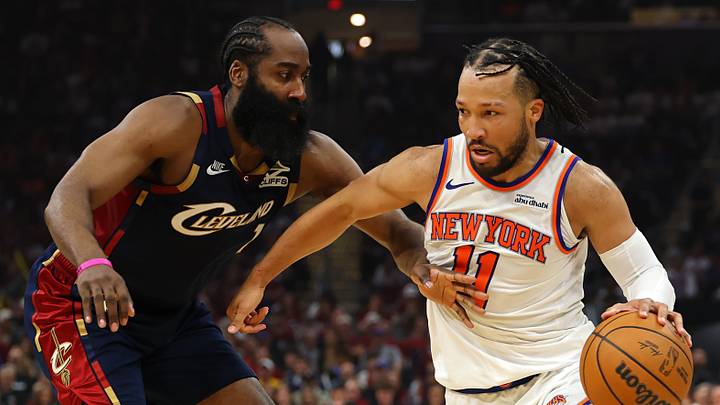
His historical stature is thus the matter of serious debate, and I found Bill Simmons and Joe House’s comparison between Harden and Jalen Brunson a fascinating entry into the Harden literature review. In short, Simmons argued that in winning the 2026 championship, Brunson has passed Harden and several other all-time greats in his 75-man pyramid (introduced in The Book of Basketball), because being the best player on a championship team is the ultimate goal of the NBA. I don’t think Simmons is right; I believe Harden is still better than Brunson all time, and in the spirit of the academic tradition, I will try to prove it as simply as I can.
Brunson versus Harden is a fascinating philosophical argument

Making a statistical or awards-based case for Harden over Brunson is easy as a Sunday morning; there is no argument that Brunson has had a better numerical career than Harden. But that’s also not the approach Simmons is taking, and he’s not wrong to do that. By pure numerical analysis, Wilt Chamberlain is probably the greatest sports human of all time, but we all know that greatness and impact goes well beyond the spreadsheet. It’s one of the things that makes the Book of Basketball and its associated pyramid so fun to read: you can engage with players, careers and stories beyond a boiled down reduction of numbers. Because sometimes, you actually did have to be there.
The argument for Brunson over Harden is rather a philosophical point about how player legacies are evaluated, and despite accusations I don’t think “best player on a title team” is the same thing as what is pejoratively referred to as “rings culture,” where championships are the only stat that matters. There is a nuance that makes the point more interesting, stating simply that the goal of being a superstar NBA player is to lead a team to a championship; Brunson did that, Harden did not. The same thing can be said, as Simmons did, about David Robinson (who won two rings, but had been usurped by Tim Duncan on his own team) and Bill Walton, who had a numerically much-worse career but led the Portland Trail Blazers to a legendary 1977 title.
It is unfair to treat Harden's playoff record as total failure

This is an interesting, defensible yet flawed philosophy. It relies entirely on specific playoff series and runs rather than the totality of playoff results — for instance, Brunson was 6-5 in playoff series coming into these playoffs, and Walton essentially only had one playoff run as a starter, breaking his ankle in the second game of their 1978 title defense. Harden, meanwhile, has never missed the playoffs, and is judged harshly for singular collapses that were his fault, but also were not the whole story.
That formulation also implies a supreme level of superstar control over the outcomes of basketball games that I simply do not think exists. In terms of career winning percentage, you have your Larry Birds and Magic Johnsons, sure, but you also have Michael Cooper and Danny Green. Michael Jordan and LeBron James both sit around 65 percent, simply because they were on some less-than-great teams early in their career — that doesn’t detract from their greatness.
Circumstance dictates a lot in a career, and I think Harden was supremely unlucky with the timing of his physical peak essentially being the apex of the late-2010s Golden State Warriors. He could never beat them, but neither could anyone; in Harden’s five-year peak, 2015-2019, he was eliminated by the Warriors four out of five years. Harden had bad moments in those series, sure, but it also felt like he was the only one in the West even trying to beat Golden State for half a decade. For all his Game 7 failures, I have always since respected that effort.
Harden is flawed, but his career was better than he gets credit for

There are things about Harden that I will never be able to unsee. The most obvious, to me at least, was the lackadaisical disinterest with which he carried himself without the ball. Find a clip of Harden throwing an entry or set-up pass to anyone: Joel Embiid, Dwight Howard, Evan Mobley, whoever you want. Then watch how he drifts away from the play toward the hash, not even pretending he has a chance of cutting on involving himself further in the play. It’s jarring once you notice it. His team’s best offense was always to have the ball in his hands, and he thus developed an antagonistic relationship with not having the ball.
Simmons and I will probably have to agree to disagree: player comparisons will always be a reflection of personal value systems over objective statistical reality, because uh, there is no objective statistical reality. I do not believe Brunson’s glorious run to the championship is enough to discount Harden’s entire career — he will never be the best player on a championship team, no, but he was, at one point, the MVP and had a five-year peak far beyond anything Brunson has even flirted with. I cannot speak to Walton or Robinson or even Jordan versus LeBron; they were before my time. But I’m here for Brunson, and I was there for Harden, a career I truly believe is over-hated and negatively overblown.
More NBA news and analysis:
 Add us as a preferred source on Google