
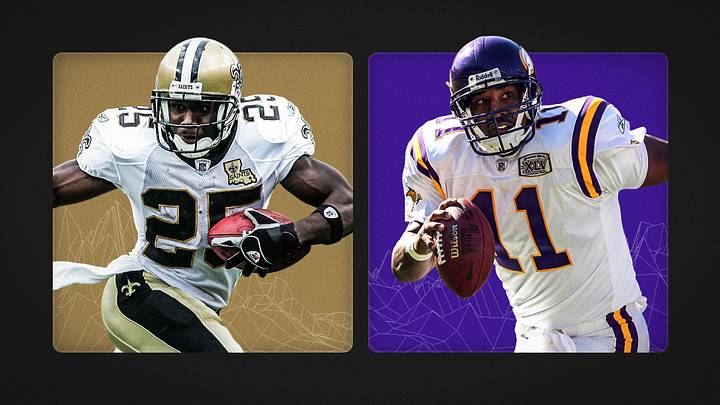
The NFL is full of stars. Truly, every team has stars on both sides of the ball. The rise of fantasy football broadened football fans' perspectives and helped more players become household names. Guys like Josh Gordon remain in our minds despite playing for the Cleveland Browns, never making the playoffs, and spending more time suspended than he did on the field. Fantasy has changed our perspective for who is underrated.
But there are still players lost in the ether of football history. Some came before fantasy football was remotely relevant, and others just fell under the radar for so long that they just stayed there forever. The football universe is full of dominant players who are not remembered that way, and there are guys we remember as busts who were actually pretty good.
1. Reggie Bush
Reggie Bush going second overall in the 2006 NFL Draft is one of the most shocking decisions in the history of the draft. The Houston Texans made the decision in the final days ahead of their number-one overall pick to take Mario Williams to solidify their pass rush rather than take the dynamic running back from USC. Bush dominated college football for years and is one of the greatest players in the history of the NCAA. However, his NFL career did not live up to those expectations.
Was he worth the second-overall pick? Probably not, but he also wasn’t a complete bust. Bush played 11 years in the league, which is a rarity for a running back. Getting more than a decade from one runner is a major win. He also had 1,300 yards from scrimmage in his rookie season. If you only looked at his rushing numbers in New Orleans (he never surpassed 600 yards rushing with his original team), then we can see why he was considered a bust, but he was so much more than rushing. His receiving numbers counted just as much.
Then, Bush moved on to the Miami Dolphins, and he immediately got his first 1,000-yard rushing season. He repeated the feat two years later with the Detroit Lions. He broke 1,200 yards from scrimmage four times, including more than 1,500 yards from scrimmage in 2013. Bush wasn’t someone who changed the NFL model, but he was a really good player for a while.
2. Steve Atwater

Do you ever hear the name Steve Atwater come up when we talk about the best safeties of all time? We hear the names of Ronnie Lott, Ed Reed, Brian Dawkins, Paul Krause, and Troy Polamalu, but Atwater could be just as great as any of them. As far as players lost in history, Atwater is near the top, which is crazy because he was on one of the most important teams of the 1990s.
Atwater made the Pro Bowl in eight of his 11 years in the league, and he was first-team All-Pro twice. He was Mr. Reliable, playing almost every game in his career and putting up crazy statistics until teams started to target the other side of the field.
We all focused on John Elway’s run to the Super Bowl at the end of the 1990s, but Atwater was the other long-time Broncos star who was looking for his championships. He was on both of those Super Bowl teams, and he delivered both years. His performance in Super Bowl XXXII is considered one of the best of all time. He recorded six solo tackles, one pass deflection, one sack, and a forced fumble in their 31—24 victory against the Green Bay Packers.
3. Herman Moore
We get it folks. If it’s not Barry Sanders, we don’t want to hear about the 1990s Detroit Lions. People think it was a pee-wee football team built around one of the greatest talents in world history. And listen, between Scott Mitchell, Rodney Peete, and Charlie Batch, the quarterback had a rough stretch, but it wasn’t all the Sanders show. Herman Moore was a very good wide receiver who made the most of what he was given, as well.
Moore had more than 1,000 receiving yards four years in a row, including 1,686 yards in 1995. He led the league in receptions twice, and he was a three-time first-team All-Pro in his career. He had more All-Pro selections than guys like Larry Fitzgerald, Tim Brown, Cris Carter, and Julio Jones. He has as many All-Pro selections as fellow Lions legend Calvin Johnson. Megatron is considered by many as the second-best wide receiver ever, but he doesn’t even have the most All-Pro selections in his franchise’s history.
Moore was fiercely loyal, playing all but one game with the Lions (he played a game with the Giants in 2002 before retiring). He finished his career with more than 9,000 yards and 63 touchdowns receiving.
4. Frank Gore
Everyone knows and appreciates Frank Gore’s career. They appreciate his longevity and his ability to keep finding teams to give him another run. However, it seems like the end of his career is overshadowing his greatness at the beginning. Gore finished his career with exactly 16,000 rushing yards, good for third all-time. He did this over 16 seasons, averaging exactly 1,000 yards per year. For that to happen, every late-career season with the Jets or Bills had to be countered with a superstar season with the 49ers.
Gore spent 10 years with San Francisco, and he was the starter essentially the entire time. He had eight seasons with more than 1,000 yards rushing, and he broke out in his second year with 1,695 yards and 9 total touchdowns. Gore was a star for the rest of his career, even if he never had superstar seasons like Adrian Peterson.
Still, Gore was more than an aggregator of statistics. He never had the touchdown numbers of his peers, but he was eating yards and first downs like it was his job. Oh, it was his job. Gore made sure that he was as reliable as they come at the position, and that’s why he lasted as long as he did in the league.
5. Anquan Boldin
Anquan Boldin is such an interesting name on this list because people remember him being good, but they only really remember Larry Fitzgerald being better. However, he was putting up WR1 numbers throughout his career in Arizona, and he even had multiple 1,000-yard seasons with the San Francisco 49ers late in his career. Despite this stellar career, he only made the Pro Bowl three times. That seems almost impossible, but Boldin was not someone who was recognized for his greatness while he was playing.
Here’s what we forget: this is someone who was building an incredible career incredibly fast. He broke a record by putting up 217 yards in his debut. He is still the fastest player to 400 and 500 career receptions.
But it’s the moments that has us scratching our heads as to why he’s not more popular as a great of his time. In Super Bowl XLVII, he had six receptions for 104 yards and a touchdown to earn his ring with the Baltimore Ravens. He had four total touchdowns in the postseason run, becoming a key component in their championship. When the Cardinals went to the Super Bowl in 2009, he played a big role in beating the Falcons and had 82 yards in the championship game on eight catches. He finished his postseason career with 1,057 yards in 15 games with eight touchdowns.
6. Ty Law

Ty Law proves that a player can make the Hall of Fame and still be criminally underrated for how good he was during his career. Law is just not talked about at all in the origins of the Patriots’ dynasty. Of course, having the GOAT Tom Brady lead those championships from the most important position in the sport does have an effect, by the Pats don’t win those championships without Ty Law.
Law was incredible during their first Super Bowl run. As one of the few players still left from the Patriots’ Super Bowl loss to the Green Bay Packers years earlier, he had the playoff experience the team needed from a player in his prime. In the Snow Game against the Raiders, Law was everywhere, recording 12 tackles and deflecting two passes. In the Super Bowl, Law scored the first touchdown, intercepting Kurt Warner’s pass and taking it back 47 yards to the house.
Two years later, Law had one of the greatest postseason performances ever by someone from any position. He intercepted Peyton Manning three times in the AFC Championship, putting one of the best players in the history of the game on his heels and pushing him to the brink of an on-field breakdown. That type of dominance should be discussed more, but because of Brady and Bill Belichick taking up so much room in the conversation, Law gets overlooked.
7. Randall Cunningham
We know Randall Cunningham as a highlight reel. He deserves better than that. In the 1990s, we weren’t exactly ready for the type of quarterback Cunningham was, a guy who was focused on making the best play by any means necessary. Running was almost looked at as a detriment to the expectations of the position, but he was just more than he is given credit for today.
Cunningham was a prototype for all the great quarterbacks of today. You might not have Patrick Mahomes, Josh Allen, or Lamar Jackson if Cunningham didn’t ignore the haters and pave a path of greatness for this generation. He was the first quarterback who forced defenses to prepare for a player who could beat you with his arm and his legs, and the league spent the next three decades trying to replicate him.
His Eagles peak should lead the conversation. In 1990, Cunningham threw for 3,466 yards and 30 touchdowns while running for 942 yards. This was 1990, an era when quarterbacks were told to stay in the pocket and take their hits. Cunningham treated the pocket as a suggestion. He was named first-team All-Pro in 1988, 1989, and 1990, a run of dominance that most quarterbacks from any era never touch. Pro Bowls followed. So did a reputation as a quarterback so dangerous that defensive coordinators lost sleep. And he was doing this while also leading the league in sacks taken. Cunningham was an enigma, and he should be discussed as such.
8. Zach Thomas
There’s just something about the middle linebacker position of the mid-2000s. Brian Urlacher, Ray Lewis, and the early years of Patrick Willis changed how teams called their offenses. Zach Thomas is in the same conversation as all of them. Despite being in the Pro Football Hall of Fame, Thomas is just discussed in a completely different tier as his peers of the same era.
Maybe it was playing for the Miami Dolphins, or maybe it was the way he dominated from the middle of the defense; something about Thomas stood out, like his massive shoulder pads did every Sunday. He was feared for his big hits and his leadership was more than enough to get this defense motivated. The Dolphins were a mess on offense post Dan Marino, so he never got the chance to showcase his value on the big stage. That's probably why we're here
Thomas was a fifth-round pick out of Texas Tech, taken 154th overall because scouts looked at his 5'11" frame and decided he was too small to survive in the middle of an NFL defense. They were spectacularly wrong. Thomas played the position with a ferocity that made his size irrelevant, and he became the best value in the 1996 NFL Draft. Thomas acted as the engine of the Dolphins defense for the next 12 years.
9. Aeneas Williams
Here’s another Hall of Famer who many knowledgeable fans might not have a clue about how impactful he was during his heyday. He spent most of his prime in Arizona, in an era when the Cardinals were an afterthought, and the league’s best defensive back of the 1990s rarely got a primetime audience. Deion Sanders had the swagger and Rod Woodson had the résumé. Williams had the interceptions.
What separates Williams from other ball-hawks is what he did once he had the ball. He finished his career with 55 interceptions and 12 defensive touchdowns, making him one of the most dangerous return men ever at the position. He had to be on those Cardinals teams. Opposing quarterbacks knew that one mistake could mean seven points the other way.
Unfortunately for Williams, losing buries everything. We love a player who commits, but we also forget a player who commits to the wrong team. He’s already coming from a place where cornerbacks aren’t often historically relevant, so doing what he did for the Cardinals was always going to be an uphill climb for long-term popularity.
10. Jeff Garcia

We think about the replacements for the great quarterbacks of the 1990s, and it’s a list that nobody wants to think about today. Some were disasters, like the Cowboys going from Troy Aikman to Quincy Carter (and eventually a roulette wheel of veteran greats who were past their prime). Others were decent, like when the Broncos went from John Elway to Brian Griese. Then, there were seamless transitions, like Brett Favre to Aaron Rodgers. Where would you put Jeff Garcia on the list?
Most would put him in the middle of the pack, but he deserved more. Garcia made three straight Pro Bowls after Steve Young retired. We don’t talk about Garcia’s story enough. He fought his way through the CFL like Kurt Warner and Warren Moon did. He scraped and clawed his way to the NFL, and he took over the iconic 49ers after their run of Brodie-Montana-Young was over. He could have crumbled under such pressure, but he stepped up.
He had the strangest career post-San Fran, and they made a terrible bet going with Tim Rattay over Garcia, but the peak was amazing. Garcia did end up playing for seven franchises, many as a backup and spot starter. He was always getting into games and making plays, but he seemed to enjoy his new role. We’ll always have those great seasons in the Bay Area.
11. Jimmy Smith
Honestly, anyone from the original Jacksonville Jaguars teams could be on this list. Fred Taylor was amazing in the backfield and never got the recognition he deserved. Mark Brunell was the engine that kept things going. An undersized lefty quarterback who built an offense that didn’t look like anything else we saw during that era. However, Jimmy Smith is the one who deserves it the most. His numbers are eye-popping.
No, seriously, have you seen Jimmy Smith’s career numbers? Smith has more than 12,000 yards in his career, good for the top 30 all time. He has more yards than many Hall of Famers, including Calvin Johnson, Michael Irvin, Charlie Joiner, and Lance Alworth. He established himself as a starter in 1996 and broke 1,000 yards in nine of his next 10 seasons. He broke 1,200 yards five times.
What’s crazier is that Smith has one of the greatest and most unlikely stories in history. He was drafted by the Dallas Cowboys, and he even won a Super Bowl with them, but he was more of a spectator that season. Then, Smith had serious complications due to an appendectomy and how the doctors diagnosed him. He missed two seasons because of that. He returned with the new franchise in Jacksonville, and he became a legend.
12. Shaun Alexander
We all know about that Shaun Alexander season. In 2005, Alexander won the NFL MVP after rushing for 1,880 yards and 27 touchdowns. It was an NFL record at the time, but LaDainian Tomlinson has since surpassed it. It is one of the greatest seasons in league history. Alexander was out of the league just three years later. He never broke 1,000 yards again, and that became Alexander’s legacy. Many believe he was a one-hit wonder, but that’s just not the case.
Alexander was dominant before that MVP season. In 2004, he had just under 1,700 yards and 16 touchdowns. He had 20 touchdowns if you count his receiving touchdowns. Has anyone ever had back-to-back 20-touchdown seasons? Yes, Alexander has. In 2003, he had 1,435 rushing yards and 14 touchdowns. In 2002, it was 1,175 yards and 16 touchdowns, and in 2001, it was 1,318 yards and 14 touchdowns.
Alexander scored 100 rushing touchdowns in his career. That’s good for ninth all time. He has more touchdowns than Barry Sanders, Jerome Bettis, Franco Harris, Curtis Martin, Eric Dickerson, and so many others. How is this man not in the Hall of Fame? It’s because his last great season is actually hurting his legacy.
13. Henry Ellard
It was hard to get recognition in the age of Jerry Rice. It’s a simple answer for why Henry Ellard is on this list, but it’s also the truth. When Ellard retired, only Rice and Art Monk had gained more receiving yards in NFL history. Even today, after two eras of explosive passing yard totals, Ellard is still 15th all-time in receiving yards. He’s ahead of the likes of Julio Jones, Torey Holt, Mike Evans, and Travis Kelce (as of this writing).
Los Angeles drafted Ellard with a second-round pick out of Fresno State in 1983, and his first position in the league was punt returner, not receiver. He was electric, leading the league in punt return yards and earning All-Pro honors. As with many great returners, the ultimate desire is to impact the offense.
In 1988, he got his one and only All-Pro spot on the first team, leading the NFL with 1,414 yards, and he followed it with another monster year in 1989 as the Rams marched to the NFC Championship Game. His routes were crisp, and his impact was second to… well Rice. Then, Ellard moved to Washington and put up one of the best seasons of his career. Age was just a number for Ellard. So were statistics, and his were astounding, including leading the league in yards per reception at 35 years old.
14. Daunte Culpepper

A quick personal story. Back in the days of Beckett trading boards, a card came by this author’s hands that paired Daunte Culpepper with Peyton Manning, Trent Green, and Brett Favre along with their game-used jerseys. This was the company Culpepper was keeping at the time. He was in the conversation with Manning, Favre, and greats like Steve McNair and Donovan McNabb (who also has an argument to be on this list).
It all culminated in the season of his life. In 2004, the Vikings were dealing with a disgruntled Randy Moss who should have derailed the season, but Culpepper’s talent took over. He threw for 4,717 yards and 39 touchdowns. He added another 406 yards and two touchdowns on the ground. He did this with Moss finishing with under 800 yards, Nate Burleson leading the team in receiving with a tick over 1,000 yards, and a receiver room that didn’t have much to offer beyond what Culpepper was feeding him. On top of that, he got nine guys over 200 yards that season.
Beyond that season, Culpepper had some great years with Minnesota. He’s a three-time Pro Bowler and led the league in touchdowns in his first season as a starter in 2000. Culpepper’s peak was very short, but he went blow for blow with Manning, and Tom Brady wasn’t even in their conversation despite all the winning he was doing.
15. Bob Sanders
Speaking of Peyton Manning, everyone talks about Dwight Freeney as if he were the defensive counterpart to the superstar QB, there to counter his greatness. And as great as Freeney was, Bob Sanders was the engine of the Colts' defense back in the day. In fact, when Sanders got injured, the Colts didn’t play as well. When he was healthy and on the field, he could beat anyone.
Sanders was known for his football IQ and massive hits that made receivers think twice about going across the middle. He could knock a guy into next week before we knew the implications of that, and the rules changed. In 2006, Sanders suffered a knee injury and the Colts defense looked awful. It seemed like it was bound to be another Manning failure, but Sanders returned for the playoffs, and everything changed. Their rushing defense especially improved, going from 100 yards allowed per game ot 73. He also made a pivotal play in the ultimate get-right game, blocking a pass headed for Troy Brown late in the AFC Title Game against the Patriots. Manning now had a chance to win the game, and he did.
In the Super Bowl, he forced two turnovers in a dominant victory against Rex Grossman and the Bears. He built on that momentum, winning Defensive Player of the Year the next season. The statistics weren’t crazy, but the narrative was obvious. With Bob Sanders, the Colts had a great defense. Without him, it was a bad defense. No player on defense had as big an impact on their team.
16. John Abraham
Nobody is putting John Abraham on the same list as Reggie White, Bruce Smith, or Myles Garrett, but he should be in the conversation for that next tier down. Unfortunately, nobody is having that conversation, either. John Abraham is the most dangerous pass rusher nobody talks about.
He retired with 133.5 career sacks, top 15 in NFL history. Players with fewer sacks have gotten louder tributes. Abraham’s problem is he wasn’t loud enough about it. He had everything else the greatest pass rushers had. He was a freak athlete who was selected in the first round of the NFL Draft. He played for the New York Jets, which probably didn’t help. His speed was natural and scary at the same time.
After he was traded to Atlanta in 2006, he switched from freak playmaker to consistent rusher. We all know that Matt Ryan came in and turned the Falcons around, but that narrative is not as prominent if Abraham didn’t lead the league in sacks in 2008 with 16.5. He was a terrifying, relentless force off the edge for more than a decade, and the offensive tackles will tell you why he should be on this list.
17. Richard Dent
Richard Dent is a Hall of Famer, a Super Bowl MVP and one of the most productive pass rushers who ever lived. So why don’t we know who he is? We know William Perry, Mike Ditka, Gale Sayers, Mike Singletary, and even Jim McMahon, but we don’t know about the guy who was deemed the most important of all of them in the Super Bowl that season.
Dent was a late-round pick out of Tennessee State in 1983, an eighth-rounder that most teams passed on again and again, including Chicago. Within two years, he was the most feared pass rusher on the best defense the league had seen in a generation; maybe ever. He had 17 sacks in 1985, one of the best pass-rushing seasons ever.
In Super Bowl XX, Dent was the most disruptive player on the field. The Bears won a destructive game, and Dent's presence in the backfield on nearly every play gave the Patriots no chance. He finished his career with 137.5 sacks and kept producing well into the 1990s, even winning another Super Bowl ring late in his career with the 49ers, a footnote that shows how long he stayed relevant.
18. Santana Moss

Santana Moss played 14 seasons in the NFL. That kind of longevity doesn’t happen on accident. For most of his career, he was considered the “other Moss” at his position, but he deserves way more recognition than he received. Moss was incredible in college, lighting it up in South Florida before becoming a first-round pick to the New York Jets. His speed made his lack of size irrelevant.
After four up-and-down years, the Jets traded Moss to Washington for Laveranues Coles. It was an interesting swap for both teams, essentially trading their number ones to give them both a change of scenery. Moss caught 84 passes for 1,483 yards and nine touchdowns, made the Pro Bowl, and put the franchise on his back for a playoff run in his first season with his new team. Not bad!
Moss would go on to acquire 10,000 receiving yards and had a few big seasons in between there. Washington kept him around because he was very good no matter who was throwing the ball to him. In his 10 years with the team, he had just two where his QB played all 16 games. He stuck through veterans on their last leg, like Mark Brunell, Rex Grossman, Donovan McNabb, and Todd Collins. He stuck around until the RGIII era, but he didn’t last until Kirk Cousins took over.
19. Carson Palmer
Carson Palmer gets his just due, right? People know about him. Right? Palmer is kind of remembered. We know he was good, but much of his career is kind of an afterthought. That’s all because of the injury he suffered in 2005. After carrying his Bengals to the playoffs with one of the best offenses in the league, his knee exploded on one of the first plays of the game.
His career changed dramatically after that. He was on a Hall of Fame trajectory before the hit that changed his career. The Bengals were supposed to finally get themselves out of the doghouse of the NFL. Instead, they were back to the bad place, and Palmer eventually asked for a trade in a very messy divorce. He was shipped to Oakland, and that went terribly.
Then, there was the Arizona revival. We all know about Kurt Warner’s Arizona revival, but nobody really talks about Palmer’s. In 2015, at 35, he threw for more than 4,600 yards and 35 touchdowns, helped lead the Cardinals to a 13-3 record and a trip to the NFC Championship Game, and finished among the top candidates for MVP. He never got to the Super Bowl, but he took two forgotten franchises very far.
20. Simeon Rice
Simeon Rice has a story that is familiar on this list, especially with the defensive players. He was a superstar on a unit that had plenty of them. The early 2000s Tampa Bay Buccaneers were a unit, winning the 2002-03 Super Bowl. He retired with 122 career sacks, a total that sits deep in the all-time top 20, and he was the sharpest edge on one of the most suffocating defenses the league has ever produced. Warren Sapp had the mouth, Derrick Brooks had the speed, John Lynch had the hits. Rice just kept collapsing the pocket.
Now, he didn’t start with the Bucs. Rice started with the Arizona Cardinals. He won the Defensive Rookie of the Year after being the third-overall pick. Rice signed with Tampa Bay in 2001 and became the finishing piece on Monte Kiffin’s defense. In 2002, the Bucs won the Super Bowl, and Rice was a massive part of it. That Tampa defense shut down Oakland’s offense.
That season, Rice led the league in sacks. Rice was never the face of that defense. And he seemed fine with that. He started his career quietly dominant, moved through his prime with bigger personalities around him, and he left the game without a peep. However, when looking at the historical context of the NFL, Rice should gain more credit for how well he played during his time.
21. Matt Forte
When you do enough of a historical analysis, you tend to start to see a pattern. One of the clearest patterns is seeing players who just missed their rightful era. That’s Matt Forte. If he’s playing today, he would be one of the most popular players in the sport. The dual threat was a force for the Chicago Bears.
He was a workhorse on the ground and a wide receiver in a running back’s body, and he carried a Bears offense for years that routinely put him in an impossible situation. Chicago’s quarterbacks came and went, the line was a mess, and the passing game was a punchline. Forte was the one constant. He had 1,400 or more yards from scrimmage in each of his first seven seasons.
Forte was one of the best pass-catching backs the league had ever seen. He could have easily just been a slot receiver. Today, he would have been a superstar. His fantasy numbers were already great, but with a better team around him, he wouldn’t have been taken for granted. He would have been celebrated and built around. Can you imagine today's Bears with Forte in the backfield? Ben Johnson and Caleb Williams might actually have a contender on their hands in that case.
22. Ozzie Newsome

Ozzie Newsome is the rare Hall of Famer whose playing career got forgotten because his second career was so enormous. Ask a younger fan who he is, and you’ll hear about the architect of the Ravens, the man who built a franchise from scratch and kept it a contender for two decades. Don’t get us wrong; that’s a legacy worth celebrating, but it has quietly buried one of the most gifted pass-catching tight ends the sport has ever seen.
When he joined the league, tight ends weren’t catching many passes. They were additional blockers who sometimes played an outlet role. He spent his entire 13-year career with the Browns, a level of loyalty that almost doesn’t exist anymore, and he retired as the most prolific receiving tight end in NFL history. (Which makes it crazy that he had any hand in moving the Browns, but let’s ignore that for now.)
Newsome finished with 662 catches and nearly 8,000 receiving yards. He was the reason a heartbreaking team kept giving that city hope. He was pulling this team up by its bootstraps and getting them to contention. He never got them over the top, but he got them closer than anyone did since the Super Bowl era begin and since.
23. Irving Fryar
How is it possible that a number-one overall pick ends up on this list, especially one who was a wide receiver? And it’s not like he was even close to a bust. He finished his career with 12,000 yards and carried a Patriots team that wasn’t exactly stacked in a pretty competitive AFC. He was a vertical threat for Steve Grogan, and by 1985 he was a Pro Bowler on a Patriots team that made an unlikely run to Super Bowl XX.
It seemed like the Patriots of yesteryear were gone, but after getting stomped by the Chicago Bears, New England never reached that type of success until the turn of the millennium. Fryar, however, just kept producing. He produced in Miami after nine seasons with the Patriots. He continued to produce with the Philadelphia Eagles. He… didn’t produce with Washington, but he was approaching 40 by then.
The rap on Fryar is that he took forever to be great. He didn’t get his first 1,000-yard season until his eighth year in the league. But he continued to dominate from there, and he became one of the most underrated receivers of the late 80s and early 90s. Fans want immediate production from number-one overall picks, but Fryar was far from a bust.
24. Michael Thomas
It’s hard to explain what made Michael Thomas special besides his statistics. He wasn’t making insane catches like DeAndre Hopkins. He wasn’t racing past cornerbacks like Tyreek Hill. Thomas was never mistaken for Odell Beckham Jr. or even Chad Johnson. He was still a unicorn in his ability to provide volume from the wide receiver position.
It might be a simple explanation. Thomas was the perfect complement to Drew Brees on the New Orleans Saints. Brees was also a volume quarterback, playing a “death by a thousand cuts” offense. Thomas was happy to be responsible for hundreds of those cuts during his career.
For four years, Thomas was untouchable. And then, injuries took it all away. He had more than 5,500 yards in his first four seasons, and he capped it off with a season where he led the league with 149 receptions, still an NFL record, and more than 1,700 yards. He was always open and almost never dropped the ball. He was as if the Saints had a really effective running back at the position. Those four years were insane production-wise, and we wonder how high he could have taken it if he was relatively healthy throughout his career.
25. Garrison Hearst
The first victim of the Madden Curse, Garrison Hearst, was represented on the football video game for a reason. He had a trajectory of greatness on one of the most important franchises in the league. Unfortunately, he broke his ankle in one of the most disgusting injuries in NFL history. The recovery took two years, and most forgot about him and assumed he was done with the league. He wasn’t done, and he came back with a vengeance.
Arizona took Hearst third overall in 1993 out of Georgia, where he’d won the Doak Walker Award as the best running back in the country. The Cardinals were a dead-end franchise, and as with everything they tried back then, it failed. When he landed in San Francisco in 1997, the 49ers got a back ready for a fresh start. Hearst ran for more than 1,000 yards in his first year in the Niners’ backfield, finally giving the team a pulse again.
Hearst came back in 2001 after the ankle explosion and ran for more than 1,200 yards, a feat that should have been impossible. He earned the NFL’s Comeback Player of the Year honor, one of the easiest award votes in history after two full years away from football. Most backs never return from an injury like that, let alone return as if they never left. It was a short spurt, but boy was that a fun season.
 Add us as a preferred source on Google