
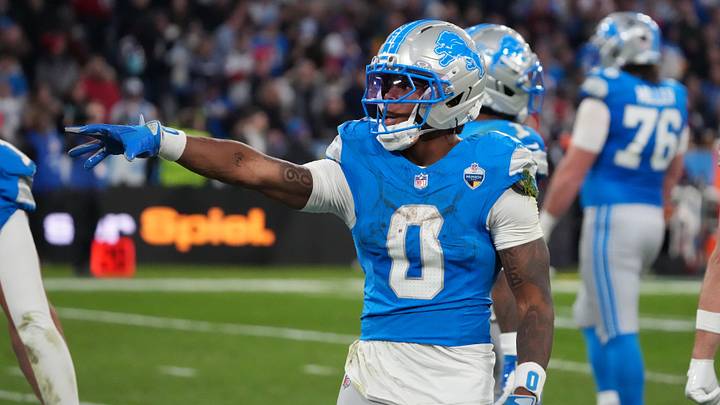
It’s fantasy football trade deadline season, the weird cousin of the actual NFL trade deadline, where instead of insiders reporting on potential deals, we just have coworkers sending cryptic texts to each other during lunch breaks; “D’Andre Swift?” “Nah sry.” But don’t worry, I’m here to help you crush this ever-important part of your fake football life!
Despite its importance, I have never seen or heard fantasy football trading properly described in any the million-plus pieces of trade content I’ve consumed in my life, so we’re going to take a moment to get our definitions straight. Pay attention, because this will be on the test, and no, there will not be test corrections available.
1. Fantasy football trading isn't like real life

Most writers and podcasters I read or listen to describe fantasy football trades like actual NFL trades or like stocks, usually in the binary of “buy low” or “sell high.” These are both woefully inaccurate. First, fantasy football trades are nothing like real NFL trades, which are almost always between a team looking to trade present value for future value. Despite often being presented as such, American sports leagues are NOT simple zero-sum games because of multi-year contracts and future draft picks. You can actually leverage value outside the current competitive ecosystem to gain an advantage.
But you can’t do that in fantasy football, at least not in normal redraft leagues. Everyone is trying to win, and plans are not measured in centuries —they’re measured in touchdowns. That means your intuition of player value from real football, that perhaps Josh Downs, Tre Tucker and Alvin Kamara should be worth Luther Burden III, is useless; depth is useless in fantasy football, and some trading four quarters for a dollar is basically just trading 25 cents for a dollar if you can only start one of the quarters.
It’s not like stock trading either, because stocks can be quickly and easily exchanged for liquid assets; cash or, in fantasy football, we would need points. If you could just convert Josh Downs, Tre Tucker and Alvin Kamara to 17 fantasy points and apply it to your score at any time, then this would be like stock trading, but you cannot. These players do not have inherent value; they just have perceived value. Which makes fantasy football trading only have one real analogy: the medieval barter system.
That’s right. When you’re making trades in fantasy football, think of yourself like a medieval peasant talking to your neighbor about trading a cow for three chickens or four bushels of wheat for some clay pots. It’s like Settlers of Catan; everyone is pursuing the same goal, and thus the only value is a value judgement. Understanding this will help you make better decisions.
2. When deciding if you should make trades, look at your points scored, not wins and losses

You may be tempted to think that you are in last because there is something wrong with your team. This is a fallacy, and is actually liable to lose you even more games than you would otherwise. You are probably in last because you got unlucky, and you should look instead at your total points relative to the rest of the league — if they are really low, then your team sucks and you should probably look to make some trades. If they’re higher than you expected, then you might be due for some regression to the mean in the win column (math note: the extent to which you can expect regression in a 14-week season is less than you’d maybe hope).
If your total points are very low, I would suggest identifying your best player, probably your first-round pick, whoever that was, and shopping them for high-risk players. I’m talking rookies, second-year players, boom-or-bust options that could turn your team into the worst thing since unsliced bread or could become everything you ever hoped for overnight.
When you’re in a position where you basically need a win out with a bad team, you have to create a win condition. If that win condition is a bunch of boom weeks out of high-variance players? Make it happen.
3. Your leaguemates aren’t stupid

“Most people are normal, like you,” is a mantra that can get you through the vast majority of life’s many awkward social situations. Traveling to foreign countries and don’t speak the language? That’s fine, because most everyone you’re interacting with is just a normal person, like you. At a party and don’t know anyone? That’s also fine, because more likely than not that person over there who also seems like they don’t know anyone is normal. In fantasy football trades, your leaguemates are normal, like you, which means they aren’t stupid; do not assume they can be had, do not assume they can be swindled.
You are going to have to give up good players in any trade. Even in medieval barter economies, nobody was giving up a chicken for a blade of grass, even if grass is green and has several medicinal properties — nobody has any use for a blade of grass. Do not try to trade your bench players, guys you just picked up or players that have little to no value. That is a waste of everyone’s time and sucks the fun out of trading and fantasy football …
… unless, of course, you don’t care about fun, or the fact that fantasy football is a game and games are supposed to be fun, and you are instead a ruthless, cynical destroyer who will do anything and everything to win at any cost to your reputation and friendships because “history does not remember friendships it remembers WINNERS” (violent, heavy breathing). If that’s you, I’m sorry, but also … yeah, you should ignore everything I just said and literally only offer terrible trades to everyone until someone finally cracks. It is a horrible, unfun and antisocial strategy, but it’s the most effective one; just refuse to give up good players ever but refuse to stop offering terrible deals. Everyone will hate you, but you can win leagues like that. Let me know afterward if it was worth it.
 Add us as a preferred source on Google