
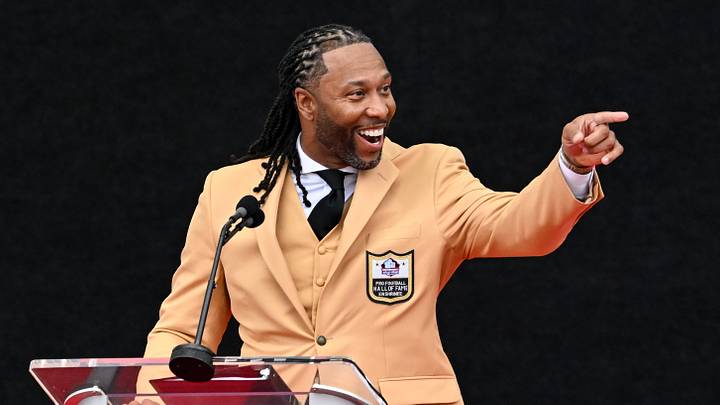
The additions of Drew Brees, Larry Fitzgerald, Luke Kuechly, Adam Vinatieri and Roger Craig to the Pro Football Hall of Fame made the halls of Canton, Ohio that much more legendary. While the hundreds of bronze busts earned their ways into immortality for their professional achievements, there are plenty in there that represent players who wouldn't have had the opportunity to be great in the NFL without dominant college careers.
Those that demonstrate extraordinary feats and performances while still an amateur are usually recognized with college football's highest individual honor: The Heisman Trophy. Although, sometimes the sport's best player in a particular season isn't bestowed the honor like everyone thought they deserved. Their pro careers tended to prove the Heisman voters wrong.
Here are four Pro Football Hall of Famers who should've had a Heisman Trophy as part of their career highlights.
RB Jim Brown, Syracuse (1956)

- 986 rushing yards, 15 total touchdowns, fifth-place in voting
Brown played in a completely different era of college football (and for the United States in general). He was the only African-American finalist, but that wasn't why he lost the award. Brown rushed for nearly 1,000 yards and scored 13 touchdowns on the ground. On top of that, he caught and threw for a touchdown, showing off a unique triple-threat ability for Syracuse in his senior year.
4⃣4⃣ Jim Brown catching a TD against Maryland in 1956. Tackle over set with a T backfield, toss to the back then the throw. @CuseFootball gets the upset win at #10 pic.twitter.com/9fvLjAa1a2
— Old Football Film (@FilmHistoric) July 21, 2020
Brown led the Orange to a 7-2 season, which doesn't feel all that impressive, but compared to who he lost the honor to, he got royally screwed. That year's winner was Notre Dame quarterback Paul Hornung, who threw for 917 yards, rushed for 420 more and scored just nine total touchdowns. Oh, and he threw 13 interceptions for the 2-8 Fighting Irish that year. The fact that Brown finished fifth in voting — behind an offensive lineman no less — is just an insult to his abilities. One sports writer was so angry with the result, he didn't vote for the Heisman for another 20 years.
WR Marshall Faulk, San Diego State (1992)

- 1,630 rushing yards, 15 touchdowns, 18 receptions, second-place in voting
Faulk fell victim to his team's conference membership and painfully mediocre record during his sophomore season. The Aztecs went 5-5-1 and finished fourth in the Western Athletic Conference but he managed to dominate the gridiron nonetheless. Faulk was voted the team's MVP and gained national notoriety for his rushing exploits. He, of course ,would go on to become one of the key cogs in the Greatest Show on Turf.
USC's 1992 defense had guys like Willie McGinest and Jason Seahorn. Marshall Faulk treated them like they were a JV squad #RBRespectMonth
— Colton Denning (@Dubsco) March 14, 2024
🔗⤵️https://t.co/UsgHVXUYAR pic.twitter.com/2g3wG6s9FX
The 1992 season, of course, was prime time for the Miami Hurricanes' dominance. They were coming off a national championship and continuing to bring in high-powered talent. QB Gino Toretta was handed the Heisman for his 3,060 passing yards, 19 touchdowns and just seven picks. Those are good numbers but not dominant by any stretch. Faulk was the foremost talented rusher in the game that season and suffered from an inadequate supporting cast.
QB Peyton Manning, Tennessee (1997)

- 3,819 passing yards, 36 touchdowns, 11 interceptions, second-place in voting
Likely the most difficult Heisman Trophy vote in history, Peyton Manning finished second behind Michigan's Charles Woodson. In his senior season at Tennessee, Manning practically re-wrote the SEC record books with his 3,819 passing yards and 36 touchdowns. He was a consensus first-team All-American and won just about every award a quarterback could earn — except the Heisman.
KNOXVILLE, Tenn. (Oct. 11, 1997) —
— Neyland Press Corps (@NeylandPress_) April 20, 2026
Locked into an early draw with Georgia, Peyton Manning fit a pass into Cedrick Wilson for a touchdown that put Tennessee up for good in the Vols' 38-13 win over the Bulldogs at Neyland Stadium. pic.twitter.com/8JP8S64VhK
Woodson was the first full-time defensive player to win the award, which was unique in its own right. He, too, won just about every award at his position in college football. This is one instance where the argument that Manning should've won the award cannot be made against his opposition. Rather, he did himself in by failing to lead Tennessee to crucial victories that Woodson did.
WR Larry Fitzgerald, Pittsburgh (2003)

- 1,672 receiving yards, 22 touchdowns, 92 receptions, second-place in voting
Oh, poor Jason White. The Heisman Trophy winner who wasn't selected in the NFL Draft. He did better than Manning with his passing (3,846 yards and 40 touchdowns) but Fitzgerald was doing generational things at the receiver position. He led the NCAA with 1,672 yards and 22 touchdowns and was catching balls one-handed before Odell Beckham Jr. made it cool. His "Heisman Moment" should've been his seven-catch, 135-yard, three-touchdown performance against Texas A&M. He was doing it for an ACC team that was never in the national title conversation either.
Larry Fitzgerald vs. Texas A&M (2003):
— 2StripesCPD (@2StripesCPD) July 23, 2026
7 catches for 135 yards and 3 TD - the last of which was a jaw-dropper in double coverage that sealed Pitt's 37-26 win. A true superstar-making performance that put the whole country on notice ⭐ pic.twitter.com/N2jv3Qebv5
Oklahoma gave White greater notoriety as the Sooners were constantly in New Years Six bowl games and in the mix for national championships. White was just the latest in a line of strong passers. You could easily make the argument that Fitzgerald was a victim of the Heisman Trophy era where it was most considered a quarterback award. In a stretch from 2000-14, only twice was it handed to a non-QB. Fitzgerald should've been the third.
 Add us as a preferred source on Google