
If you had told me following last season's playoff performance that the 2026 Houston Texans would start the 2026 season with an 0-4 record, I would have simply assumed that C.J. Stroud's struggles in the postseason continued on to the 2026 season. Fortunately for Texans fans who hope we at least have a good quarterback going forward, Stroud is decidedly not the issue in 2026. He's played very good football and has given the team a late lead in three of the four games so far, only for the defense to let him down.
So, who is to blame for what we've seen? Well...everyone else, basically. Stroud, edge rusher Will Anderson Jr. and wide receiver Nico Collins (in the games he hasn't missed due to injury) have carried this team, while the vaunted Texans defense has taken a huge step back. These players and coaches deserve a bit extra blame, though, for Houston's awful start.
CB Kamari Lassiter

I'm going to the macro-level issues with Houston in a moment, but first, let's talk about the biggest reason that the Texans lost to the Dallas Cowboys: one complete disaster of a drive for cornerback Kamari Lassiter that essentially served as a microcosm of what's wrong with the Texans defense.
Houston led 23-13 in the third quarter, but Lassiter was burned on a streak by George Pickens on the first play of the next Dallas drive after Houston's touchdown. 53 yards, putting the Cowboys in a great spot to come away with points on the drive. And, like...okay! It happens. Pickens is a good receiver and Lassiter let him get ahead of him a bit, but it wasn't the worst coverage I've seen. But then, just a few plays later, Lassiter commits pass interference on Pickens, which sets Dallas up with first-and-goal at the one. Not great, but the defense hunkers down. Drops Javonte Williams for a loss of three on first down, makes a couple more good plays and forces Dallas to go for it on fourth down. What happens then? ANOTHER LASSITER PENALTY -- this time in the form of a defensive holding call that gives the Cowboys another first-and-goal. Just a total disaster.
(Let's also not forget that Lassiter dropped what would have been a game-ending interception against the Bills.)
Lassiter has struggled, but the secondary as a whole has as well. Linebacker injuries have played a key factor there, as the Texans aren't getting as much push up front, which means quarterbacks have been able to throw the ball more comfortably this season. That adds stress to the secondary, as you're mostly getting more on-time passes thrown your way, and the secondary just hasn't been ready for that.
RB David Montgomery

A couple of potential AFC contenders made splashy running back additions this offseason. The Chiefs added Kenneth Walker, who is a huge part of why the team started 4-0. The Texans added David Montgomery, who is a big part of why the team started 0-4.
Montgomery's Texans debut went well. He found the end zone twice on the ground and once as a receiver, and it looked like he was the boost this offense needed. Since then, though, he hasn't found the end zone a single time and he is currently averaging just 2.7 yards per carry. There's just no juice here from the former Lion, who is averaging the fewest rushing yards per game of his NFL career.
The blame for the run game can't all fall on Montgomery. Woody Marks has struggled as well. The offensive line isn't opening up holes. Offensive line coach and offensive run game coordinator Cole Popovich should have already been fired. But Montgomery is most visible example of how this team has been an absolute disaster when it's tried to run. Thankfully, Stroud has played so good that the Texans have been in three games until the end, but with any semblance of a rushing attack, we're probably looking at a team that's 2-2. (And if Lassiter doesn't drop that interception against the Bills, 3-1!)
WR Jared Wayne

I am blaming Jared Wayne here, but you could really blame any backup receiver for this team. With Collins out and Jayden Higgins done for the year, the team has had to turn to some depth options, but those depth options just haven't been performing. Wayne is the best example of that, as he's turned his 12 targets into just four receptions. At least Jaylin Noel has played well in the rare instances that the ball does his way, and at least Xavier Hutchinson has caught almost half of his targets. Kayshon Boutte is still figuring out the system. Wayne has been a non-entity despite playing way more snaps than he should be.
It's those snap numbers that really get me. Wayne has already played 114 snaps, roughly 42.5 percent of Houston's offensive plays. He's only been on the field for six fewer snaps than Noel. The lack of production with that level of snaps is unacceptable, and that's not even necessarily on Wayne. Houston should have tried to upgrade its receiver depth this offseason, because trotting out the same end-of-roster guys over and over is how you get this.
With Collins back, Wayne played just 16 snaps against Dallas, so it looks like he should fade as a concern going forward simply because he won't be asked to do more than he's capable of doing as often, but having to rely on him so much in Week 2 and Week 3 really hurt this Texans offense.
OC Nick Caley

Credit to Houston Texans offensive coordinator Nick Caley, who adjusted well in Week 4, calling what was by far his best game of the season. With that said, he stands out overall as a big part of Houston's issues.
The playcalling hasn't been creative. I'm not sure if the number changed after Week 4, but after Week 3, Houston ranked last in the league in first down passing rate in the first quarter. The team runs too much early in games, then realizes that the run game isn't working, then finally adjusts and passes early in series during the second half, but by that time, it's like...well, you basically wasted a whole quarter of football with your predictable playcalling.
Personnel groupings are on Caley as well. Why was Wayne playing more than Noel? Why has second-round tight end Marlin Klein barely seen the field? (Though that one might be on GM Nick Caserio for using a second-round pick on a developmental tight end, something you don't need to do when you're trying to be a Super Bowl contender.) Caley just hasn't consistently put his best players in the best positions to succeed. If he finally just commits to letting Stroud sling it like he did in Week 4, then he might be able to salvage things, but Caley certainly looks to be on the fast track to, IDK, an offensive coordinator job a low-level FBS program next year.
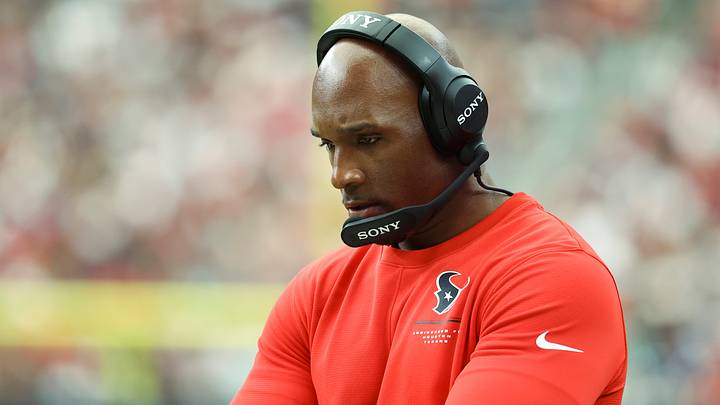
HC DeMeco Ryans

DeMeco Ryans doesn't get to escape criticism here. Houston's success since hiring Ryans has been a great story, but 2026 has shown some cracks in the armor.
Ryans is a defensive-minded guy. That's always a risk in the modern NFL, as it means he has to get his offensive coordinator hire right. So far, it appears he's now failed at that twice. As a defensive-minded guy, you also expect defense to be his team's best unit, and while that had been true, the defense is struggling so far. Defensive coordinator Matt Burke deserves blame there as well, but at the same time, the defensive issues highlight why head coaches who come from that side of the ball are so risky.
But even more than this, Ryans' in-game management has been a major question. Against the Colts, you can argue that Ryans' timeout usage was one of the biggest reasons that the team lost. Ryans let a ton of time come off the clock before calling a timeout on defense late in the game, and ultimately, Houston didn't have time left to answer after a Colts field goal put Indianapolis in front. If you're going to use a timeout on defense in that situation, why wait so long? Ryans seemed to learn his lesson in the first half against Dallas, using timeouts on defense to give his team a chance to get the ball back.
It worked and the Texans got a field goal before the half. But then, at the end of the game, Ryans had the opposite issue that he had against the Colts, as he did use his timeouts on defense. That saved Dallas from potentially using theirs, and it meant that when Houston got the ball back with 40 seconds to go on their own 28, they might have had the option to stop the clock a time or two. Alas, they didn't, and a couple of incomplete deep heaves later, Houston was 0-4.
 Add us as a preferred source on Google