
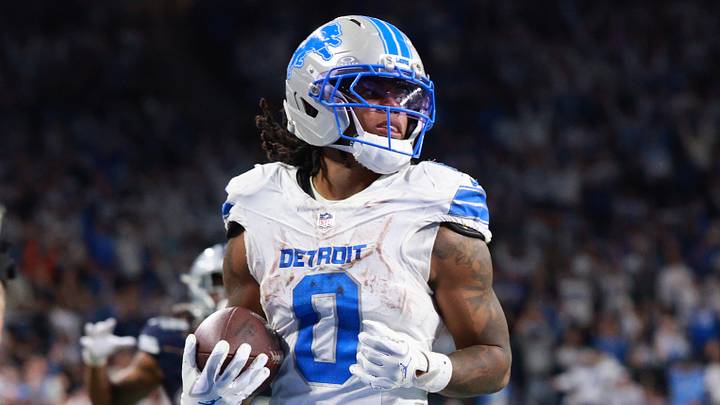
This might be as good as it gets for NFL running backs. For quite some time. And it’s still not nearly good enough.
A few years after the free-agent class of Saquan Barkley and Josh Jacobs and Derrick Henry at least provided a glimmer of hope for brighter days for feature backs being paid what they are worth, the reality of their situation is as bleak as ever. Jahmyr Gibbs of the Lions and Bijan Robinson of the Falcons hitting free agency at the same time, some hoped among the NFLPA and agent ranks that it might significantly move the need for do-it-all running backs to be paid closer to, if not alongside No. 1 receivers — or at least like the second tier at that position.
Jahmyr Gibbs and Bijan Robinson didn't totally reset the RB market

And they would be wrong. Gibbs and Robinson still couldn’t overcome these drastic front office headwinds, and while they achieved generational wealth and eliminated the massive injury risk that comes with playing their position on their rookie contracts, given how uniquely important they are to their teams and how much value they provide on every down, it seems impossible for even the most transformational backs to earn more than $40M gully guaranteed at signing.
If these two didn’t push it to a hold-out scenario and they couldn’t shatter this glad ceiling, no one is going to. The general managers have won at this position group. It’s over. I’m calling the fight.
“I’m confused,” said one top NFL agent who has negotiated multiple best-of-breed contracts in his career. “This still doesn’t make sense to me. Call every defensive coordinator in the NFL and ask him if he’s more worried about Amon-Ra St. Brown or Jahmyr Gibbs. Ask him if he’s got to focus on stopping Drake London, or Bijan.
“I’m not talking about comparing their deals to Ja’Marr Chase or Justin Jefferson. But Zay Flowers? This is it? … I hate to say it but running backs are more (screwed) than ever).”
Indeed, while those are nice receivers, the Lions (under Ben Johnson and now with him gone even more so) require a dominant run game to function at the level they have, and Gibbs is asked to do anything and everything on any down. Robinson is the best football player on the Falcons — he’s arguably a top 10 talent in the game who was in the hands of an overmatched offensive coordinator — and it’s not even close (and both of their middling quarterbacks are already dealing with injuries). This seemed like the right time for a running back breakthrough, but it was anything but that.
“They can try to defend it however they want,” said an agent who does represent one of the higher-paid running backs in the league. “It’s collusion. That’s what it is.”
NFL running backs still get no respect

The first agent said he understands teams not wanting to extend as far with the true guarantees for running backs given the injury risk. But contends their windows in the first three years of these deals are entirely too skewed in favor of the teams. Gibbs could make just under $40M in that span and Robinson $38M, while St. Brown, whose deal is a little more dated than these others, receives $63.4M in his first three years; London, who just signed, makes $89M in that span and Flowers, who signed last week and is outside the top 30 in TDs by wide receivers during his three years in the league, will make $80.5 in the next three years.
Adrian Peterson, way back in 2011 when the cap was a fraction of what it is today, made $40.25M in the first three years of his deal, and, as transformational as he was at the time he isn’t the demon in the passing game with the hands and ability to be flexed out anywhere on the field like Gibbs and Robinson.
“You’d think (the teams) would have to give back on something,”’ the first agent said. “If you won’t do the full guarantee like the other positions, and you won’t give the signing bonus, then the first two and three years of these deals should look more like wide receiver deals.”
If football had an accepted metric like WAR in baseball, it would invariably help the cause of the RB. Those who win in the pass game and can be explosive in overall scrimmage and finish drives in the endzone and don’t need to leave the field in two-minute situations are among the more versatile and impactful players in the game.
Seems as if they don’t get paid in the present what those 350-400 touches are worth in real time, and they get the cumulative impact of their potentially truncated careers held over them at the time of signing as well. Perhaps it’s going to take a handful of them hitting the market consecutively and all sticking to a new number ($30M a year over the first two years of the deal or something like that) to see if a team caves.
Maybe a unicorn feature back withholds his services on a contending team and swings the balance back. You wish it wouldn’t come to that, but as long as teams can negotiate with backs pegged into a position box that limits their worth across the board, they will. Especially now after how things went down last week.
“It’s not looking any better for them is it?” said one general manager who has not been in the high-end running back market recently.
Nope.
 Add us as a preferred source on Google