
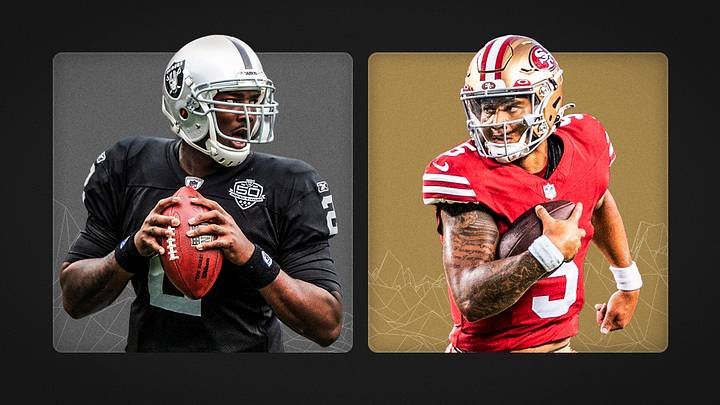
While every franchise has made some whiffs in the NFL Draft — that is simply the nature of this particular exercise in talent acquisition — there are a few legendary mistakes that stand out above the rest in our collective psyche.
These are the biggest NFL Draft busts every franchise has ever had the displeasure of picking. Note that we've listed players here based on their quality of play, who the team passed on taking to select him, and their overall impact on the franchise. We've also selected picks from the modern draft era starting in 1970, as teams often lost first-round picks to other leagues beforehand.
Arizona Cardinals: DE Andre Wadsworth
- Draft: 1998
- Pick: No. 3
- College: Florida State
Wadsworth will forever be known as the player Arizona took just two selections after Peyton Manning and right before Charles Woodson. The ACC Defensive Player of the Year’s 4.65 40-yard dash and immense physical strength impressed evaluators, but the Cardinals ended up receiving a perpetually injured question mark instead of a physical powerhouse.
After tallying 16 sacks in his final college season, Wadsworth managed just eight in three seasons as a Cardinal. Knee injuries caught up to him and limited him to three sacks between 1999 and 2000, when he played his last game. Woodson being as good as he was almost immediately gave Arizona buyer’s remorse. Calling him a bust is tough when his knees gave out on him, but he was designated as the best non-QB in a stacked draft, and the “can’t miss” prospect missed titanically.
Honorable mentions: Kelly Stouffer, Steve Little, Josh Rosen, Steve Pizarkiewicz
Atlanta Falcons: CB Bruce Pickens
- Draft: 1991
- Pick: No. 3
- College: Nebraska
No. 1 pick Aundray Bruce often gets tagged with the title of worst Falcons pick ever after a middling career and being picked over Michael Irvin, Tim Brown, and Randall McDaniel. However, Bruce at least had 32 sacks in an 11-year career. Bruce Pickens was just a bad player from the jump, and the Falcons were so impatient with him that he didn’t even make it to his third season.
Starting off your career by suing your new franchise and not stepping on the field until October is bad enough. Following that up with just two interceptions across 27 games (eight starts), is even worse. It became clear very early that Pickens, a smaller corner at 5-10 and 190 pounds, lacked the size and instincts to even be a passable starter.
Pickens was traded to the Packers in 1993 and was out of the NFL by 1995. Taking a cornerback at No. 3 is a gigantic risk in its own right, and Pickens showed the dark side of what that investment can look like.
HM: Aundray Bruce, Joe Profit, Michael Booker, Tony Smith

Baltimore Ravens: QB Kyle Boller
- Draft: 2003
- Pick: No. 19
- College: Cal
The combination of drafting well and winning often makes Baltimore’s draft history mostly solid. Thanks, Ozzie Newsome! Boller was a miss, however, as his size (6-3, 234), athleticism (4.61 40), and huge arm had this team sold. The traits were there, but he never put it all together.
Ravens fans will correctly point out that OC Matt Cavanaugh’s conservative style and the lack of pass-catching talent hurt Boller’s development, and they would be right. However, that can’t explain the totality of his failure in Baltimore.
Boller completed just 48 percent of his passes as a four-year starter at Cal, and Baltimore overlooked that for reasons that boggle the mind. The accuracy problems never improved in the NFL (56.7 percent completion percentage), and he ended his Ravens stint with almost as many interceptions (44) as touchdown passes (45). Boller found work for a few years as a backup, but his failed Ravens tenure was perhaps their biggest pre-Joe Flacco QB slip-up.
HM: Travis Taylor, Hayden Hurst, Breshad Perriman, Matt Elam
Buffalo Bills: LB Tom Cousineau
- Draft: 1979
- Pick: No. 1
- College: Ohio State
Say what you will about Walt Patulski, a No. 1 overall pick who managed just 21 sacks in four years before being let go, and Aaron Maybin, who amassed zero sacks in two years as a Bill. At least they played for the Bills! Cousineau, picked No. 1 overall with a selection Buffalo got in an OJ Simpson trade, never managed that.
Cousineau immediately spurned the Bills and signed with the CFL’s Montreal Alouettes, who offered him double the money Buffalo did. After three years in Canada, Cousineau wanted to return to the NFL, and the Cleveland Browns traded a first-round pick to Buffalo to acquire him. Cousineau would play six seasons in the NFL, making Second Team All-Pro once.
The one silver lining for Buffalo is that the pick they acquired from Cleveland in the trade would be used on…Hall of Fame quarterback Jim Kelly! Indirectly, the Bills’ biggest NFL Draft whiff became one of their biggest successes.
HM: Walt Patulski, Kaiir Elam, EJ Manuel, Aaron Maybin
Carolina Panthers: WR Rae Carruth, Colorado
- Draft: 1997
- Pick: No. 27
- College: Colorado
Jason Peter has a claim to this top spot because of his status as a No. 14 pick, but Carruth’s combination of terrible play and despicable behavior off the field cast a large and dark cloud over the Panthers organization. Lost in his hideous off-field conduct is the fact that he was faltering on the field as well.
Carruth, once thought to have No. 1 wide receiver potential, didn’t even reach 1,000 receiving yards for his career and only caught four touchdowns in the NFL. The Panthers were just about done with Carruth, and then he ended his own career in truly sickening fashion.
Carruth orchestrated the drive-by shooting of his pregnant then-girlfriend Cherica Adams, who passed away. He was found guilty of conspiracy to commit murder, shooting into an occupied vehicle, and using an instrument to destroy an unborn child. Carruth was sentenced to between 18 and 24 years in prison, and served 18 before being released in 2018.
HM: Tim Biakabutuka, Jason Peter, Rashard Anderson, Jeff Otah
Chicago Bears: RB Curtis Enis, Penn State (No. 5 overall, 1998)
- Draft: 1998
- Pick: No. 5
- College: Penn State
Kevin White’s perpetual injuries can garner some sympathy, and Cade McNown certainly has an argument for this top spot. However, when picking a running back this high, that back had better come right out of the gate looking like an impact player, and Enis was so poor that he contributed to the “Penn State running back” curse that lasted up until Saquon Barkley.
Picked after Wadsworth and Woodson, Enis had all the signs of a star in the making. At 240 pounds with solid speed, Enis dominated at the college level. However, an injury in his rookie season sapped most of his electricity as a runner. He topped 1,200 scrimmage yards in 1999, but that came on a paltry 3.2 yards per carry.
By 2000, the Bears’ one-time successor to Walter Payton’s throne had to convert to fullback after losing carries to James Allen. Enis was out of the NFL after that year with just four rushing touchdowns to his name and a legacy as one of the main reasons not to pick a running back early in the Draft.
HM: Kevin White, Lionel Antoine, Cade McNown, Shea McClellin

Cincinnati Bengals: QB Akili Smith
- Draft: 1999
- Pick: No. 3
- College: Oregon
Smith had to be quite the whiff for a running back picked No. 1 overall with 1,144 career rushing yards in Ki-Jana Carter to be ranked as a better choice than him. Carter was a gargantuan whiff, and David Klingler was yet another 1990s Bengals bust under center, but Smith never even looked like someone who belonged in the NFL for a second.
Cincinnati went all-in on Smith’s athletic potential. The Pittsburgh Pirates baseball draftee had a rocket arm and great mobility, which led to a 30-TD final season with the Ducks. However, Smith was a one-year college wonder, and his own offensive coordinator would later admit that he didn’t try as hard as he should have to grasp a complex NFL playbook.
The result was a 3-14 record as a starter, 46 percent completion percentage, five touchdowns, and 13 interceptions. Cincinnati seemingly knew immediately that they messed up, as Smith’s eye-bleach style of play led to them replacing him with Carson Palmer No. 1 overall in the 2003 Draft.
HM: Ki-Jana Carter, David Pollock, David Verser, David Klingler
Cleveland Browns: LB Mike Junkin
- Draft: 1987
- Pick: No. 5
- College: Duke
Where do we even start with this team? Of the many misses Cleveland has collected in their history, Junkin stands out perhaps the most inept. Justin Gilbert had fleeting glimpses of talent, Brady Quinn and Johnny Manziel were at least picked in the 20s, and Tim Couch was productive for stints while getting dragged down by the reformed 1999 newbies. Even Trent Richardson and Courtney Brown showed more than Junkin.
Selected five picks before Hall of Famer Rod Woodson, Marty Schottenheimer picked Junkin despite scouts telling him Junkin had a second-round grade. Rather than pick three-time All-Pro LB Shane Conlan, the Browns rolled with Junkin. After transitioning from inside linebacker in college to 4-3 outside linebacker next to Clay Matthews, Junkin proved to be overwhelmed.
Incapable of tackling well, struggling against NFL athletes, and suffering through injuries, Junkin was done after just two season and 15 games, seven of which he started. Schottenheimer gave Junkin a second chance in Kansas City when he moved there, but he barely played and was out of the NFL after 1989. Rod Woodson probably would have worked out better.
HM: Tim Couch, Johnny Manziel, Justin Gilbert, Brady Quinn
Dallas Cowboys: DE Taco Charlton
- Draft: 2017
- Pick: No. 28
- College: Michigan
Bobby Carpenter gave Charlton a run for his money here due to his higher draft status, but taking Charlton when TJ Watt was still on the board (and everyone with a pulse knew that Watt was the better player) has to sting. Charlton could have mitigated that by being productive in his own right, but he never got out of first gear.
Charlton was billed as a prototypical 4-3 end who could defend the run and get after the quarterback, but he never showed the bend and juice needed to cause havoc in the backfield. After two years with just four sacks, Dallas gave up on Charlton and shipped him away to the Miami Dolphins.
Charlton would bounce around with four different teams in four years after leaving the Cowboys, all of whom seemingly believed they had the secret ingredient needed to unlock his potential. Charlton is now out of the NFL with 11.5 sacks to his name in six seasons, while Watt is on track for a career that will end with him in Canton.
HM: Mazi Smith, Rod Hill, Morris Claiborne, Bobby Carpenter
Denver Broncos: DT Ted Gregory
- Draft: 1988
- Pick: No. 26
- College: Syracuse
Gregory is a sign of how advanced NFL Draft scouting has become. Head coach Dan Reeves had never met with Gregory before he was drafted. Upon meeting Gregory, who was listed at 6-1 and 260 pounds, Reeves exclaimed, “I’m taller than he is!” and estimated that Gregory was closer to 5-9. Oops.
To make matters worse, Gregory was damaged goods from the start, as he suffered a serious knee injury during his final college injury and suffered yet another major ailment during his first training camp. Gregory didn’t play at all during his rookie season, and he was traded to the Saints in 1989. Thurman Thomas or Dermontti Dawson would have been better picks, right?
Gregory would play three games for the Saints before another knee injury ended his career. This flop was so catastrophic that it forced Denver to start meeting with prospects before they selected them, a process they somehow chose not to do before this whiff. Not even Paxton Lynch or Tim Tebow can claim to have had that much of an impact.
HM: Paxton Lynch, Tim Tebow, Jarvis Moss, Marcus Nash

Detroit Lions: WR Charles Rogers
- Draft: 2003
- Pick: No. 2
- College: Michigan State
Selected one pick before Andre Johnson, Rogers was supposed to be the king of Detroit as a local product and Michigan State star. Injuries hit him at the most unfortunate time, as a broken clavicle five games into his rookie year was followed up by that same bone breaking once more to start the 2004 season.
His make-or-break season in 2005 started with a suspension for violating the substance abuse policy. By 2006, new head coach Rod Marinelli had released Rogers after he participated in just 15 games. This was quite a fall for someone once thought to have Calvin Johnson-esque talent on the outside.
By 2017, Rogers was living in Florida and working at an auto repair shop. In a heartbreaking end to his story, Rogers passed away in 2019 at the age of 38 after being diagnosed with cancer and failing to receive a liver transplant. The highs of his college career will live on forever in the state of Michigan.
HM: Andre Ware, Reggie Rogers, Jeff Okudah, Joey Harrington
Green Bay Packers: QB Rich Campbell
- Draft: 1981
- Pick: No. 6
- College: Cal
Picking Tony Mandarich over Barry Sanders, Deion Sanders, and Derrick Thomas is terrible, but at least Mandarich had a respectable NFL career. Campbell was picked sixth overall in 1981 (two picks before Hall of Fame defensive back Ronnie Lott) with the goal of becoming the next franchise quarterback in Green Bay, and he never started a single game.
The combination of veteran Lynn Dickey putting up prolific stats for his era and Campbell’s lack of NFL arm strength prevented him from making a start. In spot duty as a backup, Campbell didn’t exactly do much to convince his team that he should be starting, throwing three touchdowns and nine interceptions.
The Campbell selection clearly scarred the Packers, as they did not select another quarterback in the first round of the NFL Draft for 24 years. That streak ended with Aaron Rodgers, who was a much better quarterback than Campbell in every phase of the game.
HM: Tony Mandarich, Jerry Tagge, Jamal Reynolds, Justin Harrell
Houston Texans: QB David Carr
- Draft: 2002
- Pick: No. 1
- College: Fresno State
The expansion Texans put on a clinic in how to ruin a young quarterback. Carr was picked No. 1 overall by a team that has next to nothing as far as an offensive support system was concerned, which led to him getting sacked an unthinkable 76 times during his rookie season. It seems like he never recovered from that slow start, as he was gun-shy for the rest of his Houston tenure.
Carr would start for five years in Houston, going just 22-53 in that time. Carr would be the most-sacked quarterback in the NFL in three of those five seasons, and he would throw more interceptions (65) than touchdown passes (59) for a Houston team that never had a winning season with him under center.
Carr found good work as a backup for the Panthers, Giants, and 49ers after leaving Houston. While he was assuredly limited by a Texans team that threw him to the wolves, Carr also rarely showed the flashes of talent to overcome less-than-ideal situations that many No. 1 picks have worked through in the past.
HM: Travis Johnson, Kevin Johnson, Amobi Okoye, Kenyon Green
Indianapolis Colts: QB Art Schlichter
- Draft: 1982
- Pick: No. 3
- College: Ohio State
Schlichter’s name has become synonymous with scandal and disappointment, as he has served over 10 years in prison for a litany of crimes including gambling-related theft, fraud, and drug possession. Even taking away the off-field problems that make the subject of an ironically titled book called “Straight Arrow” look like one of the worst picks of all time, this pick was destined for failure from the jump.
Schlichter’s Ohio State teams ran the ball as much as possible and only threw out of desperation. Schlichter getting picked third overall was bad enough, but the then-Baltimore Colts also selected Mike Pagel in the fourth round, and Pagel turned out to be a much better quarterback than him almost immediately.
Schlichter played sparingly with the Colts, losing all six games he started while throwing just three career touchdown passes and 11 interceptions. Throw in a suspension for violating the league’s gambling policy in the 1983 season, and it’s no wonder that even a bust picked No. 1 overall in Steve Emtman isn’t anywhere close to Schlichter in terms of sheer ineptitude and destruction.
HM: Trev Alberts, Steve Emtman, Bjoern Werner, Randy Burke
Jacksonville Jaguars: WR Justin Blackmon
- Draft: 2012
- Pick: No. 5
- College: Oklahoma State
Blackmon’s college stats are, quite frankly, ridiculous. In his final two seasons in Stillwater, Blackmon caught 233 passes for 3,304 yards and 38 touchdowns. Those numbers came in 25 games. Blackmon’s 865-yard rookie season was promising, as the Jaguars were likely preparing for a world in which he would be their No. 1 wide receiver for whoever was under center.
Blackmon not panning out in Jacksonville is almost entirely of his own volition, as he was suspended to kick off the 2013 season after being arrested for driving under the influence. Midway through 2014, after a 14-catch, 190-yard game, Blackmon was suspended indefinitely. His repeated attempts for reinstatement were never granted, and his entire NFL career lasted just 20 games.
Blackmon’s troubles with alcohol continued after the Jaguars cut him out of their long-term plans, as he was arrested in both 2015 and 2025 for DUI and public intoxication, respectively. Blackmon is a true “what could have been” for Jacksonville, made all the worse by Hall of Famer Luke Kuechly being selected just four picks later.
HM: R. Jay Soward, Blaine Gabbert, Luke Joeckel, CJ Henderson
Kansas City Chiefs: QB Todd Blackledge
- Draft: 1983
- Pick: No. 7
- College: Penn State
The famed 1983 quarterback class produced three Hall of Famers (John Elway, Jim Kelly, Dan Marino), a solid Pro Bowl starter (Ken O’Brien), and a largely ineffective player who still started 10 games on a team that made the Super Bowl (Tony Eason). The only confirmed complete bust was Blackledge, who Kansas City made the second quarterback off the board.
Blackledge’s problems were twofold. First, veteran Bill Kenney had the best season of his career in 1983, which made it even harder for the coaches to turn to this unproven youngster. Second, when he did get into games, Blackledge was a very inaccurate passer. With 32 interceptions against 26 touchdown passes and a 48 percent completion percentage, Blackledge’s erratic style ultimately sealed his fate with the Chiefs.
While it’s easy to look at this Draft with the benefit of hindsight, even reports from the time suggest that Blackledge being picked both as high as he was and over names like Marino were genuine shocks. Kansas City overthought things here, and it kicked off the Chiefs’ paralysis with draft quarterbacks until Patrick Mahomes came along.
HM: Felix Anudike-Uzomah, Jonathan Baldwin, Sylvester Morris, Trezelle Jenkins
Las Vegas Raiders: QB JaMarcus Russell
- Draft: 2007
- Pick: No. 1
- College: LSU
Anyone who says that Russell is the biggest bust in NFL history should not be discounted. Russell could not have been more enticing as a prospect. With a 6-6, 265-pound frame and arm that was perhaps the strongest in the league when he entered the NFL, Russell seemingly had stardom in his grasp. Even though he went to a bad Raiders team, Russell largely failed due to his own poor work ethic.
Russell held out into the start of his rookie season and essentially spent all of 2007 on ice. In 2018, Russell went 5-10 as a starter and completed just 54 percent of his passes with 13 touchdowns. Sprinkled in the middle of this stint was a famous story in which the coaches sent Russell home with blank DVDs to catch him in the act of lying about watching film.
Russell was unfathomably bad (3 TDs, 11 INTs) in 2009 and was released, never to play in the NFL again. As if picking someone who immediately showed that he had no concept of what it means to work hard as a quarterback in the NFL, Oakland’s misery was compounded when Calvin Johnson was taken with the next pick after him.
HM: Alex Leatherwood, Damon Arnette, Henry Ruggs III, Patrick Bates

Los Angeles Chargers: QB Ryan Leaf
- Draft: 1998
- Pick: No. 2
- College: Washington State
It’s easy to forget, but there was a genuine debate between Peyton Manning and Ryan Leaf. Manning was viewed as the finished product, but many thought the 6-5, 240-pound Leaf had the stronger arm and more upside. San Diego took the plunge, and what followed was perhaps the biggest bust in quarterback history. Throw in a prickly demeanor and an inability to put in the work, and it’s no wonder Leaf crashed out of the NFL in 2002.
Throwing two touchdowns and 15 interceptions in his rookie season and missing his sophomore season entirely with a shoulder injury is about as bad as it gets. Former Chargers safety Rodney Harrison said that Leaf’s 1998 season was so painful for him that he would quit playing if he had to suffer through it again.
Leaf was just regular bad instead of “all-time terrible bad” in 2000, and he ended up as a backup for the Dallas Cowboys after that year. While he has since managed to get his life back on track after retirement, the combination of his attitude, off-field issues, and unwatchable play makes Leaf’s name the equivalent of poison for Chargers fans.
HM: Larry English, Bo Matthews, Mossy Cade, Leon Burns
Los Angeles Rams: OT Jason Smith
- Draft: 2009
- Pick: No. 2
- College: Baylor
Sometimes, it’s clear right away that picking a certain player high was a huge mistake. In 2009, Smith was viewed as the eventual successor to Orlando Pace as the St. Louis left tackle of the future. By 2010, he had been beaten out by Rodger Saffold and needed to be moved over to the right side.
Smith, who started his college career as a tight end, had some major injuries at Baylor and in the NFL. The Rams immediately found out both how brittle he was and his inability to handle the power NFL-level athletes can provide. The Rams tried for three seasons to make Smith work, and it just never clicked.
Smith tried to latch on with the Jets, but after the 2012 season, they had given up on him too. Lawrence Phillips flopping as a No. 6 overall pick has a strong case to overtake Smith, especially with 2009 being a relatively subpar first-round, but Smith was the highest non-QB selected in that draft, and he’s a long way off from No. 1 pick Matthew Stafford.
HM: Greg Robinson, Lawrence Phillips, Tye Hill, Gaston Green
Miami Dolphins: DE Dion Jordan
- Draft: 2013
- Pick: No. 3
- College: Oregon
The Dolphins traded up to No. 3 overall this year, and it seemed like a virtual lock that Miami was going to take offensive tackle Lane Johnson. Instead, they ended up with their supposed next great pass rusher in Jordan. Johnson just capped off a Hall of Fame career, while Jordan was incapable of even becoming a below-average player.
Jordan started just one game in two years and only had three sacks to his name. After earning a suspension for the 2015 season, he didn’t return to the NFL until the Seattle Seahawks gave him a reserve role in 2017. Jordan was out of the NFL by 2020.
The Dolphins have whiffed early in the Draft before, but trading up to acquire Jordan at a time when even the announcers on live TV were expecting them to take Johnson may have been one of the biggest reasons that Jeff Ireland ran out of road in his quest to build Miami into a winner.
HM: Yatil Green, Eric Kumerow, David Overstreet, Noah Igbinoghene

Minnesota Vikings: WR Troy Williamson
- Draft: 2005
- Pick: No. 7
- College: South Carolina
You know you’ve made a good wide receiver selection in the Top 10 when he immediately says that he has issues with hand-eye coordination and drops. Williamson had good size and tremendous speed, but his butterfingers and uselessness at making an impact in the red zone all helped sink Williamson’s ship.
Drafted to be the heir apparent to Randy Moss, Williamson lasted just three seasons in Minnesota. He caught just three touchdowns in that timeframe and never managed to tally more than 500 yards receiving in any season.
Williamson lasted for two years in Jacksonville before he was done with life in the pros. Dimitrius Underwood getting cut before his first season started, Lewis Cine almost never playing, and JJ McCarthy’s recent disaster stint are all bad looks, but the scale of Williamson’s flop is magnified by the pick they used to select him.
HM: JJ McCarthy, Lewis Cine, Erasmus James, Dimitrius Underwood
New England Patriots: WR Hart Lee Dykes
- Draft: 1989
- Pick: No. 16
- College: Oklahoma State
While N’Keal Harry is fresh in everyone’s mind, Dykes was an equally bad player who received even more investment from a capital point of view. The late 1980s and early 1990s were the black hole of Patriots football, and whiffing on players like Dykes is one of the main reasons why.
Dykes only played for two seasons in New England. While he did last long enough to tally more than 1,000 yards in his career, they picked with the thought he could possibly rewrite Stanley Morgan’s franchise records. After failing to get on track under Dick MacPhearson and Rod Rust in the infamous 1-15 season, Dykes was cut.
The Bill Belichick era had some whiffs, especially in the middle rounds, but Belichick often managed to bring in some solid role players with his premium picks. With Kenneth Sims at least showing something as a No. 1 pick and Tony Eason’s contributions to the 1985 team, Dykes stands out as the worst pick they made.
HM: N'Keal Harry, Eugene Chung, Tony Eason, Kenneth Sims
New Orleans Saints: K/P Russell Erxleben
- Draft: 1979
- Pick: No. 11
- College: Texas
Saints head coach Dick Nolan had a crazy idea. Drafting a punter or kicker in the first round is wild enough, but picking him No. 11 overall boggles the mind. In New Orleans’ mind, the Saints could have Erxleben handle both the kicking and punting duties for the next 15 years, which would free up another roster spot.
The man they nicknamed “Thunderfoot” in college soon earned the dubious moniker of “Blunderfoot” in the pros. Erxleben injured himself in his first game, and he lost his kicking duties by 1980. With thoroughly average production under his belt as a punter, the Saints dumped him after the 1983 season.
Erxleben found himself mired in white-collar legal trouble after he retired, being arrested and convicted of counts including securities fraud, money laundering, and wire fraud. Wisely, since Erxleben, the thought of using premium picks on specialists has been stomped out of New Orleans’ philosophy.
HM: Payton Turner, Lindsay Scott, Shawn Knight, Johnathan Sullivan
New York Giants: TE Derek Brown
- Draft: 1992
- Pick: No. 14
- College: Notre Dame
The Giants were not the same dominant team they often portray themselves to be in the 1990s, and trying to replace Mark Bavaro with Brown is one of the reasons they often struggled to get themselves off the mat. Brown wasn’t just a poor replacement for Bavaro; he wasn’t even a backup-caliber NFL player who was picked in the Top 15.
Cedric Jones being picked in the Top 10 is tough to stomach, but he at least had some success. Brown, who infamously ran a 4.98 40-yard dash at 270 pounds in his pre-draft workouts, was never able to make any sort of impact as a receiver. How does 11 catches in three years before an unceremonious parting of ways sound?
Brown finished his NFL career with 43 catches for 400 yards, most of them with the expansion Jaguars. Kadarius Toney being picked later and having more production (oddly enough) is what gave Brown the edge in this futility contest.
HM: Cedric Jones, Kadarius Toney, Deandre Baker, Jarrod Bunch

New York Jets: DE Vernon Gholston
- Draft: 2008
- Pick: No. 6
- College: Ohio State
Zach Wilson was a colossal miss that left a crater of destruction in his wake, so much so that he will receive no argument if he is at the top of any Jets bust list. The argument in Gholston’s favor is that Wilson has at least some production. Gholston getting zero sacks as a No. 6 pick is the type of ineptitude that simply doesn’t show up in the modern NFL.
Gholston was a workout warrior at Ohio State, but he was unable to adjust to the pros, where more than just raw athleticism and technique is needed to win against veteran linemen. Gholston was tried in both a 3-4 and 4-3 alignment, and neither of them produced enough to turn him into even a bad player.
Gholston was let go by the Jets just three years into his tenure with the team, and he never played in the NFL again. Penn State RB Blair Thomas would be the worst pick ever for about half of the franchises in the NFL, but Wilson and especially Gholston were so terrible that they put him in a distant third.
HM: Zach Wilson, Blair Thomas, Dee Milliner, Ron Faurot
Philadelphia Eagles: OT Kevin Allen
- Draft: 1985
- Pick: No. 9
- College: Indiana
Eagles head coach Buddy Ryan called Allen a “USFL reject” and only said he was useful to “stand around and kill the grass.” His nickname for Allen? “The General,” which stood for General Hospital. Even without describing his play (which was bad, have no fear), that should give an accurate summation of why Allen busted in the NFL.
Allen’s first game in the NFL saw his offensive line allow eight sacks against the New York Giants. By the middle of the season, Allen was only playing on special teams. After just one season, in which he started four games, Allen tested positive for cocaine at Eagles training camp in 1986 and was let go.
After the Eagles cut him, Allen served 15 years in prison and was banned for life from the NFL. The legal issues and unwatchable play were too much for Eagles fans to stomach. By the way, Allen was selected just seven picks before Jerry Rice. Philly probably wants a do-over.
HM: Marcus Smith, Jalen Reagor, Jerome McDougle, Danny Watkins
Pittsburgh Steelers: DT Gabriel Rivera
- Draft: 1983
- Pick: No. 21
- College: Texas Tech
The Steelers knew Terry Bradshaw was about to retire, and they had a local product and Pitt alum in Dan Marino fall perfectly into their laps. Instead of making the no-brainer choice, Chuck Noll picked the man known as “Señor Sack” and let Marino fall to Miami. What followed was extremely unfortunate for all parties involved.
Just six games into his pro career, in which he already tallied two sacks, Rivera was paralyzed in a car crash after drinking and driving. The incident instantly ended his pro career not even halfway into his first season, which was disappointing for a player who was just starting to flash.
Rivera had a great career in front of him, and the accident isn’t Pittsburgh’s fault, but Marino will loom large over that franchise, who passed on the chance to have 30 years of unbroken Hall of Fame quarterback play.
HM: Troy Edwards, Artie Burns, Jarvis Jones, Tim Worley

San Francisco 49ers: QB Trey Lance
- Draft: 2021
- Pick: No. 3
- College: North Dakota State
The 49ers have managed to bounce back from this miss and keep contending, but that doesn’t change the fact that they traded multiple first-round picks to move up in the draft to select someone who would start four games in two years before getting kicked to the curb in favor of Brock Purdy.
Lance had a strong arm and great mobility, but with limited college tape and some accuracy problems on top of an injury suffered right before Purdy broke out, he just was not going to be a fit in Kyle Shanahan’s offense. Rather than leaning on Lance’s draft status, John Lynch recognized the mistake and quickly pivoted.
Lance has flexed his muscles enough to wiggle into backup roles with the Cowboys and Chargers, but whatever fleeting glimpse he had of becoming a franchise quarterback was thrown away the minute Purdy started to uncork deep shots all over the field.
HM: AJ Jenkins, Reggie McGrew, Rashaun Woods, Jim Druckenmiller
Seattle Seahawks: LB Aaron Curry
- Draft: 2009
- Pick: No. 4
- College: Wake Forest
Dan McGwire (Mark’s brother) has a valid case for the top bust after the 6-8 No. 16 pick tossed just two career touchdowns. However, Curry gets the nod for being as bad as he was and being an off-ball linebacker taken in the top-five. It’s not unfair to expect immediate impact production.
Curry is yet another player who got used to winning purely on his physical gifts, and he wasn’t able to master the tricks of the trade that other great linebackers learn to succeed in a league where everyone is a physical freak. When paired with some major issues in coverage, Curry was destined for a life as a backup.
Curry was sent to the Oakland Raiders midway through his third season, and he was out of the NFL by 2012. Curry has made the transition into coaching, most recently serving as the Jets’ linebackers coach in the 2025 season.
HM: Dan McGwire, Rashaad Penny, Marcus Tubbs, Chris McIntosh
Tampa Bay Buccaneers: RB Bo Jackson
- Draft: 1986
- Pick: No. 1
- College: Auburn
Fans may remember Jackson with the Raiders, but he once picked No. 1 overall after a brilliant college career that defies all logic. However, the Bucs got nothing out of this selection, as he made true on a threat to owner Hugh Culverhouse that stated he would go play baseball full-time if Tampa Bay picked him.
After a pre-draft visit with the Bucs cost Jackson his eligibility during his senior baseball season, Jackson informed Tampa Bay that they would be wasting a pick if they took him. Tampa Bay called his bluff, and Jackson kept true to his word by choosing to sign with the Kansas City Royals. Tampa relinquished his draft rights, which led to the Raiders picking him again way later in the 1987 Draft.
Whiffing on a No. 1 pick is bad enough, but not even getting a snap out of him is a level of incompetence that perfectly represented exactly how poorly things were run when Culverhouse was running the show.
HM: Vernon Hargreaves, Gaines Adams, Charles McCrae, Keith McCants

Tennessee Titans: OT Isaiah Wilson
- Draft: 2020
- Pick: No. 29
- College: Georgia
Wilson’s NFL career lasted just four snaps, all of which came on kneel-downs. That may have been four snaps too many. The 6-6, 350-pound Wilson certainly looked the part as a franchise tackle, but the Titans were in no hurry to get Dennis Kelly out of the starting lineup and let Wilson take over.
Wilson’s poor practice habits, propensity for running afoul of the Titans’ rules and regulations, and his own unsatisfactory play all led to Tennessee declaring that one season was more than enough. His talent is immense, making this departure look even more shocking.
To make matters worse, multiple teams tried to bring him in for a second chance. The Dolphins parted with him after he missed an initial meeting with the team, and the Giants kept him on the practice squad. Wilson has since tried to make it as a rapper, and that may be the only thing less productive than his football career.
HM: Caleb Farley, Treylon Burks, Alonzo Highsmith, Jake Locker
Washington Commanders: QB Heath Shuler
- Draft: 1994
- Pick: No. 3
- College: Tennessee
In much the same way as Schlichter and Pagel, Shuler was picked third overall the same year that Gus Frerotte entered the NFL as a seventh-round pick. From the start, not only was Frerotte more popular with fans, but the future Pro Bowler was a better quarterback than Shuler.
Shuler’s 13 touchdowns and 19 interceptions in three seasons with Washington tell the story of another player who was able to lean on his arm talent in the SEC, but never mastered the transition from simplistic college offenses to being the marquee man for an NFL team.
Shuler, who became active in politics after leaving the NFL, threw just two touchdowns and 14 interceptions in his big comeback with the New Orleans Saints. Shuler doesn’t get discussed as one of the biggest QB busts of all time, but his numbers put him in that infamous tier.
HM: Dwayne Haskins, Josh Doctson, Andre Johnson, Desmond Howard
 Add us as a preferred source on Google