
The NFL is full of stars who didn’t have the best college careers. Some are fourth or fifth-round picks. Others are even undrafted free agents. However, more often than not, NFL stars are often top college football players who take that talent into the NFL and dominate.
Looking back at the pipeline from college football to the NFL, we’ve seen stars stay stars from one level to another. So let’s take a look at 25 of the biggest programs in college football and determine which NFL legend represents the best of the best.
Alabama Crimson Tide: Don Hutson
- Class of 1934
We’re starting off with possibly the hardest player on the list. There are currently eight players in the Pro Football Hall of Fame who went to Alabama, including possibly the best guard of all time in John Hannah, three superstar quarterbacks in Joe Namath, Ken Stabler, and Bart Starr, and one of the best defensive players of all time in Derrick Thomas. There are even stars not yet eligible for the Hall of Fame, like Derrick Henry and Julio Jones.
We went with Don Hutson. He’s one of the best players in the history of the league, even if he doesn’t always get his flowers. He’s credited with changing the way the modern wide receiver is assessed. Hutson played eight seasons, and he was first-team All-Pro eight times. The other three times, which were the first three seasons of his career, he was second-team All-Pro.
Even better than that, Hutson led the league in receiving seven times. He led the league in receiving touchdowns nine times. In 1942, he had 1,211 yards and 17 touchdowns. That’s a preposterous stat line even in today’s world. In the 40s, that was the stuff of superheroes. Hutson deserves to represent Alabama for all time. If Henry has one more great season, we could see the argument that he should take his place, but he might need a Super Bowl because Hutson has three championships to his name.
Auburn Tigers: Kevin Greene
- Class of 1984

There are really three options for Auburn’s choice, and they all have pretty insane stories. Cam Newton was incredible for the Tigers and made them contenders, winning a national championship in one of the most epic seasons in college football history. He went on to be the greatest dual-threat QB of the era and broke multiple records that are now being broken by Josh Allen and Lamar Jackson. Bo Jackson is another really interesting case, but his career was cut short by injury.
The choice here is Kevin Greene. One of the most unlikely options for the Pro Football Hall of Fame, when looking at his early college career, Greene wasn’t even on varsity when he first went to Auburn. Then, through hard work and determination, Greene pushed himself, led the SEC in sacks by his senior season, and made it to the NFL.
He became a star with the Los Angeles Rams and Pittsburgh Steelers, finishing his career with 160 sacks, good for third all-time. Only Reggie White and Bruce Smith have more. The 2016 Hall of Famer wasn’t always the most heralded player in the league. He only has two first-team All-Pros in his career, and they came later in his career, but he was always a dominant force who deserves praise for his career both in college and the NFL.
Clemson Tigers: Brian Dawkins
- Class of 1995

This one feels like it should be one of the modern-era greats, but the superstars of the Dabo Swinney era have not translated at the next level. Trevor Lawrence was supposed to be a sure thing, but he’s been inconsistent in the NFL. Deshaun Watson was a champion in college, but off-the-field issues derailed his career. This really comes down to superstar safety Brian Dawkins and alien wide receiver DeAndre Hopkins. Dawkins takes it for the career as a whole.
Dawkins was drafted at the end of the second round in 1996 after he was a second-team All-American in his final season with the Tigers. His leadership qualities is what drew the Eagles to taking him in the first round, saying he was even showing those qualities at the NFL Combine that year. That translated incredibly well to the NFL, where Dawkins became probably the league's premier leader.
He also joined the NFL at a time when being a safety meant something. The great safeties were great. Ed Reed, John Lynch, Rodney Harrison, Sean Taylor, and Troy Polamalu changed the way the position was played. Dawkins is right up there with them, making nine Pro Bowls and four first-team All-Pros in his career. Beyond his Hall of Fame career, Dawkins's service earned him his greatest honor. Clemson University established the Brian Dawkins Lifetime Achievement Award to annually honor a former Clemson player for their performance on the field, contributions in leadership, and community service
Florida Gators: Emmitt Smith
- Class of 1989

There are a lot of great players from the University of Florida, but building your legacy in The Swamp hasn’t always led to greatness in the pros. That wasn’t the case for two players who stand alone at the top of Florida’s NFL success. Jack Youngblood was iconic for his defensive prowess and his reputation as one of the toughest players in an era where toughness was king. However, this is Emmitt Smith’s honor to hold until someone physically takes it from him.
The man who passed Sweetness for many of the most important running back records in the history of the league, Smith came out of the University of Florida in 1990 as a first-round pick to the Dallas Cowboys. He would go on to be the key to their dynasty, rushing all over the league for the better part of a decade.
He had more than 1,000 yards rushing every year from 1991 to 2001, leading the league in four of those seasons. He retired with a likely untouchable record of 18,355 rushing yards and 164 touchdowns. What was most insane was the fact that he rushed for a first down more than 1,000 times in his career. Not bad for an “undersized” player out of Gainesville.
Florida State Seminoles: Deion Sanders
- Class of 1988

Speaking of Cowboys, let’s talk about Deion Sanders for a quick moment. The man personified greatness. He oozed superstardom, and that started in Tallahassee. Florida’s capital city is also home to Florida State, one of their three premier universities when it comes to college football.
At Florida State, Sanders was not a one-trick pony. In fact, he played three sports on campus. He played center field for the baseball team, led the track team to conference championships, and he was a monster in the secondary for Bobby Bowden’s squad. In his final two years at cornerback, Sanders was a unanimous All-American. It was clear he was different as a player on the field, dominating at all levels. That’s not even mentioning his impact as a punt returner, where he could score a touchdown in a moment’s notice. Sanders was a big-play machine.
The 1994 Defensive Player of the Year was as impactful as any player during his peak. The six-time first-team All-Pro was the best cornerback in the game for a good amount of time in the 1990s, and he’s still a legend among superstar players today. He’s one of the few players to win Super Bowls with two franchises, and he is still one of the most athletic people we’ve ever seen in the NFL.
Georgia Bulldogs: Champ Bailey
- Class of 1998

For Georgia’s choice, do you take the superstar quarterback from yesteryear, the cornerback who is one of the best in the history of the position, or the Hall of Fame running back who helped John Elway finally get his Super Bowl? As great as Terrell Davis and Fran Tarkenton were, we’re giving this one to Champ Bailey. He was so dominant in his heyday at a time when passing was becoming even more important than it was prior to his arrival. Bailey had to adjust to a league that focused on putting air under the ball, and Bailey’s role on the defense became that much more important.
Playing a true shutdown role, Bailey made 12 Pro Bowls in his career, missing the All-Star showdown just twice in his career, including his final year of his career. He was also a part of possibly the biggest trade of the era, which sent him to Denver and sent Clinton Portis to Washington. It changed the trajectory of both franchises, and it gave Denver a star on the other side of the ball.
This all started at Georgia, where Bailey became an All-American in his last year in Athens. Today, no other player has deflected more passes than Bailey, a testament to his career highlights. He blocked 203 passes in his career. Add that to his 52 interceptions, and wide receivers didn’t stand a chance against him.
Iowa Hawkeyes: Paul Krause
- Class of 1963

Iowa honestly has a lot of players to choose from. While some of these might not be considered the GOATs in the NFL, they had incredible careers, with many ending up in the Hall of Fame. The one that probably comes to the top of people’s heads right now is George Kittle, who is still one of the best tight ends in the game. Dallas Clark once held that distinction himself. Offensive linemen Duke Slater, John Niland and Marshal Yanda deserve mentioning. Then, there’s a list of great defensive players, including Alex Karras, Bob Sanders, Emlen Tunnell, and Hall of Famer Andre Tippett. It was really hard not to take Tippett, who remains incredibly underrated as an NFL player, but Paul Krause holds an unbreakable NFL record.
Krause has intercepted 81 balls during his career. The superstar member of the Purple People Eaters Minnesota Vikings' defense, Krause was a monster in the secondary. It was more than the record. The four-time first-team All-Pro was as reliable as anyone in this era. Teams had to stop throwing on the Vikings because it was too big a risk.
Krause also stepped up in big moments, helping the Vikings win the NFL Title Game and make it to the Super Bowl, where he also intercepted a pass. He was even the Vikings’ field goal holder, and that led to a passing touchdown to add to his resume.
LSU Tigers: Patrick Peterson
- Class of 2010

This honor could look incredibly different in the future. Justin Jefferson, Joe Burrow, Malik Nabers, Brian Thomas Jr., Jayden Daniels, Derek Stingley Jr., and Danielle Hunter could all push their way on this list with how their careers have started. Odell Beckham Jr., Jarvis Landry, Leonard Fournette, Jamal Adams, Tyrann Mathieu, and Tre’Davious White are all players who looked great for a period, but it didn’t last long enough for it to matter with regard to their legacy and representation of LSU. Weirdly, this comes down to one recently retired player, Patrick Peterson, and one who is the most dominant player at his position, Ja’Marr Chase.
Chase will likely hold this title one day, but Peterson’s career deserves its flowers. The three-time first-team All-Pro was the entire Arizona Cardinals’ defense for a long time. He was a hard hitter and turnover machine. He spent 10 seasons with the Cardinals, going through their ups and downs while being a force in the secondary.
Peterson entered LSU with a ton of fanfare. He was one of the highest-rated high school players ever. There wasn’t any doubt this player was going to be a star right away. He played 13 games his freshman year, and he was a star by his sophomore season. His craziest college statistic is in his first game as a returner: the kickoff game against North Carolina in 2010, he had 257 return yards, second in SEC history.
Miami Hurricanes: Ray Lewis
- Class of 1995

Ray Lewis is in the conversation for the greatest defensive player in the history of the NFL. The two-time NFL’s Defensive Player of the Year and two-time Super Bowl champ was the centerpiece of the Baltimore Ravens' defense. He was on defenses that were unstoppable, like that 2000s Ravens team, and he was the centerpiece of teams trying to stay relevant. Every year, he stayed great.
But this is still one of the craziest batches of talents you’ll ever see. It starts with Lewis’s future teammate Ed Reed, who became possibly the best safety of all time. Then, there were Warren Sapp, Ted Hendricks, Cortez Kennedy, and Vince Wilfork on the defensive side. On offense, the talent pipeline was just as strong, with quarterbacks Jim Kelly and Vinny Testaverde, running backs Edgerrin James and Frank Gore, wide receivers Michael Irvin and Andre Johnson, and a long list of other all-timers and Hall of Famers who brought pride to the U.
Still, this is Lewis’s honor to hold above everyone else. Lewis is an icon for the game today. His dance is still used across the league after big defensive plays or sometimes even touchdowns. He was even a Super Bowl MVP, something that is incredibly rare for a defensive player.
Michigan Wolverines: Tom Brady
- Class of 1999

Sorry to everyone else who went to the University of Michigan, this honor might be closed for good. Tom Brady is the greatest football player of all time, and for some, it’s not even close. He holds almost all of the records, passing for 89,214 yards and 649 touchdowns in the regular season alone. If you add the playoffs, he has more than 100,000 career yards and more than 700 touchdowns.
Many of these playoff records are untouchable. Look what just happened to Patrick Mahomes last season. He missed the playoffs, then tore his ACL. There’s a lot that has to go right for a player to have the kind of career as Brady. Heck, anyone in any injury needs to have a ton of luck to be Brady. Things just seemed to work out for him.
And that’s crazy to think about when discussing his Michigan career. He was fighting for his job every week with Drew freaking Henson. And yet, no player has ever been greater in the NFL. Something happened during his time at Michigan that changed his makeup and made him driven to be great. So, sorry to the Charles Woodsons and Ty Laws of the world. We’re sorry to Aidan Hutchinson and Nico Collins who have no path to this honor. It’s Tom Brady, and it will continue to be Tom Brady.
Nebraska Cornhuskers: Will Shields
- Class of 1992

There are a few really good players who are Nebraska alumni in the league. It’s one of those colleges that was once considered a top program in the country, with five national championships to its name (and another seven considered “unclaimed championships). Of course, with that kind of success, some very talented players have come through campus. Guys like Roger Craig, Ndamukong Suh, and Lavonte David could have an argument for the list, but this really comes down to offensive linemen. Both Bob Brown and Mick Tinglehoff were five-time first-team All-Pros, but Will Shield just did it for longer.
Shields was an anchor in the middle of the Kansas City Chiefs offensive line from 1993 to 2006, making it to 12 Pro Bowls during that time. Despite only playing about half of the decade, he still made the NFL’s All-Decade Team for the 2000s. He was also incredibly durable, playing 231 consecutive games at right guard (only the great Bruce Matthews had more at that position).
Shields also left an incredible legacy at Nebraska, which includes a jersey retirement and making the Athlon Sports Nebraska All-Time Team. He’s a great representative for the university. He's also a great representative for the Kansas City Chiefs.
Notre Dame Fighting Irish: Joe Montana
- Class of 1978

Notre Dame continues to be one of the most iconic schools in the history of college football. In fact, it might be the most iconic brand in college football. Everything from Touchdown Jesus to the Fighting Irish logo put South Bend, Indiana on the map. And with that came a bunch of great players who came through campus, but only one takes the list for greatest NFL player.
Joe Montana, like Tom Brady at Michigan, just did so much as a pro that it would be relatively impossible for anyone else to catch him. Montana was a four-time Super Bowl champion, winning MVP in three of them. He’s a two-time MVP and one-time Offensive Player of the Year. His statistics speak for themself. He finished his career with 40,000 passing yards and 273 touchdowns in the regular season. We know some of those seem paltry by today’s standards, but those were truly top of the line in the 1980s and 1990s.
So, we’re sorry to Tim Brown, Jerome Bettis, and Paul Hornung, but Montana is clearly ahead of everyone.
Ohio State Buckeyes: Orlando Pace
- Class of 1996

Ohio State literally has a laundry list of players who could represent them on this list. The representation also hits just about every position, from wide receivers (Cris Carter and Paul Warfield) to offensive linemen (Jim Parker and Orlando Pace) to running backs (Eddie George and Ezekiel Elliott) to defensive linemen (Cameron Heyward and Joey Bosa) to the secondary (Dick LeBeau and Malcolm Jenkins), the Buckeyes have great representation at every position other than quarterback (sorry Justin Fields and C.J. Stroud). However, we’re leaning towards Orlando Pace for his overall impact on how linemen play even today.
The Pro Football Hall of Famer was one of the great tackles of his generation. He held down the position for multiple generations of St. Louis Rams football, including the Greatest Show on Turf era with Kurt Warner and Marshall Faulk. For that offense to work, Pace had to be at his best, and he was every week. He also blocked for three consecutive MVPs from 1999 to 2001.
Pace finished his career with three first-time All-Pros and seven Pro Bowls. His amazing career at Ohio State actually earned him the first-overall pick in the 1997 NFL Draft, a rarity for an offensive lineman.
Oklahoma Sooners: Trent Williams
- Class of 2009

Oklahoma has a great pipeline to the NFL, producing multiple all-time greats. Adrian Peterson is probably a top-five running back of all time and has a league MVP to his name. DeMarco Murray is another great running back from his time. Trent Williams and Creed Humphrey are probably the best at their position in this era, and Lane Johnson is in the conversation for offensive tackles. Gerald McCoy, Lee Roy Selmon, Roy Williams, and many others could be the choice. We’re going with Trent Williams.
If we are talking about absolute dominance, longevity, and redefining a position, nobody tops Trent Williams. The Silverback was a physical marvel in Norman, where he earned consensus All-American honors. In a league designed to protect pass rushers and favor high-octane skill players, Williams made watching film on a left tackle appointment television, effortlessly pairing rare speed for a guy his size with a mean streak that leaves defenders rethinking their career choices.
Williams was great with Washington, but he became a legend with the San Francisco 49ers. The 12-time Pro Bowler was always considered the best tackle in the game for almost two decades. When looking at the full resume, Williams is the easy choice. He’s going to waltz into the Pro Football Hall of Fame when he’s eligible.
Oregon Ducks: Dan Fouts
- Class of 1972

Oregon has a strange pipeline from college to the NFL. The team has been incredible for the NCAA. This school, which has made us all know about the town of Eugene, has produced some really high draft picks. Marcus Mariota, Akili Smith, and Joey Harrington were all selected in the top three of the draft. They are three of the biggest draft busts of the modern era. The jury is still out on Justin Herbert, and there are a few players in the league now who could take this spot eventually (mainly Christian Gonzalez, Penei Sewell, or Bo Nix), but right now, the man with the greatest legacy in the NFL is Dan Fouts.
Oregon has produced so many NFL quarterbacks, but Fouts was the only one who has proven to be special at the next level. As the man under center for Don Coryell’s legendary "Air Coryell" offense in San Diego, Fouts permanently changed the landscape of offensive football. He became the first quarterback in league history to throw for over 4,000 yards in three consecutive seasons. Now, that’s considered child’s play.
Fouts might not get the same fanfare as guys like Montana, Brady, and Dan Marino, but he was just as skilled as any of them and could do the same if he were in their situation. He just happened to play for the Chargers. He’s the last guy who led the league in passing yards for four consecutive seasons, showing a level of dominance that was near unmatched statistically at the time.
Penn State Nittany Lions: Franco Harris
- Class of 1971

It feels wrong to pick someone who isn’t a linebacker for Penn State, but that’s exactly what we’re going to do. Franco Harris is one of the great running backs in the history of the game, and he got to do it down the street from Happy Valley for the Pittsburgh Steelers. He’s part of the fabric of the NFL, including the man behind the Immaculate Reception. Harris has too many plays both at Penn State and in the NFL to list them all.
The MVP of Super Bowl IX, Harris was a four-time champion, becoming the star of the dynasty Steelers. He remains one of the most well-liked athletes from any era. And he deserved all the recognition he was getting. The nine-time Pro Bowler finished his career with more than 12,000 rushing yards and 100 total touchdowns in the regular season. His 400 playoff rushing attempts are still the most in NFL history.
South Carolina Gamecocks: John Abraham
- Class of 1999

First, let’s discuss the elephant in the room for South Carolina football. This was supposed to be Jadeveon Clowney. Coming out of college as the first overall pick, he was projected to be the best defensive player with quickness. When he destroyed Vincent Smith in the Outback Bowl, his legend became what we thought was inevitable. Instead, like many of the hyped Gamecocks prospects, he did not live up to expectations. He had a fine NFL career, but he was never the best defensive player in the league.
So, we’re choosing John Abraham. The superstar pass rusher for the New York Jets and Atlanta Falcons finished his career with two first-team All-Pro selections and five Pro Bowl selections. Abraham was a monstrous tackler, forcing 48 fumbles in his career. He finished with 133.5 sacks in his career, good for 19th all-time. He even got a Pro Bowl selection in his second-to-last year when he recorded 11.5 sacks with the Arizona Cardinals.
Abraham is the choice because it’s a relatively weak crop of players who take up the SC pipeline. This isn’t the legacy of the “other” USC or most of the teams that make up the SEC.
Stanford Cardinal: John Elway
- Class of 1982

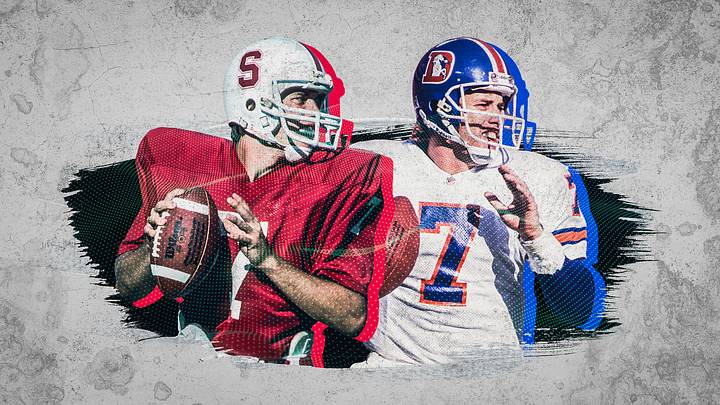
John Elway is still the standard we compare every prospect coming into the league. We hear “the greatest quarterback profile since John Elway” a lot. That’s because, coming out of Stanford, Elway was expected to walk into the NFL and quickly become the best of the best. He was an all-time “great” before leaving the confines of California. His college career was incredible, and he had a lot to live up to once he joined the NFL.
And he sure as heck didn’t want to do it with the Baltimore Colts. Elway forced his way out and made his way to Denver. Ironically, decades later, the actual greatest prospect since John Elway, Andrew Luck, was drafted by the Colts to be Peyton Manning’s replacement. He might have a legit argument to fight for this slot if a career of injuries didn’t force him to walk away from the sport.
Elway took a while to become the superstar many expected, but he eventually put together one of the great careers in the history of the sport. The 1987 MVP was a nine-time Pro Bowler throughout his career. Interestingly, he never was named first-team All-Pro, but he was Super Bowl MVP after finishing his career with back-to-back championships. We don’t think he lost any sleep about those All-Pros after he got those two rings.
TCU Horned Frogs: Ladainian Tomlinson
- Class of 2000

When we talk about the greatest running backs we’ve ever seen, two names come up: Barry Sanders and LaDainian Tomlinson. It was just special to watch them both play. They were elusive, strong, impactful, and fast as can be. Tomlinson did this coming out of Texas Christian University, where he had 5,263 rushing yards, ranking sixth in NCAA Division I history at the time. His journey to San Diego was interesting, as they were expecting to take Virginia Tech superstar Michael Vick, but they decided to trade the pick and took Tomlinson fifth overall.
Over his career, Tomlinson had more than 18,000 total yards and 162 touchdowns. He had a nose for the end zone on top of the ability to break away from tacklers as well as anyone in the league at the time.
He spent nine years with the Chargers, earning five Pro Bowl appearances, three Associated Press first-team All-Pro nominations, and two NFL rushing titles, before finishing his career with the New York Jets. Tomlinson was voted the NFL Most Valuable Player (MVP) in 2006 after breaking the record for touchdowns in a single season. He scored a ridiculous 31 touchdowns total that season. That’s a quarterback stat. He remains one of the highest-scoring players ever, something usually reserved for kickers. There’s nobody who can touch him coming out of TCU, both on this list and in real life.
Tennessee Volunteers: Reggie White
- Class of 1983

There is no harder decision on this list than the one for Tennessee. While some universities have a lot of really good players, maybe even some Hall of Famers, nobody has a decision like the one between Peyton Manning and Reggie White. Manning is a top-five quarterback all-time, a distinction of greatness for the most important position in sports. Reggie White was probably the second-best defensive player of all time behind Lawrence Taylor. It’s an impossible decision that we have been forced to make for the good of football fans. And we’re going for Reggie White.
Manning deserves all of the flowers for everything he did in the NFL. His legacy is cemented, both in the league and with the Volunteers, but White was on another planet from everyone defensively during his career. He could not be stopped. We see the likes of Myles Garrett, J.J. Watt, and Michael Strahan since White’s peak, but none of them are even in the same conversation as White. This is how he was able to beat out a five-time MVP for this choice.
White is second all-time in sacks with 198. That doesn’t include the 23 sacks he had for the Memphis Showboats of the USFL, where he started his career after college. In his first game with the Eagles, he recorded 2.5 sacks. He won Defensive Rookie of the Year after recording 13 sacks in 13 games. In 1987, he finished the season with 21 sacks in 12 games. If he were playing a 17-game season at that pace, he would have 30 sacks. White is one of the all-time greats, and he proves that he was truly in a league all his own.
Texas Longhorns: Earl Thoms
- Class of 2009

The running back legacy of the Texas Longhorns is a long and winding road of greatness. Many times, that greatness continues in the league. Just some of the running backs who went through Austin include Ricky Williams, Earl Campbell, Priest Holmes, and Jamaal Charles. Now, Bijan Robinson is taking over the mantle of great Texas running backs dominating the NFL.
Which even surprised us when we went in another direction for Texas and NFL greatness. Earl Thomas is our pick. This might seem like a change for change's sake, and Earl Campbell and Priest Holmes both deserve this just as much, but Earl Thomas was the man driving one of the best defenses of this era, allowed Russell Wilson to become a star, and allowed Richard Sherman to run his mouth as much as he did. That’s a lot riding on one player!
The biggest argument against Thomas was that his career was short, and his peak was even shorter. He was only a starter for nine seasons. But in those nine seasons, he was the reason this was considered the Legion of Boom. He made six Pro Bowls and was first-team All-Pro five times with the Seahawks, and he added another Pro Bowl season with the Ravens.
Texas A&M Aggies: Myles Garrett
- Class of 2016

This one is a really interesting debate between Von Miller and Myles Garrett. Mike Evans is in the conversation, but the two defensive stars clear him. We’re leaning towards Garrett because he is very close to Miller’s total impact in the regular season, and he has a few years of his prime left. We acknowledge that Miller has Garrett beat in playoff dominance, but it’s not Garrett’s fault he was drafted by the Cleveland Browns, and now he has a chance to showcase himself with the Los Angeles Rams.
Garrett just broke the sacks record in the 2026 season. He’s already a five-time All-Pro and the reigning Defensive Player of the Year. That’s pretty wild to win that award on the terrible Cleveland Browns. He’s had at least 10 sacks in eight straight seasons, and he’s had 14+ sacks over the last five seasons. Of course, he had that record with 23 sacks last season.
Garrett was expected to be this type of player when he was chosen with the first-overall pick in the 2017 NFL Draft. Think about this: Patrick Mahomes was in that same draft, and nobody talks about the “big” mistake the Cleveland Browns made. We love to dunk on their quarterbacks! Yet, they missed out on possibly the best of this era, but because they got this era’s best defensive player, nobody says anything about it.
UCLA Bruins: Troy Aikman
- Class of 1988

The UCLA Bruins are an interesting franchise. Of course, they are the dominant team in basketball thanks to John Wooden and his college dynasty. They don’t even put up banners for Final Four performances because of him, but they have a fascinating legacy in college football. For all the players who have come through Los Angeles, we’re going with a controversial choice. Troy Aikman was a transfer from Oklahoma, became a California boy, and went back to Texas.
Troy Aikman was the cherry on top for the Cowboys dynasty, giving them the final and most important piece that led to three Super Bowl championships. This is famously the last great Cowboys team, and Aikman was the last great Cowboys QB (no offense to Dak Prescott and Tony Romo). The reigning Davey O’Brien Award winner went first overall to the Cowboys, and the race was on to becoming an iconic franchise again.
The six-time Pro Bowler was named the Super Bowl MVP for Super Bowl XXVII. He was a true star and brought the Cowboys back to prominence alongside Michael Irvin, Emmitt Smith, and a stellar offensive line. Other UCLA Bruins who were great include Jimmy Johnson, Jonathan Ogden, and Ken Norton Jr., but Aikman is the man who takes this honor.
USC Trojans: Bruce Matthews
- Class of 1982

USC probably has the best pipeline to the NFL of any franchise on this list. There are legitimately a dozen players who could be argued as the best Trojan in the NFL ever. To make this pick, we had to leave off Ronnie Lott, Anthony Munoz, Troy Polamalu, former first-overall pick Keyshawn Johnson, Junior Seau, Carson Palmer, O.J. Simpson, Marcus Allen, Clay Matthews, Lynn Swann, and Tyron Smith. All of these players would be the top choice for multiple college franchises on this list. But Bruce Matthews is one of the all-time greats at every offensive line position.
Matthews was a seven-time All-Pro and 14-time Pro Bowler. He inches past Munoz because of his longevity (fewer All-Pros but more Pro Bowls). After he was selected with the ninth-overall pick, Matthews spent the next 19 seasons as a starter on the offensive line.
He made his first Pro Bowl at the age of 27, and he remained a Pro Bowler every season until he retired at age 40. He was very reserved, but he could be violent when necessary. Still, he almost never took penalties and had just one holding call and one false start in his final season. Matthews is an all-time great, and while the Trojans have a ton of them, we go with the one who did it for longer than anyone else.
Washington Huskies: Warren Moon
- Class of 1977

The list of Washington Huskies who left their mark on the professional ranks is surprisingly stacked. The pipeline from the Pacific Northwest to the NFL isn’t a recent phenomenon. Hall of Famers and game-changing playmakers have made their way through Montlake to a top NFL city. Some of the names in the running include back Hugh McElhenny, Olin Kreutz, Corey Dillon, and Mark Brunell. Even modern secondary stalwarts like Budda Baker and Marcus Peters deserve a nod for keeping the "DBU" tradition alive on Sundays.
Yet, when you look at the total body of work, undisputed greatness, and historical significance, nobody touches Warren Moon. After leading Washington to a legendary 1978 Rose Bowl victory, Moon was forced to go to the CFL to prove he could play quarterback. There, he won five straight Grey Cups before finally getting his shot in the NFL at 27 years old.
He continued to add to his Hall of Fame resume. A nine-time Pro Bowler and the 1990 AP Offensive Player of the Year, Moon racked up over 49,000 passing yards in the NFL alone, a total that skyrockets past 70,000 professional yards when including his CFL days. He also became the first Black quarterback inducted into the Pro Football Hall of Fame.
 Add us as a preferred source on Google