
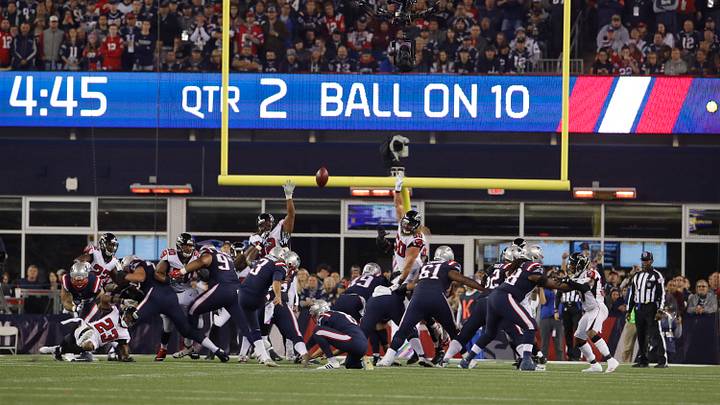
The New England Patriots really thought of everything, didn't they? As if the football world needed any more evidence the team is diabolically good at gamesmanship, a sharp eye has pieced together a clever trick utilized by the staff at Gillette Stadium over the years.
Former NFL Strategy and Analytics coach Ryan Paganetti laid out the undeniable evidence that New England's jumbotron operators influenced opponents' kicking abilities during games. When foes lined up to kick field goals, specifically facing the south end zone, the screen would display the broadcast angle from behind the kicker and give a double uprights visual. Those uprights would be placed just off center of the actual goal in an attempt to throw off the place kicker's aim. And it actually worked for a statistically significant portion of time.
Patriots opponents made just 77.2% of FG since 2002 when Gillette Stadium opened. Based on the distance of these kicks and other factors, they should have made 84.1%. Meanwhile, the Patriots converted very close to expected. pic.twitter.com/W7d3B9qnTf
— Stathole (@Statholesports) September 2, 2026
Paganetti, who helped the Philadelphia Eagles win Super Bowl LII (against the Patriots no less), had his claims backed up by Barstool's "Stathole" in his own thread on X. New England's opponents made seven percent fewer field goals than expected given other conditions at Gillette Stadium since it opened in 2002.
Patriots field goal distractions paid Super Bowl-winning dividends
Sure, you could make the argument that the kickers who made attempts at Gillette were just bad on those specific days, but the numbers don't lie. According to "Stathole," those kickers scored 6.8 fewer points than expected in that stadium compared to playing literally anywhere else. So when you think about that kind of margin and the amount of pivotal playoff games that were held at Gillette Stadium, the trick probably was a significant driver of the team's eight trips to the Super Bowl in that era.
The most iconic field goal miss of that era, sending the Patriots to the Super Bowl. Look at the video board at 1:07! pic.twitter.com/AqHySkGbfq
— Ryan Paganetti (@RyanPaganetti) September 2, 2026
The vast majority of the field goal misses fall under the category of the kicker sending the ball wide or hitting the upright. So it was human error which could have been easily influenced by the environment, including the visual of a different set of uprights.
Kickers also just performed way worse at Gillette when compared to expectation. In only six years since 2002 have opposing kickers performed better, and it was marginal at best. The rest of the time they came up short of expectations, and they were way short. It simply cannot be ignored.
Finally - here's the year-by-year opponent kicking pct vs expectation. Anything below horizontal "0" means worse.
— Stathole (@Statholesports) September 2, 2026
Red = Gillette
Gray = Foxborough pic.twitter.com/dIppWs1Evh
You have to hand the Patriots and Gillette Stadium staff their flowers on this. It's one way the unique circumstances of home-field advantage can truly impact the play on the field. Even Paganetti admitted that Philadelphia attempted to replicate the effect, but Lincoln Financial Field's jumbotron placement was simply not ideal. Gillette Stadium was built to capitalize on The Patriot Way.
This revelation isn't going to forgive the team for Deflategate or Spygate, however. Those are still blights on the franchise's history. But for once, it can be celebrated for an advantage gained through genuine means. Was it perhaps distasteful or against the spirit of fair play? Maybe. But it was legal at the time and no different than thousands of fans on that end waving pool noodles to distract as well.
Credit where credit is due. New England's staff had an eagle eye for details and this one made a tremendous impact on the success of the franchise. Five Lombardi Trophies in eight tries says so.
 Add us as a preferred source on Google