
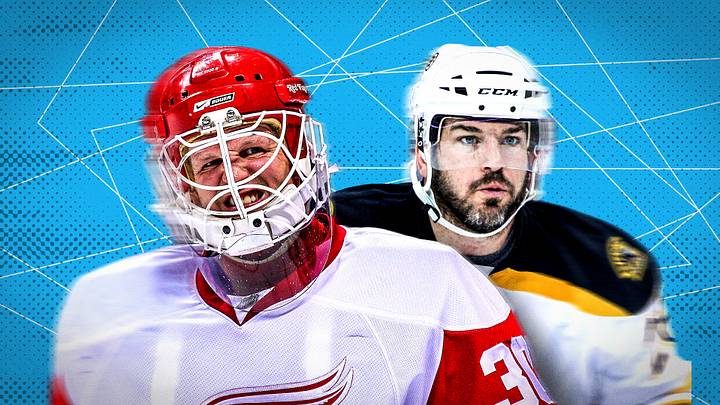
There are plenty of players that NHL fans can rattle off immediately. But there’s another group of players who had the same level of greatness while flying under the radar.
While players like Wayne Gretzky, Mario Lemeiux and Bobby Orr were dominating the sport, there was another wave of players who were also great but didn’t have the same level of flair. This makes those players not seem as great as their peers, but with many of them in the Hall of Fame or making an impact in other ways, there’s a long list that deserves more recognition.
25. Pat Verbeek
A third-round pick in the 1982 NHL Draft by the New Jersey Devils, Verbeek debuted as an 18-year-old and spent 20 years in the NHL. He scored 522 goals, recorded 540 assists and registered 1,062 points while playing for the Devils, Hartford Whalers, Dallas Stars, Detroit Red Wings and New York Rangers. He also is the only player in NHL history to record over 500 goals and 2,500 penalty minutes during his career and is the only player to score 40 goals and 200 penalty minutes in a single season in a feat he did three times.
Mix in a Stanley Cup with the Stars in 1999, a pair of All-Star appearances and a Gold Medal for Team Canada during the 1994 World Championship and Verbeek was an underrated player that may not be at the front of fans’ memory banks and he’s still not in the Hockey Hall of Fame.
A key reason is the time he played. Cam Neely, Eric Lindros, Keith Tkachuk and Brendan Shanahan were dominant power forwards at the time and he played for smaller markets including the Devils and the Whalers. His extended time in the penalty box also gave him an agitator label and his current role as general manager of the Anaheim Ducks has kept his playing career out of the spotlight.
24. Tomas Vokoun

Vokoun isn’t in the conversation for the greatest goalies of all-time due to peers like Martin Brodeur, Patrick Roy and Dominik Hasek. But considering how he rose to stardom, that makes sense. A ninth-round pick by the Montreal Canadiens in the 1994 draft, Vokoun started just one game before he was taken in the 1998 expansion draft by the Nashville Predators.
Given the opportunity, Vokoun had his quirks considering his unorthodox goaltending style. But he made up for it with a lightning fast glove hand and quickly became a fixture in net. He went on to become a workhorse, appearing in 700 games during his career and was one of the best netminders in the game from 2005-2010 with an NHL-high .922 save percentage, which helped him rank 13th all-time with a career save percentage of .917.
That performance helped Vokoun drag the Predators to relevance in their early years but shined through when he was paired with elite teams. He won a pair of World Championship Gold Medals in 2005 and 2010 and an Olympic bronze medal for Czechia during the 2006 Olympics and went on to play for the Florida Panthers, Washington Capitals and Pittsburgh Penguins before retiring after the 2012-13 season.
23. Dave Andreychuk
It’s hard to say that fans would forget a player that is in the Hockey Hall of Fame and scored 640 goals during his 23 year career. But Andreychuk may be in that category as a player that didn’t win a Stanley Cup until one of his final seasons in the NHL and had his longevity inflate his numbers.
The 16th overall pick in the 1982 draft, Andreychuk began his career with the Buffalo Sabres and immediately became a weapon on the power play thanks to his 6-foot-4, 220-pound frame. After scoring 161 of his 274 career power play goals over 12 seasons in Buffalo, he was traded to the Toronto Maple Leafs in 1993 and scored 53 goals to lead them to the Eastern Conference Finals.
While Andreychuk bounced around from the New Jersey Devils, Boston Bruins, Colorado Avalanche and even had a return to Buffalo during the 2000-01 season, he became a productive veteran for the Tampa Bay Lightning before finally capturing the Cup during the 2003-04 season before retiring after the 2005-06 season.
22. John LeClair

LeClair’s career began with the Montreal Canadiens and his back-to-back, game-winning overtime goals during Games 3 and 4 of the 1993 Stanley Cup Finals helped Montreal take control of that series on the way to a championship. But things took off when he was traded to the Philadelphia Flyers and became part of the “Legion of Doom” line with Eric Lindros and Mikael Renberg.
The line’s size was the key component to that group and LeClair fit the bill at 6-foot-3 and 226 pounds. LeClair also had skill to match his physicality and was the first American-born player in NHL history to record three consecutive 50-goal seasons from 1995-96 through the 1997-98 campaign.
LeClair went on to lead the Flyers to the 1997 Stanley Cup Final and helped the United States win gold at the 1996 World Cup of Hockey and silver at the 2002 Winter Olympics in Salt Lake City. After 16 years, LeClair finished with 406 career goals and 819 points, making him one of the most dynamic all-around players in NHL history but playing alongside Lindros made him a secondary player and while he’s a member of the U.S. Hockey Hall of Fame, he has yet to be inducted into the Hockey Hall of Fame.
21. Mark Howe
The son of Gordie Howe, Mark Howe’s legacy is complicated since he split time in the World Hockey Association (WHA) and the NHL. He began his career as a forward with the Houston Aeros, forming a line along his father and brother, Marty Howe, and went on to join the New England Whalers in 1977, who became the Hartford Whalers when the two leagues merged in 1979.
The merger came with a position switch for Howe, who moved from left wing to defense, and he joined the Flyers in 1982, becoming a three-time runner up for the Norris Trophy in 1983, 1986 and 1987. While he was a solid defender, his offensive ability never wavered, helping him post a plus-87 rating during the 1985-86 season and a plus-400 over rating over his 16-year NHL career.
The split in his stats make him an afterthought to some fans even though he logged 742 points in 929 NHL games and his father cast a large shadow even though he did well for himself. When combining his NHL numbers with his WHA stats, Howe is the second-highest scoring defenseman in the history of professional hockey with 1,246 points and earned a rightful spot in the Hockey Hall of Fame in 2011.
20. Rod Brind’Amour

While current fans know Brind’Amour as the head coach of the Carolina Hurricanes, his hockey journey started as a player known for his durability and gritty work ethic.
It started when Brind’Amour was the ninth overall pick in the 1988 NHL Draft and was later traded to the Flyers as part of a trade in 1991. The move helped Brind’Amour set a franchise record by playing in 484 consecutive regular season games and lead Philadelphia to the 1997 Stanley Cup Finals but his career took another turn when he was traded to the Carolina Panthers during the 1999-2000 season.
Brind’Amour went on to spend the final 10 years of his playing career in Carolina, and won back-to-back Selke Awards as the top defensive forward in the NHL during the 2005-06 and 2006-07 seasons. His biggest accomplishment, however, came when he captained the Hurricanes to the Stanley Cup, scoring 12 goals in 25 games and he finished his career with 452 goals and 1,184 points in 1,484 career games.
While he had a fine career as a player, his late peak and post-career accomplishments, which include winning a Stanley Cup in 2026 have overshadowed it. But that’s not a bad problem to have for a player that had a long, solid career.
19. Doug Gilmour
Like Verbeek, Gilmour’s size (5-foot-11, 177 pounds), didn’t stop him from being a force in the NHL. He scored 450 goals and logged 1,414 points in 1,474 games over his 20-year career and earned the nickname “Killer” for his demeanor on the ice.
That intensity helped Gilmour have a massive 1992-93 season with the Toronto Maple Leafs where he set single-season records with 95 assists and 127 points, won the Selke Trophy and racked up 35 points in 21 playoff games. The playoff performance was also par for his career as he racked up 188 points in 182 playoff games and won a Stanley Cup with the Calgary Flames in 1989.
If it weren’t for playing at the same time as Gretzky and just missing out on a Stanley Cup in Toronto, Gilmour would be more of a known name. But he was able to be inducted into the Hockey Hall of Fame in 2011 and has his No. 93 retired by the Maple Leafs.
18. Theo Fleury
Another player who was small in stature but big on production, Fleury entered the game at 5-foot-6 and 180 pounds but wound up recording 1,088 points over a 15-year career. Fleury’s career began with the Flames and he made a quick impact, scoring an overtime winner in Game 6 of the Smythe Division Semifinals against the Edmonton Oilers.
While he slid across the ice in one of the most iconic moments in the history of the Stanley Cup playoffs, he also performed on an international stage, winning a World Junior Gold Medal in 1998, a Canada Cup in 1991 and leading Team Canada to the gold medal at the 2002 Winter Olympics.
A dangerous penalty killer with 28 career shorthanded goals, Fleury’s play overcame the odds and also his struggles with substance abuse and sexual abuse he endured as a teenage player during his junior career. But after initially being an advocate for abuse survivors, his current shift as a combative political commentator have caused the Flames and the NHL to distance themselves from him.
17. Pierre Turgeon
The No. 1 overall pick in the 1987 draft, Turgeon’s calling card was his consistency. He scored at least 20 goals in 13 straight seasons, beginning as a 19-year-old with the Buffalo Sabres during the 1988-89 season and ending as a 31-year-old with the St. Louis Blues in the 2000-01 season and it helped him rack up 515 goals, 812 assists and 1,327 points during his 19-year career.
But that didn’t mean that Turgeon didn’t have superstar upside. He went off with the New York Islanders during the 1992-93 season with 58 goals and 132 points in an effort that led them to the Wales Conference Finals and won him the Lady Bing Trophy. He then was traded to the Montreal Canadiens and served as captain until he was traded early in the 1996-97 season.
Stints with the Blues, Dallas Stars and Colorado Avalanche followed but he didn’t get inducted into the Hall of Fame until 2023 because he played at the same time as Gretzky and Lemieux.
16. Larry Murphy

Murphy’s career lasted 21 seasons and he responded with 288 goals, 929 assists and 1,217 points on his way to the Hall of Fame. But unlike most stars, Murphy operated in the shadows as a consistent, reliable defenseman with offensive upside.
The 1990s were Murphy’s best years as his 566 points were more than any other defensemen including fellow Hall of Famers Ray Bourque and Paul Coffey. He also won back-to-back Stanley Cups with two different franchises, capturing the trophy with the Pittsburgh Penguins in 1991 and 1992 and with the Red Wings in 1997 and 1998.
While he set NHL record for the most assists (60) and points (76) by a rookie defenseman as the fourth overall pick by the Los Angeles Kings in the 1980 draft, Murphy got better with age and made a massive – if underrated – impact from the blue line.
15. Chris Osgood
Osgood was a fixture on the Red Wings’ dynasty in the 1990s, winning two Stanley Cups in 1997 and 1998 and another upon his return to Hockeytown in 2008 when he took the starting job from Dominik Hasek. But because he played with such a loaded team, he remains waiting for his call to the Hockey Hall of Fame.
Looking at his career, Osgood has a case for more recognition. Debuting with the Red WIngs during the 1993-94 season, Osgood posted an overall record of 401-216-95 with a save percentage of .905 and goals against average of 2.49. His game turned up a notch in the playoffs however as he went 74-49 in 129 games (124 starts) with a .918 save percentage and 2.02 goals against average.
As a result, Osgood is fifth all-time with 15 playoff shutouts and ninth with 74 postseason wins. But many feel that legacy is watered down playing with stars like Steve Yzerman, Sergei Federov, Nicklas Lidstrom and Paul Coffey. If anything, Osgood deserves a Hall of Fame bid after his iconic brawl with Patrick Roy late in the 1998 season and should get his call someday.
14. Mark Recchi

Like many players on this list, Recchi was undersized but it didn’t stop him from being so durable, it earned him the nickname “The Recchin’ Ball.”. He went on to win three Stanley Cups across three different decades and became the oldest player to score in a Stanley Cup Final, earning a tuck in Game 2 of the 2011 finals against the Canucks. The longevity helped Recchi rack up the stats in 1,652 games during his 22-year career and he finished with 577 goals, 956 assists and 1,533 points.
That didn’t mean that Recchi didn’t have upside. He scored 53 goals and recorded 123 points for the Flyers during the 1992-93 season and scored 30 or more goals seven times during his career. Because he took care of his body, he was able to play until age 42 and was still productive, logging 14 goals and 48 points on a Boston Bruins team that won the Stanley Cup in 2011.
13. Peter Stastny
Stastny had a 15-year career that helped him score 450 goals with 789 assists and 1,239 points but it almost didn’t happen if he and his brother Anton didn’t defect from the communist Czechoslovakia team during a tournament in Austria in 1980. The move opened the door for other Soviet and Eastern European players to make their way to the NHL and allowed him to make an immediate impact when he arrived in the NHL, recording 39 goals and 109 points to win the Calder Trophy with the Quebec Nordiques.
Aside from his backstory, Stastny was known for his speed. He needed just 682 games to record 1,000 points, trailing only Gretzky and Mike Bossy and would later become a captain for his native Slovakia at the 1994 Winter Olympics after Czechoslovakia peacefully dissolved.
12. Denis Potvin
The first overall pick in the 1973 draft, Potvin became an anchor for the Islanders in the 1970s. In addition to winning four Stanley Cups, he was the winner of the 1973-74 Calder Trophy, a seven-time All-Star, three-time Norris winner and member of the NHL’s 100th Anniversary Team announced last season.
Those accolades along with a spot in the Hall of Fame make Potvin notable now, but that wasn’t the case during his career as he played in the shadow of Orr. Potvin did his best to distinguish himself, however, recording 310 goals, 742 assists and 1,052 points during his 15-year career, which was all spent with the Islanders.
Potvin’s propensity for hard, clean hits also became notable and he was one of the highest-scoring playoff defenseman ever with 164 points and 185 playoff game. A true quarterback of the power play, Potvin is a player with plenty of credentials but may not be as well known due to the time he played and an Islanders’ dynasty that is largely forgotten.
11. Brad Park
Like Potvin, Park chased Orr regularly as a member of the rival New York Rangers. Selected with the second overall pick of the 1966 draft, Park scored 213 goals and was the NHL’s all-time leader in assists (683) among defensemen at the time of his retirement. But he also never got the recognition he deserved, finishing as a runner-up for the Norris trophy a record six times during his career.
That doesn’t mean that Park wasn’t among the game’s elite. In addition to his stats he made the Stanley Cup Playoffs in each of his 17-year career and was part of a massive trade that included Phil Esposito as Orr’s knee injuries eventually took him out of the game at age 30.
But his status as a Norris trophy runner-up and a player that never won a Cup, he’s more of an afterthought in that era of hockey.
10. Bernie Federko

The seventh overall pick in the 1976 draft, Federko played 13 of his 14 years with the Blues and was one of the greatest playmaking centers in NHL history. Federko’s most notable achievement was becoming the first player to record 50 or more assists in 10 straight seasons from 1978 to 1988 and he is St. Louis’s all-time leader in assists (721) and second in goals (352) behind Brett Hull.
Because of this, Federko only needed 853 games to reach 1,000 career points and was a noted playoff performer recording 101 points (35 goals, 66 assists) in 91 playoff games including 21 points during the 1986 playoffs. When he was inducted into the Hall of Fame in 2002, he was the first player to be inducted primarily for his accomplishments for the Blues and has his No. 24 jersey retired by the franchise.
But playing in St. Louis shielded him from the national spotlight and with no Stanley Cup appearances and Hull becoming an even bigger figure, Federko doesn’t have the same notoriety as some of his peers.
9. Jere Lehtinen
Lehtinen’s resume with 243 career goals, 271 assists and 514 points don’t jump off the page, but he was one of the best defensive forwards in NHL history. The Selke Trophy, given to the league’s best defensive forward, is usually reserved for centermen, but Lehtinen became a standout, winning it three times and finishing as a runner-up during the 2005-06 season as a wing.
In addition, Lehtinen was an international legend playing for his home country of Finland. Along with linemates Saku Koivu and Ville Peltonen, he helped lead Finland to its first IIHF World Championship Gold medal and he’s one of four players in ice hockey to win four Olympic medals including a silver in 2006 and three bronze medals in 1994, 1998 and 2010.
In the NHL, Lehtinen got his recognition when he won the Stanley Cup in 1999 alongside Mike Modano and Sergei Zubov and his No. 26 jersey was retired alongside both legends in 2017.
8. Alexander Mogilny

Like Statsny, Mogilny was a trailblazer, defecting from the Soviet national team during the World Championships in Stockholm, Sweden in 1989. The decision paved the way for future Russian stars including Sergei Federov and Alexander Overchkin to make their way to the NHL, but it also set up Mogilny for a Hall of Fame career.
Mogilny began his career with the Sabres and formed a strong connection with fellow Hall of Famer Pat LaFontaine. He wound up netting 76 goals and 127 points during the 1992-93 season and went on to become the first Russian captain and All-Star in NHL history.
Unfortunately because he played for four different teams and wasn’t open to talking to the media, Mogilny wasn’t enshrined in the Hall of Fame until the 2025 season. But his resume and path to the NHL speaks for itself.
7. Sergei Zubov
The prototype for the modern defenseman, Zubov was a power-play quarterback and a smooth skater. Of his 152 career goals, over half of them (81) came with the man advantage and after beginning his career witht he Rangers and Penguins, he became a franchise icon with the Stars.
Zubov played 12 years in Dallas, scoring 111 goals, recording 438 assists and 549 points with a plus-103 rating in 839 games. But despite winning a Stanley Cup, Zubov is largely an afterthought due to an introverted personality and playing at the same time as icons like Nicklas Lidstrom, Chris Pronger, Scott Stevens, Rob Blake and Scott Niedermayer.
Eventually, Zubov got his due, being inducted into the Hockey Hall of Fame in 2019 and having his No. 56 jersey retired by the Stars in 2022.
6. Mike Gartner

Ranking eighth in NHL history with 708 goals, Gartner used his speed and consistency to blaze a trail to the Hockey Hall of Fame. He set an NHL record by scoring 30 or more goals in 15 straight seasons and reached the mark in 17 of his 19 years in the NHL. But despite becoming a significant player in Washington Capitals history, he isn’t talked as much as other stars like Gretzky, Lemieux and Bossy.
While Gartner was a steady producer, he did so in an under-the-radar way. He only reached the 50 goal plateau once in his career (1984-85) and never led the NHL in goals or points in a single season. While his peers were putting the league on tilt, it also boxed out Gartner from winning an individual award in his career and he never played in a Stanley Cup Final.
Still, any member of the 700-goal club deserved recognition and while he didn’t get credit during his career, he has it now as a Hall of Famer.
5. Marcel Dionne
A few spots ahead of Gartner with 731 goals (sixth all-time), Dionne is a Hall of Famer inducted in 1992 and ranks sixth in NHL history with 1,771 career points. A member of the Los Angeles Kings’ “Triple Crown Line” alongside Charlie Simmer and Dave Taylor, Dionne took home the Art Ross trophy as the NHL’s leading scorer with 137 points during the 1980 season and racked up eight 100-point seasons during his career.
Unfortunately, there are a few things that have him on the backburner in the minds of hockey fans. Playing in Southern California in the late 1970s and 1980s was one problem as teams like the Anaheim Ducks, San Jose Sharks were not founded until the 1990s and Dionne only got past the first round of the playoffs three times during his career.
Playing at the same time as Guy Lafleur, Orr and Gretzky was another common problem for the players on this list and when Gretzky arrived in a trade from the Edmonton Oilers in 1988, Dionne became even more of an afterthought on his own team.
4. Dale Hawerchuk

The first overall pick in the 1981 draft, Hawerchuk became the greatest player in Winnipeg Jets history, racking up 379 goals and 929 points over nine seasons. He also made an impact right away as he scored 45 goals and recorded 103 points to win the Calder Trophy as an 18-year-old during the 1981-82 season.
While he was the fifth-fastest player in NHL history to record 1,000 points (681 games) and finished as the runner up to Gretzky for the Hart Trophy during the 1984-85 season, he never won a Stanley Cup and didn’t appear in one until he was a 34-year-old with the Flyers in 1997.
Playing in Winnipeg also didn’t help his exposure and monster seasons by Gretzky and Lemieux made him a secondary act despite a fine legacy with the Jets.
3. Adam Oates
Oates is one of the greatest distributors in NHL history, ranking ninth all-time with 1,079 career assists. He also played alongside Hull during his time with the St. Louis Blues and helped him score 86 goals during the 1990-91 season. A 97-assist season with the Bruins alongside Cam Neeley also was a high point and as an undrafted player, he did pretty well for himself over his 19-year career.
But he makes this list because he was always a sidekick. Even when he went to the Captials later in his career, he played alongside Peter Bondra and never won a Stanley Cup despite getting there once with the Capitals in 1998 and again with the Ducks in 2003.
Playing for seven different teams didn’t help his cause and with a low-key personality that has helped him become an independent skills coach, he isn’t talked as much as some of his peers.
2. Bryan Trottier

A seven-time Stanley Cup champion including six as a player, Trottier was one of the greatest two-way centers in NHL history. He’s one of three players along with Lemieux and Orr to win the Calder, Art Ross, Hart and Conn Smythe Trophies and was a glue guy during the Islanders’ dynasty that took home four straight Cups from 1980 through 1983.
After collecting two more Cups with the Penguins in 1991 and 1992, Trottier looks like a player that should be talked about more. But again, he played at the same time as some of the game’s greats and even played aside them including Potvin, Lemieux and Jaromir Jagr.
Known as one of the greatest “glue guys” in NHL history, Trottier is deserving of his spot in the Hall of Fame, but also had plenty of reasons to fly under the radar.
1. Ron Francis
Francis ranks fifth in NHL history with 1,798 points and second behind Gretzky with 1,249 assists. He also won back-to-back Stanley Cups in Pittsburgh and was the face of the Whalers’ franchise that eventually moved to Carolina and became the Hurricanes. In addition, he won the Selke Trophy in 1995 and won the Lady Byng Trophy three times but did all of it quietly.
In Pittsburgh, he played alongside Lemieux and Jagr, who understandably gained all of the headlines. Francis was also a consistent player that never had a 45-goal or 150-point season and played for teams that were under the radar or rebuilding.
Now a general manager for the Seattle Kraken, Francis is rarely in the public eye. But that doesn’t mean he have a strong career that lasted 23 seasons after Hartford took him with the fourth overall pick in the 1981 draft.
 Add us as a preferred source on Google