
Key Points
Bullet point summary by AI
- One of soccer's most infamous red card reversals unfolded during the 1962 World Cup under mysterious circumstances.
- Multiple high-level political figures allegedly intervened while key testimony vanished from the disciplinary process.
- The precedent set that year still shapes modern World Cup red card rulings today, including recent decisions affecting top stars.
In the history of the World Cup, there have been a total of 189 red cards shown. The first was to Placido Galindo of Peru in 1930. The most recent was to the USA's Folarin Balogun at the 2026 tournament. The 18th belonged to Brazil's Garrincha in 1962. As it happens, Balogun and Garrincha are two of just four players to score a goal in a knockout game before being sent off. However, Garrincha holds another distinction: He is also the most high-profile player to receive dispensation from FIFA after receiving a red card.
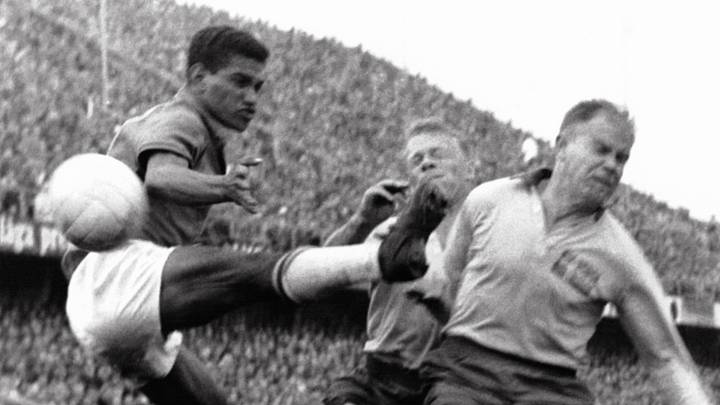
How Garrincha came to play in the final of the 1962 World Cup is the stuff of myth. It may or may not involve one presidential petition, another presidential phone call, a bribe and a witness who fled the country. We only know two things for certain: Garrincha was shown a red in Brazil's semifinal win over Chile and he went on to play in Brazil's 3-1 final win over Czechoslovakia.
All the things that allegedly led to Garrincha's red card being overturned
Garrincha's red card was for kicking a Chilean player. The video evidence shows it happened, though the severity of the kick is widely considered minor. The player even admitted it happened, calling it an "involuntary reaction" triggered by being kicked himself so often during the game. He apologized to the people of Chile for the incident.
It would all come down to FIFA's disciplinary committee. At the time, there was no automatic suspension for a red card. The board would convene to assess whether a red card should result in a suspension after hearing evidence from the match officials.
The precedent of several other red-carded players being suspended for the following game at the tournament suggested he would be in danger of missing the final. In fact, the other player shown a red card in Brazil's win over Chile was suspended for the third-place game.
In the end, they let Garrincha off lightly with a warning. How they came to that ruling is where things get dramatic.
Presidential intervention
Not one, but two presidents may have intervened on Garrincha's behalf to varying degrees of sketchiness.
FIFA.com credits the backing of Chilean president Jorge Alessandri, who led a petition to allow Garrincha to play. That account suggests "Chilean supporters had become besotted with the exhilarating winger" and couldn't bear the thought of him missing the most important match of the tournament.
The Guardian tells of Peruvian president Manuel Prado Ugarteche calling up the Peruvian referee Arturo Yamazaki Maldonado and "requesting that he tone down his testimony" to make Garrincha's foul "sound positively trifling." Mind you, this was in the middle of political unrest in Peru, which would ultimately result in Ugarteche being deposed a month later.
A bribe and a disappeared witness
Brazilian journalist Argeu Affonso, as quoted by SporTV, best described this section of the Garrincha red card saga: "It seemed like an Agatha Christie story.
The referee himself didn't see the infringement. He made the call after being alerted by Uruguayan linesman Esteban Marino. So it was Marino's testimony that would matter the most in front of the disciplinary committee (regardless of whether you believe the tale of the Paraguayan referee being told by his president to downplay the foul)...except Marino didn't show up.
Without Marino's recounting of the foul, the committee didn't have evidence to move forward with a suspension.
"The reality is that Esteban Marino disappeared," the journalist Affonso said. "He was the Agatha Christie of football. He vanished suddenly and nobody heard from him."
Where he'd gone is out of the country. An alternate referee at the tournament claimed in 2012 that it was João Etzel, Brazil's head referee at the time, who convinced Marino to skip the hearing and leave the country with a five-figure bribe.
"João Etzel took $10,000, which was a lot of money at the time. He gave it to Esteban Marino on the orders of the directors of the Brazilian Football Confederation," Olten Ayres said. "I met João Etzel later and he told me, 'I was the one who won the World Cup.'"
It gets worse because Ayres also recounted an interaction he had with Marino, seemingly confirming the bribe with the added detail that the Uruguayan linesman got stiffed.
"Then some years passed and I met the old and dearly missed Esteban Marino, who was an excellent referee. He told me, 'I'm looking for João Etzel.' I asked why, and he replied, 'João received $10,000 to give me and only delivered $5,000.'"
Folarin Balogun and FIFA's mercy

If Garrincha had been red-carded today like Balogun, the suspension would have been automatic, and it could not be appealed. For all the modern bribery accusations against FIFA, this isn't one that would take.
Since FIFA brought in the automatic suspension, no player has managed to be granted a reprieve. The closest thing to leniency we've seen was bestowed on superstars Ronaldinho and Cristiano Ronaldo. The former received a straight red card in 2002. It was bad enough to potentially trigger a three-game suspension, which would have held the Brazilian out of the final. However, FIFA stuck to the one-game suspension, which Ronaldinho served in the semifinal.
The latter didn't commit his red card offense during the World Cup. He elbowed an Irish defender in the head during a World Cup qualifier in 2025, triggering an automatic three-match ban for violent conduct. Those three matches would have included two group stage games at the World Cup. Ronaldo sat out Portugal's final World Cup qualifier and FIFA commuted the ban to allow him to participate, citing his otherwise clean career.
The USA would have loved for Balogun to be shown similar leniency, but that was always a pipe dream. On Friday, FIFA confirmed that the striker would be suspended for one game. The only mercy they conveyed was not applying a multi-match ban. Balogun will be available for the quarterfinals, if the United States make it through Belgium.
UPDATE: Believe it or not, FIFA suspended Balogun's suspension and will allow him to play for USA against Belgium. Just like Brazil in 1962, there seems to have been presidential intervention. If there was a bribe involved, we'll surely find out about it around 2076.
More World Cup news and analysis:
 Add us as a preferred source on Google